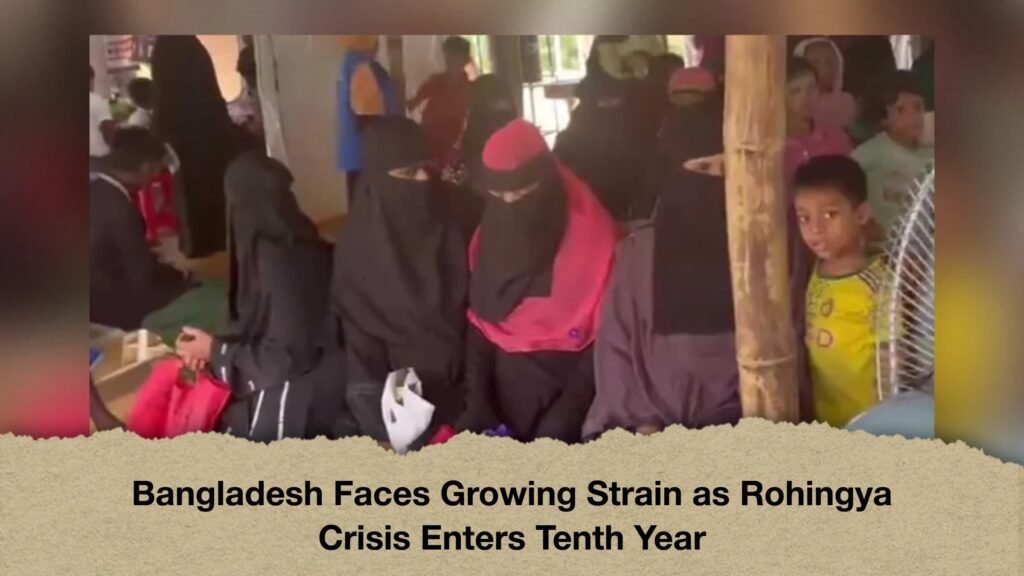
Bangladesh is entering the tenth year of the Rohingya refugee crisis, with little progress towards repatriation and growing concern over declining international assistance. After years of hosting a vast refugee population in Cox’s Bazar, the country is now facing renewed pressure as funding shortages make it increasingly difficult to maintain essential services in the camps.
Nine years have passed since a major influx of Rohingya refugees began on 25 August 2017, when nearly one million people fled Myanmar’s Rakhine State and sought refuge in Bangladesh. Since then, the refugees have remained in camps across Cox’s Bazar, where their future continues to be uncertain.
Despite sustained diplomatic efforts, there has been no significant breakthrough in creating conditions for a safe and sustainable return to Myanmar. Bangladesh has repeatedly called for international engagement to ensure that the Rohingya can eventually return to their homeland in safety and dignity.
Foreign Secretary Asad Alam Siam told the news agency ANI that Bangladesh continues to maintain diplomatic pressure through international and regional forums to facilitate the repatriation process. He said conditions must be created that would allow the Rohingya to return safely to Myanmar. However, a lack of funding has emerged as one of the major challenges facing the humanitarian response.
Siam said financial support for the Rohingya response was declining, prompting Bangladesh to engage with bilateral and international partners in an effort to secure additional assistance. The funding shortage is becoming increasingly significant as the crisis enters another year without a lasting political solution.
Humanitarian organisations working in the camps have also raised concerns about the diminishing international attention. Human Concern International, a Canada-based charitable organisation that has worked in the Cox’s Bazar refugee camps since the 1990s, says the Rohingya crisis is receiving less attention amid numerous other emergencies around the world.
Mahmuda Khan, the organisation’s chief executive officer, said the level of assistance previously received from different countries and donors was no longer available. She warned that the reduction in support was already affecting living conditions in the camps.
According to Khan, greater public awareness of the Rohingya crisis is essential to sustaining international support. If global attention continues to fade, humanitarian funding could decline further, placing additional pressure on refugees who remain dependent on assistance for many of their basic needs.
The consequences of reduced funding extend beyond food supplies. Education and healthcare are also critical to the wellbeing of the refugee population, particularly as many families have spent years living in temporary settlements with limited prospects for a permanent solution.
Experts warn that inadequate access to food, education and medical care could make an already complex humanitarian situation more difficult to manage. Prolonged deprivation could also have wider implications for security and stability in the region, making continued international engagement important even as other global crises compete for attention.
The difficulties are reflected in the experiences of refugees themselves. Hossain Johor, a 30-year-old Rohingya who arrived at the Kutupalong camp in 2017, said the current ration was not sufficient for many families. He called for increased food assistance, along with better access to education and healthcare.
For Bangladesh, the Rohingya crisis has therefore become a long-running humanitarian and diplomatic challenge. The country continues to press for repatriation while carrying the immediate responsibility of supporting a large refugee population. With international funding declining and no clear prospect of an immediate return, the coming years are likely to remain difficult for both the refugees and their host communities in Cox’s Bazar.