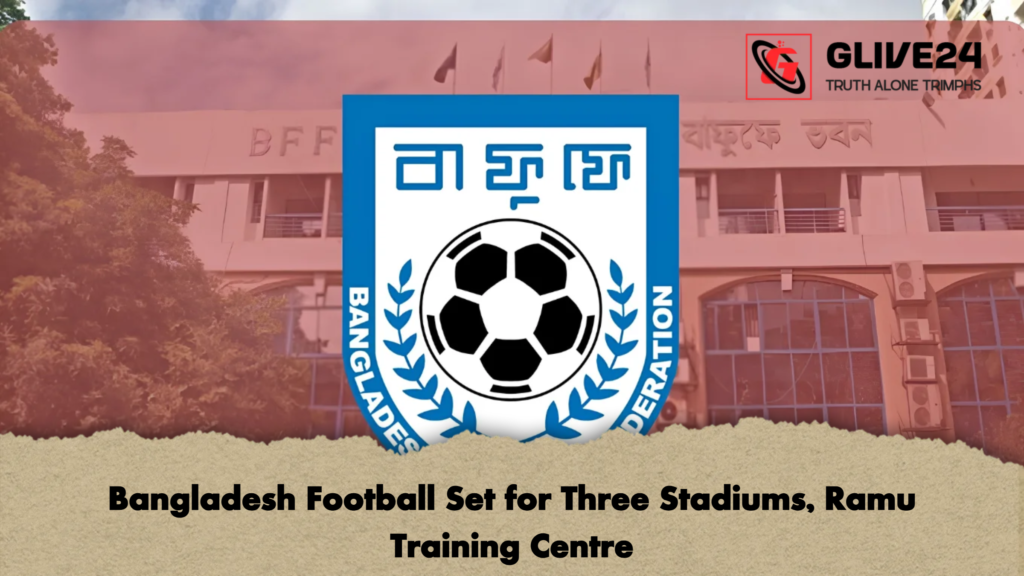
Bangladesh is moving ahead with several initiatives aimed at strengthening its football infrastructure, with the Bangladesh Football Federation (BFF) working to take responsibility for the football-related facilities at three major stadiums. The grounds, galleries and dressing rooms at stadiums in Sylhet, Chattogram and Kamalapur are currently being considered for transfer to the federation.
At the same time, plans are progressing to establish a training centre on 15 acres of land in Ramu, Cox’s Bazar, with funding from FIFA. BFF president Tabith Awal believes improved infrastructure and dedicated venues are essential if Bangladesh is to make sustained progress in international football.
Discussions with the government and the Ministry of Youth and Sports are already under way over the three stadiums. However, the transfer process has taken time because of administrative and documentation-related complications.
Awal has clarified that the BFF will not receive ownership or commercial rights over the stadium shops. Shop ownership and rental income will remain under the National Sports Council. The federation would instead take responsibility for football-related areas, including the playing surface, galleries and dressing rooms.
The proposed training centre in Ramu is another major part of the BFF’s long-term plans. The original proposal envisaged 25 acres of land, but 15 acres are currently being made available. Once the land is formally transferred to the BFF, the federation plans to discuss a revised design with FIFA based on the available space.
Although the reduced land area may require changes to the original plan, Awal has stressed that there will be no compromise on quality. A dedicated training facility could provide Bangladesh’s national and age-group teams with a more consistent environment for camps and preparation.
The national team is also expected to have a busy international schedule. Bangladesh could play four matches during the September-October FIFA window. The BFF has invited several countries to participate in a three- or four-nation tournament in Bangladesh, while Kyrgyzstan has also invited Bangladesh to take part in a triangular series.
Alongside preparations for international fixtures, the federation is also seeking greater professionalism from national-team players during the off-season.
Players who represent Bangladesh at international level sometimes take part in district-level ‘khেপ’ matches during periods without national-team commitments. Such appearances may come at the request of social or political figures, or in exchange for payment.
Tabith Awal has warned national players to exercise greater caution over their participation in these matches. The concern is particularly relevant when the national team has international fixtures approaching, as unregulated matches can place additional physical demands on players and increase the risk of injury.
The federation’s current approach therefore extends beyond stadium management. Improved playing facilities, a dedicated training centre, regular international fixtures and greater discipline among national players are all being considered as parts of a broader effort to build a stronger football system in Bangladesh.
With the proposed transfer of three stadiums and the Ramu project moving forward, the BFF hopes to create more reliable facilities for both the national side and Bangladesh’s age-group teams. The success of these plans, however, will depend on completing the administrative processes and turning the proposed facilities into functional, high-quality football venues.