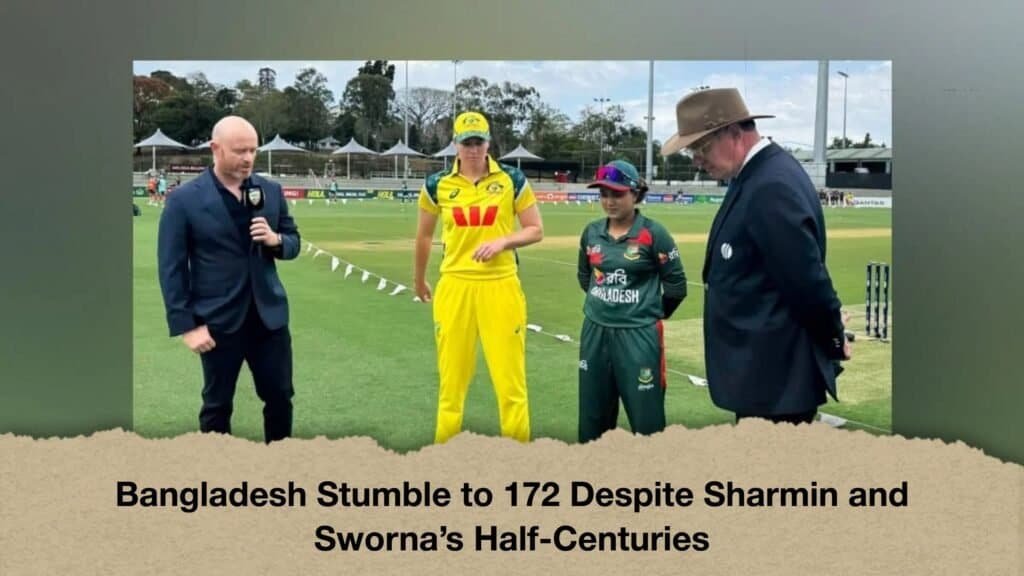
Bangladesh were bowled out for 172 in the third and final one-day international against Australia in Brisbane, leaving themselves with a challenging task as they sought to avoid a series whitewash. Half-centuries from Sharmin Akhter and Sworna Akhter offered some resistance after an early collapse, but the visitors struggled to build the partnerships needed for a competitive total.
The match brought a disappointing change in fortunes for Sobhana Mostary, who had made history at the same venue in the previous ODI. She became the first Bangladesh woman to score an ODI century against Australia, producing an outstanding 118-run innings in the second match. However, Mostary managed only nine runs in the third encounter, becoming the fourth Bangladesh batter to be dismissed.
Bangladesh’s troubles began almost immediately after they were put in to bat. The visitors lost three wickets for just 18 runs, placing the middle order under considerable pressure and leaving the team in need of a substantial partnership to rebuild the innings.
Openers Murshida Khatun and Sharmin Sultana departed for one and six respectively, before captain Nigar Sultana Joty was dismissed for just three. The early losses left Bangladesh struggling to establish any momentum, with Australia quickly gaining control of the contest.
Mostary was expected to provide stability following her record-breaking performance in the previous match. Instead, she fell for nine, leaving Bangladesh at 45 for four. Her early departure was a significant setback, particularly given the importance of her previous innings in demonstrating Bangladesh’s ability to challenge the Australian bowling attack.
Sharmin Akhter and Sworna Akhter then attempted to repair the damage. The pair added 54 runs for the fifth wicket, providing much-needed stability after the top-order collapse. Their partnership helped Bangladesh recover from a precarious position and offered hope of reaching a more competitive total.
Sharmin completed her half-century before being dismissed for exactly 50, bringing the partnership to an end. Her contribution was particularly valuable given the pressure created by the early loss of wickets. However, her departure once again exposed the fragility of the batting line-up.
Sworna continued to fight at the other end, scoring a team-high 54 runs. Despite her efforts, wickets continued to fall at regular intervals, preventing Bangladesh from building another meaningful partnership. Her innings nevertheless helped the visitors reach 172 before the team was bowled out.
Beyond the two half-centurions, Rabeya Khan and Disha Biswas were the only Bangladesh batters to reach double figures. Both scored 13 runs, with Disha remaining unbeaten. The limited support from the rest of the batting order meant that Bangladesh could not capitalise fully on the recovery initiated by Sharmin and Sworna.
Australia’s Megan Schutt was the most effective bowler, claiming four wickets for just 16 runs. Her economical spell played a central role in restricting Bangladesh’s scoring and preventing the visitors from establishing momentum during the middle and later stages of the innings.
The contrast between Mostary’s performances in the second and third matches was particularly striking. Her 118 in the previous ODI had been a landmark achievement for Bangladesh cricket, but her failure to make a substantial contribution in the final match left the team without one of its key sources of runs.
The innings also highlighted Bangladesh’s difficulty in maintaining consistency across the batting order. Losing three wickets inside the opening 18 runs created immediate pressure, while the fall of the fourth wicket at 45 left Sharmin and Sworna with a considerable rebuilding task. Although both responded with half-centuries, the lack of further partnerships ultimately restricted the total.
With 173 runs required for victory, Bangladesh’s bowlers faced a demanding challenge against Australia’s batting line-up. Early wickets and sustained pressure would be essential if the visitors were to defend their total and keep their hopes of avoiding a clean sweep alive.
After a disappointing batting display, Bangladesh needed a strong response with the ball to remain in contention. Sharmin and Sworna had provided the innings with some resistance, but the team’s hopes of salvaging the final match now rested on the bowlers’ ability to make the most of a modest total.
Breaking News :