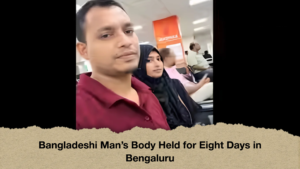
The body of a Bangladeshi citizen who died while receiving treatment at a private hospital in Bengaluru was allegedly kept there for eight days, with his family claiming that the hospital initially refused to release the body over an outstanding medical bill.
The deceased, 32-year-old Mohammad Abdul Hakim Sabuj from Naogaon, had travelled to Bengaluru with his wife, Tanzila Islam Asha, for kidney treatment. He was admitted to Manipal Hospital on Old Airport Road on 6 September, a day after arriving in India.
According to his wife, Sabuj’s condition deteriorated after admission, with his breathing difficulties and chest pain becoming more severe. He was subsequently transferred to the intensive care unit (ICU). Asha said she paid a total of 750,000 Indian rupees at different stages of his treatment in response to demands from the hospital.
She said the medical crisis became more serious on 14 September, when an infection developed in Sabuj’s right leg. Doctors subsequently amputated the leg, according to the family. His condition continued to deteriorate and he died at about noon on 18 September.
After his death, Asha began making arrangements to return his body to Bangladesh. She alleges that the hospital then told her that 35.79 lakh rupees remained outstanding for his treatment. According to her account, hospital officials said the body would not be handed over unless the claimed amount was paid.
Asha also alleged that her passport had been retained by the hospital. She said she had already paid 750,000 rupees during her husband’s treatment but had not received receipts for those payments. She further claimed that she had not been given a clear indication in advance of the likely overall cost of treatment.
With the dispute preventing the immediate repatriation of Sabuj’s body, Asha sought assistance from the Bangladesh High Commission. After subsequent intervention and communication, the hospital handed over the body on 26 September, eight days after his death.
Mohammad Moktadir Hossain, a friend who had accompanied Sabuj, gave a different account of the financial aspect of the handover. He said no additional payment beyond the 750,000 rupees already paid was required to obtain the body. He also said Asha’s passport was eventually recovered with assistance from local people.
A hospital official confirmed that Sabuj’s body had been handed over but did not immediately comment on the allegations concerning the outstanding bill, the passport or the receipts for payments.
The hospital later issued a statement describing Sabuj’s medical condition. According to the statement, he was admitted with severe breathing difficulties and low oxygen levels. After being transferred to the ICU, he suffered cardiac arrest. Doctors revived him twice and subsequently continued treatment with artificial heart-lung support and mechanical ventilation.
The case has therefore raised questions from the family about the financial arrangements surrounding Sabuj’s treatment and the circumstances in which his body was eventually released. At the same time, the hospital’s statement has focused on the seriousness of his condition and the intensive medical measures taken after his admission.
For families travelling abroad for complex medical treatment, unexpected complications can create substantial financial and logistical pressures, particularly when prolonged intensive care is required. In Sabuj’s case, the family’s account and the hospital’s statement provide different perspectives on the dispute, while the body was ultimately released following assistance from Bangladeshi diplomatic authorities.