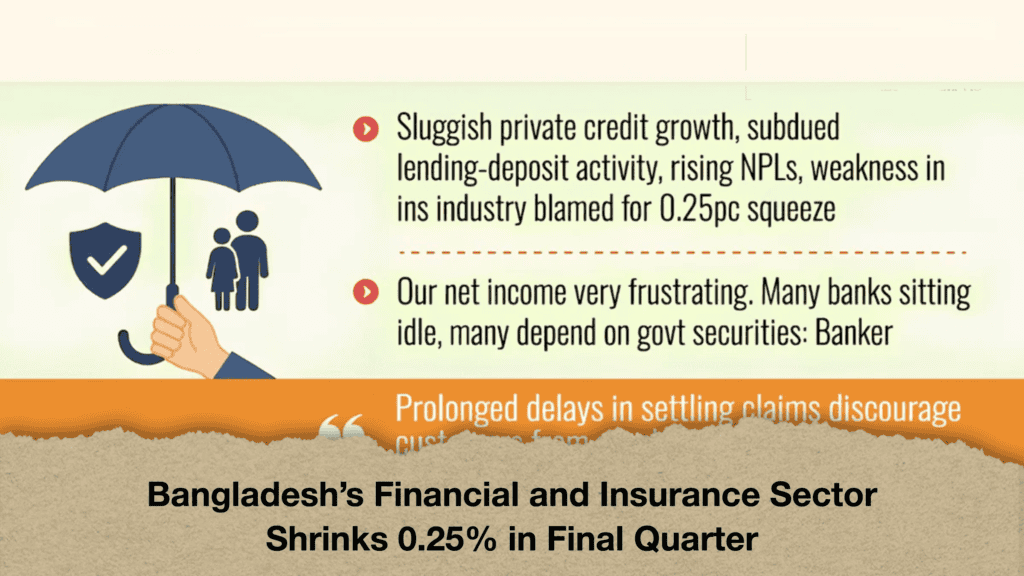
Bangladesh’s financial and insurance sector contracted by 0.25 per cent in real terms during the final quarter of the 2025–26 financial year, reversing the growth recorded in the preceding three quarters and signalling a loss of momentum across the industry.
The contraction, covering April to June 2026, was reported in provisional data released by the Bangladesh Bureau of Statistics (BBS). The figures compare the sector’s performance with the corresponding period a year earlier and suggest that its recovery lost pace towards the end of the financial year.
The sector’s real growth had already been slowing throughout FY2026. It stood at 3.56 per cent in the first quarter, fell to 2.05 per cent in the second and declined further to 1 per cent in the third. In the final quarter, growth turned negative, contrasting with the 2.64 per cent expansion recorded in the same period of FY2025.
The downturn in real terms, however, was not reflected in the sector’s growth at current prices. The BBS data showed an increase of 8.94 per cent on that basis in the fourth quarter of FY2026. Financial and insurance activities accounted for approximately 3.22 per cent of Bangladesh’s gross domestic product (GDP) at current prices during the quarter.
The difference between the two measures is significant. Growth at current prices includes changes in the prices of goods and services, whereas real growth is calculated at constant prices to account for price changes and provide a clearer picture of changes in economic activity. Consequently, an increase in nominal value does not necessarily mean that the sector has expanded in real terms.
The latest figures do not, on their own, establish that all banks and insurance companies experienced falling revenues or profits. GDP statistics measure the value added by an industry as a whole, while the financial performance of individual institutions can vary according to their lending portfolios, investments, operating costs and business strategies.
Economists and bankers have linked the sector’s weakening performance to sluggish private-sector credit growth, subdued lending and deposit activity, a rise in non-performing loans (NPLs) and persistent difficulties within the insurance industry. Lower fee-based income at banks has also been identified as a possible factor behind the slowdown.
Independent economist Dr Zahid Hussain said the sharp increase in non-performing loans had forced banks to allocate a substantial share of their operating profits to provisions against bad debts. Such provisions are intended to cover potential losses when borrowers fail to repay their loans. As the amount set aside increases, less profit remains available to banks, putting pressure on their net earnings.
A rise in bad loans can have consequences beyond a bank’s immediate profitability. When a larger share of lending becomes impaired, financial institutions may become more cautious about extending new credit. This can restrict access to finance for businesses and borrowers, potentially weakening investment and economic activity. The scale of this effect depends on banks’ capital positions, their capacity to manage problem loans and the wider demand for credit.
Dr Hussain also pointed to the effects of high inflation on deposit mobilisation. When inflation erodes the purchasing power of savings, some depositors may reconsider how they hold or use their money. Banks seeking to attract and retain deposits may then have to offer higher returns, increasing their funding costs. If lending income does not rise sufficiently to offset those costs, pressure on profitability can intensify.
The insurance industry is facing a separate set of challenges. Dr Hussain said prolonged delays in settling insurance claims had discouraged customers from purchasing new policies. Timely claim settlement is central to maintaining confidence in insurers, as policyholders expect compensation in accordance with the terms of their contracts when covered events occur. Delays can undermine trust and make it harder for companies to attract new customers or retain existing ones.
Weakness in insurance activity can affect the sector’s overall performance alongside problems in banking. Although banks and insurers operate through different business models, both depend on customer confidence, effective management and a stable financial environment. Difficulties in either area can weigh on the combined performance of financial and insurance activities.
The decline in real growth over successive quarters points to mounting pressure on a sector that plays an important role in channelling savings into investment, financing businesses and providing protection against financial risks. Private-sector lending, in particular, can influence business expansion, employment and consumption, while insurance services help households and enterprises manage exposure to unexpected losses.
The contraction in the final quarter therefore raises questions about the underlying strength of financial intermediation and insurance activity in Bangladesh. The provisional figures provide an indication of the sector’s overall performance, but further data would be needed to determine how much each factor contributed to the decline.
Improving loan recovery, managing non-performing assets, controlling funding costs and restoring confidence in insurance claim settlement are among the issues that will matter for the sector’s future performance. Whether these pressures ease will help determine if the industry can return to positive real growth in the coming financial year.