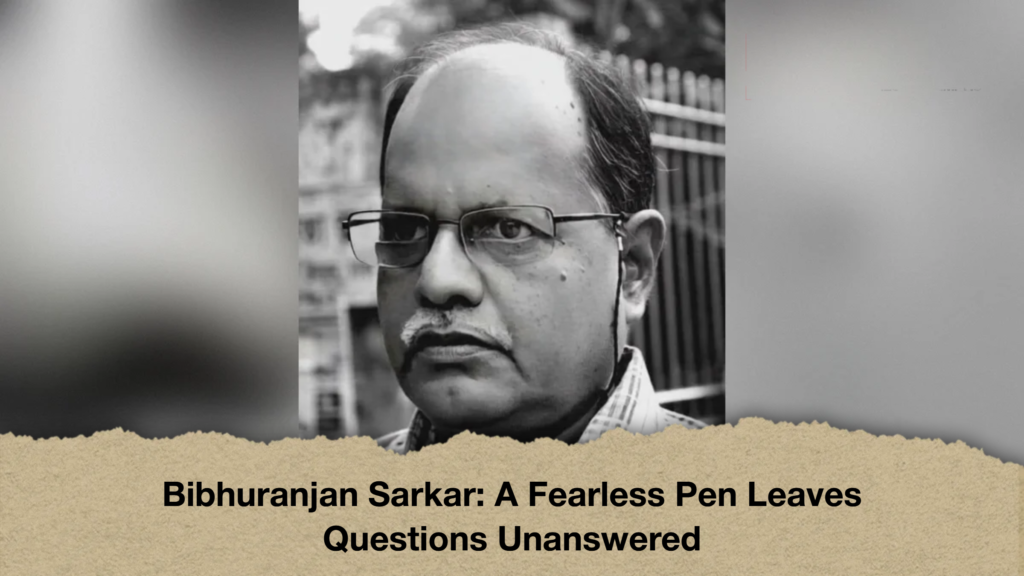
Some people leave this world, but their voices do not fall silent. Their writings, ideas, questions and commitment to truth continue to return across the years. Journalist and columnist Bibhuranjan Sarkar was one such fearless practitioner of the pen. His life was devoted to journalism, to understanding politics and society, and to pursuing the truth even when the answers were difficult to find.
Bibhuranjan Sarkar was born on 6 June 1954 in Boda upazila of Panchagarh, in northern Bangladesh. From an early age, he displayed a deep curiosity about society and the changing times around him. While still a schoolboy in the late 1960s, he began his journalistic career as a local correspondent for Dainik Azad. The pen he picked up in his youth would eventually become his most powerful instrument.
His student years also brought him into politics. He served as vice-president of the Dinajpur district committee of Bangladesh Chhatra Union and later as assistant general secretary of its central organisation. For him, politics was not merely a contest for power. It was also a way of understanding society, the state, people and the forces shaping the country.
After completing his education at Boda Pilot High School and Dinajpur Government College, Sarkar enrolled in the Department of Bengali at the University of Dhaka in 1973. During his university years, he chose journalism as his profession. Over the course of his career, he worked with a number of newspapers and periodicals, including Saptahik Joydhwani, Ekota, Jaijaidin, Dainik Sangbad and Dainik Rupali. He also served as an editor of Saptahik Chaltipatra, Dainik MatribhumI and Saptahik Mridubhashan.
His contribution as an editor was remembered with particular affection by colleagues and fellow journalists. At Dainik MatribhumI, he provided guidance to reporters while maintaining a sharp eye for both news value and the quality of writing. Those who worked with him recall an editor who did not regard a report simply as a collection of facts. He sought to understand the people behind the events, the social realities surrounding them and the wider political context in which they unfolded.
In the mid-1980s, when Saptahik Jaijaidin began publication, Sarkar attracted considerable attention for his political articles written under the pseudonym ‘Tarikh Ibrahim’. His writing combined information, reasoning and political analysis. Rather than merely describing what had happened, he attempted to examine why it had happened and what it might mean for the country.
For more than three decades, he wrote extensively on Bangladesh’s political landscape. His columns appeared across daily, weekly and online publications, establishing him as a distinctive voice in political journalism. In the final phase of his professional life, he continued writing for the online newspaper bdnews24.com. His work also appeared in Dainik Bangladesh Pratidin, Dainik Ittefaq, Dainik Jugantor, Dainik Sangbad and Dainik Bartaman.
Sarkar’s intellectual interests extended beyond daily political commentary. He authored more than ten books, reflecting his sustained engagement with history, politics and contemporary Bangladesh. At the 2023 Ekushey Book Fair, Agami Prakashani published two of his notable works, Bangabandhu: Historir Nirmata and Sheikh Hasina: Swapna Puraner Safal Karigor. These publications demonstrated the breadth of his interests and his determination to document political figures and developments through his own analytical lens.
The Liberation War of 1971 also formed an important part of the historical period through which Sarkar worked as a journalist. Gathering and communicating information during times of national upheaval is among the central responsibilities of journalism, and his career remained closely connected with the effort to record the political and social realities of Bangladesh.
Yet the final chapter of his life remains shrouded in profound uncertainty.
At around 10am on 21 August, Sarkar left his home in Siddheshwari, Dhaka, for his office. He never returned. The following day, 22 August, police recovered his body from the Meghna River in Gazaria, Munshiganj, where it was found floating in the water.
The circumstances surrounding the death of such an experienced journalist naturally raised deeply troubling questions. What happened after he left home that morning? How and where did he die? And how did his final journey end in the vast waters of the Meghna?
Years may pass, and memories may become less immediate, but such questions do not necessarily disappear. In Sarkar’s case, the unanswered questions surrounding his death have remained part of the memory of a journalist whose professional life was defined by his determination to ask difficult questions about the world around him.
His absence is therefore felt not only by his family and friends but also by colleagues and readers who encountered his work over the decades. His articles, political analyses and books remain a record of a life spent observing and interpreting a rapidly changing country.
For a journalist, perhaps the most enduring legacy is the truth contained in the words left behind. Sarkar’s writings continue to preserve his intellectual curiosity, his political observations and his commitment to examining the deeper meaning of events.
Some deaths bring an individual’s life to an end, but they cannot silence the questions that person leaves behind. Bibhuranjan Sarkar’s departure carries that particular poignancy: the loss of a determined journalist, the memory of a fearless columnist and a series of questions that remain unanswered.
On the anniversary of his passing, he is remembered with profound respect—not simply for the years he spent in journalism, but for the integrity with which he approached his craft.
Bibhuranjan Sarkar is no longer here, but his words remain. They survive in his writings, in the memories of those who worked alongside him, and in the questions he raised about politics, society and the times in which he lived.
His life ended, but his pen left a legacy that continues to speak.