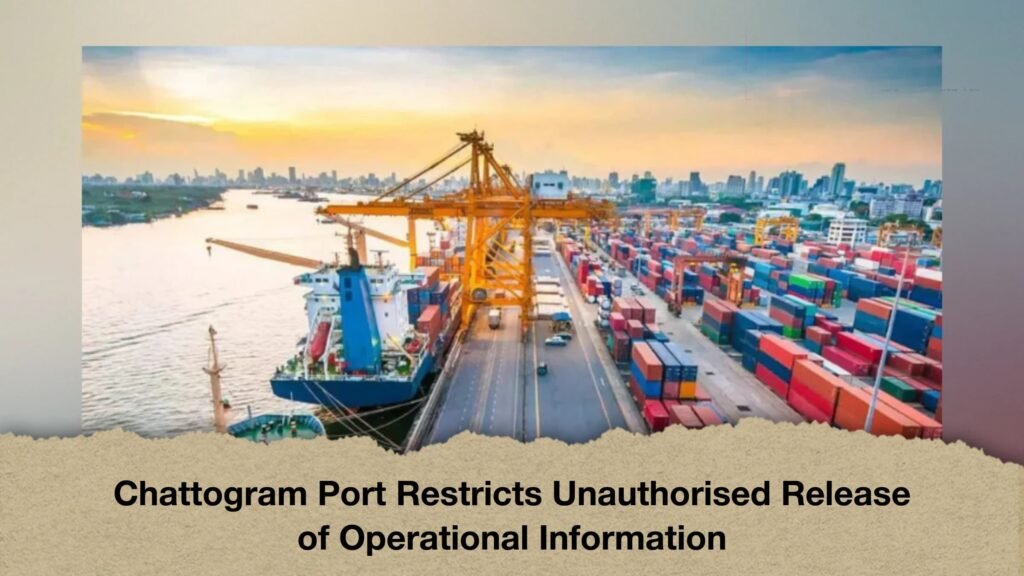
The Chattogram Port Authority has warned media organisations and port users against publishing or broadcasting photographs, videos, designs and operational information relating to the port without prior permission, citing security concerns.
The directive was issued in a notice published on Tuesday (6 October). It covers material relating to the port’s security arrangements, communication systems, ships, cargo loading and unloading operations, restricted areas and infrastructure. The authority has specifically referred to the publication or dissemination of such material through news organisations, social media and online platforms.
The notice states that legal action may be taken against those who violate the instruction under the Chattogram Port Authority Act, 2022, and the Official Secrets Act, 1923.
The notice was signed by Syed Refayet Hamim, acting secretary of the Chattogram Port Authority, and sent to editors and bureau chiefs of various media organisations.
The authority’s decision has, however, prompted questions over both its legal basis and the timing of the directive. The restrictions come at a time when the Chattogram port is at the centre of a growing debate over a proposal to lease the New Mooring Container Terminal to foreign operator DP World for 15 years.
The proposed arrangement has generated discussion and tension around the port, with opponents raising objections to the planned management of the terminal. Against that backdrop, the decision to impose restrictions on the publication of port-related images and operational information has attracted additional attention.
Protesters have demanded the resignation of Chattogram Port Authority Chairman Rear Admiral S M Moniruzzaman. They have also accused him of acting as an ‘agent of DP World’. The allegation is made by the protesters and has not, on the basis of the information available in the report, been established as fact.
The protesters have threatened to surround the chairman’s office on 13 October and prevent him from leaving the premises. Their planned action comes amid the wider disagreement over the proposed arrangement involving the New Mooring Container Terminal.
The latest directive has therefore raised a question that goes beyond the immediate issue of photographs and videos. While restrictions on sensitive security information can be justified on safety grounds, concerns have emerged over whether a broad requirement for prior permission could affect routine news gathering and reporting on matters of public interest.
Chattogram Port is a vital part of Bangladesh’s international trade infrastructure. Information concerning its operations, terminals, infrastructure and management can be relevant not only to port users but also to businesses, workers, policymakers and the wider public.
At the same time, details that reveal security arrangements or the layout and operation of restricted facilities can carry legitimate security implications. The challenge, therefore, lies in clearly distinguishing genuinely sensitive material from information that is relevant to legitimate public scrutiny.
With the port already facing heightened attention over the proposed 15-year arrangement for the New Mooring Container Terminal, the scope of the new restrictions is likely to remain under scrutiny. The key issue will be how the requirement for prior permission is applied in practice and whether it remains confined to security-sensitive material or extends to broader reporting on port affairs.