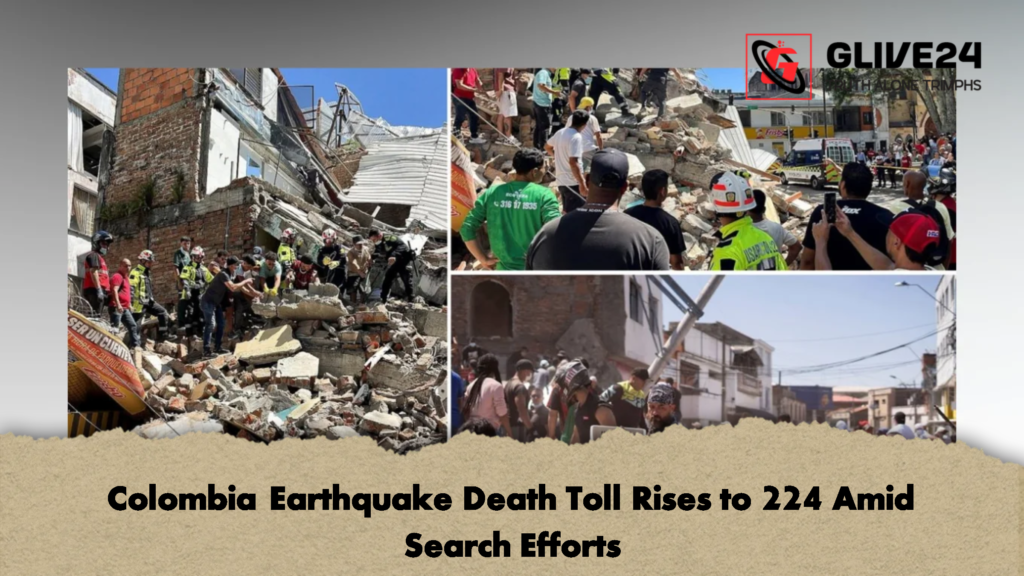
The death toll from a devastating earthquake in Colombia has risen to 224, with emergency responders warning that casualties will almost certainly increase as search teams clear the rubble of thousands of collapsed buildings.
The magnitude 7.4 earthquake struck the South American nation on Monday, causing widespread destruction across western provinces. Described by seismologists as a “once-in-a-decade” event, the tremor was felt in the capital, Bogotá, as well as in major urban hubs across Colombia, neighbouring Ecuador, and Panama.
Initial reports from the Association of Capital Cities on Tuesday morning, 11 August, confirmed 165 fatalities. Shortly afterwards, rescue crews recovered ten more bodies from the debris in the western city of Cali, pushing the official count higher before international news reports confirmed that total casualties had surpassed two hundred.
Epicentre, Aftershocks, and the Scale of Destruction
Data provided by the United States Geological Survey (USGS) placed the epicentre of the quake near San José del Palmar in the Chocó region, approximately 400 kilometres west of Bogotá. The seismic event originated at a depth of 107 kilometres beneath the Earth’s surface. Within hours of the main shock, seismologists recorded at least 21 significant aftershocks, causing further alarm and complicating early search operations.
The mountainous province of Chocó sustained extensive structural damage. Urban centres across western Colombia—including Cali, Pereira, Quibdó, and Manizales—reported infrastructure failures, damaged residential blocks, and severed power lines.
Crisis Management and International Relief Efforts
Rescue efforts remain focused on locating survivors, with news reports indicating that approximately 2,700 people remain unaccounted for. Disaster management personnel fear that many of the missing may be trapped under the ruins of homes, commercial complexes, and public facilities.
The disaster presents an immediate challenge for President Abelardo de la Espriella, who assumed office on Friday. In response to the growing humanitarian crisis, President de la Espriella declared a state of national disaster, mobilising military units, civil defence forces, and medical teams to assist in search and rescue missions.
Governments internationally have pledged emergency humanitarian aid, specialized urban search-and-rescue teams, and medical supplies to support Colombia’s emergency response. Relief workers continue clearing heavy debris in affected cities as search efforts proceed.