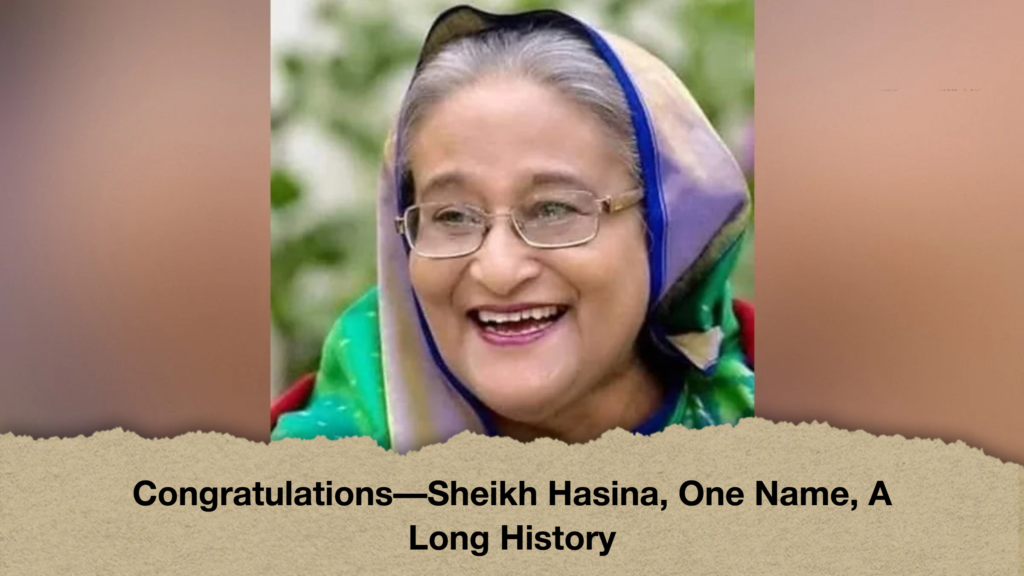
Sheikh Hasina remains one of the most polarizing, resilient, and influential figures in the political history of Bangladesh. From her birth into the nation’s founder’s family to her tenure as the country’s longest-serving prime minister, her trajectory mirrors the complex and turbulent story of the nation itself.
Born on 28 September 1947 in Tungipara, she was the eldest child of Bangabandhu Sheikh Mujibur Rahman and Begum Fazilatunnesa Mujib. Growing up amidst the crucible of Bangladesh’s independence movement, her early life was inextricably linked with political activism and personal sacrifice. The tragic assassination of her family on 15 August 1975 forced her into prolonged exile abroad until her historic return to Bangladesh on 17 May 1981. Upon taking the helm of the Bangladesh Awami League, she embarked on a four-decade-long journey that fundamentally shaped the nation’s governance, party structure, and state institutions.
Her decades at the helm yielded landmark governance actions alongside intense political contestation. Her administration established the International Crimes Tribunal to prosecute perpetrators of crimes against humanity committed during the 1971 Liberation War—a move widely seen as an imperative step toward historical justice. Furthermore, her government saw through the judicial proceedings regarding the assassination of Bangabandhu Sheikh Mujibur Rahman, bringing a long-standing national tragedy to legal closure.
Under her stewardship, Bangladesh registered significant expansion in socio-economic indicators and major infrastructure development. Modernization initiatives transformed domestic connectivity, elevating the nation’s economic profile on the global stage. However, these accomplishments coexisted with mounting international and domestic concern over democratic backsliding, press freedoms, human rights abuses, and the institutional independence of governance organs.
Supporters viewed her as an uncompromising leader whose iron will brought political stability and economic modernization. Critics, conversely, pointed to her stubbornness and political inflexibility, arguing that an increasingly authoritarian stance eroded democratic institutions and marginalized opposition voices.
Her dramatic resignation on 5 August 2024 amidst widespread civil unrest brought an end to her political chapter in power as she departed the country. Yet, the legacy of her administration and the future of the Awami League—one of the country’s oldest political platforms—remain subjects of intense debate. Whether through internal reform, self-criticism, or eventual political re-evaluation, history will ultimately render its neutral judgment on the achievements, failures, and controversies of her era.