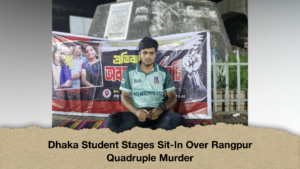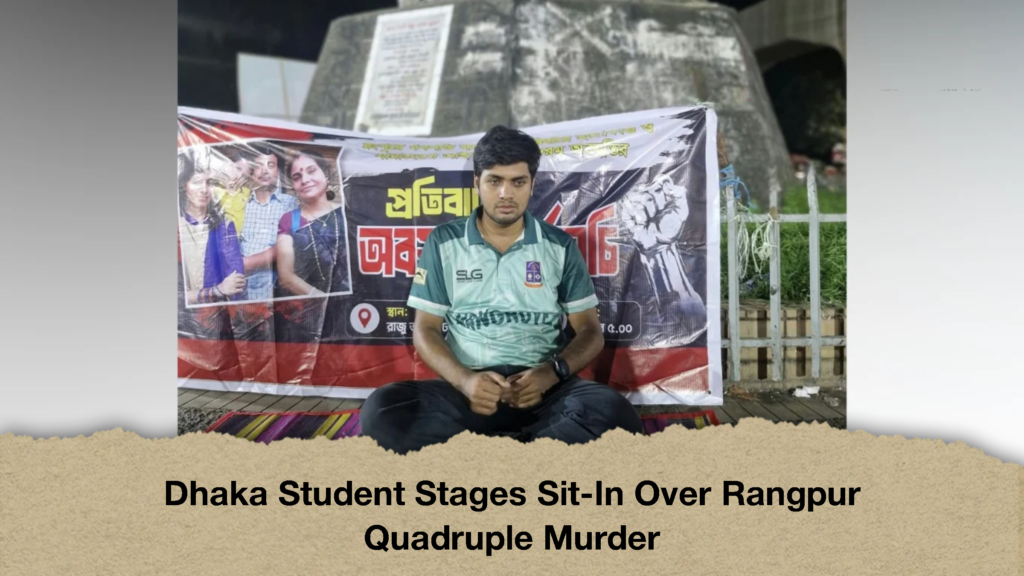
A student at Dhaka University has staged a solitary sit-in protest at the iconic Teacher-Student Centre (TSC) on campus, demanding rapid justice for the brutal murder of a retired schoolmaster and three members of his family in Rangpur. Joy Biswas, a resident student of Jagannath Hall, launched his demonstration on Wednesday evening, 26 August, using the platform to highlight the tragic slayings alongside what he characterised as a wider collapse of public safety across the country.
The demonstration comes in the wake of a horrific discovery made on the night of 22 August within the Daspara-Machhuapara quarter of Rangpur city. Local police discovered the bodies of retired teacher Ganapati Chakraborty, 65, his 52-year-old wife Preetilata Chakraborty, their daughter Agami Chakraborty, 25, and their 12-year-old son Ayush Chakraborty inside their family home. Post-mortem findings and initial forensic reports confirmed that all four victims had been killed by strangulation.
Detectives have made initial strides in the criminal investigation, arresting two primary suspects, identified as Mugdha Das and Siddhartha Das. Both men have since recorded formal statements before a judicial magistrate. Investigators confirmed that a third associate, Seemanta Das, has likewise given a confession under judicial supervision. The homicide investigation remains under the direct purview of the Detective Branch (DB) of the Rangpur Metropolitan Police.
Despite these legal steps, surviving relatives of the Chakraborty family have expressed sharp scepticism regarding the scope and depth of the police probe. Family members argue that it is virtually impossible for just two intruders to carry out the systematic killing of four people inside a residential property without broader logistical support. They have publicly demanded a rigorous re-examination of critical unresolved details, including the abrupt disconnection of the property’s main power supply moments before the crime occurred and the preservation of physical evidence recovered from the scene.
Echoing these public anxieties, Joy Biswas turned to social media during his four-hour sit-in to rally students, civic bodies, and political factions behind his cause. His demonstration centers upon a firm three-point charter of demands directed at state authorities.
His primary demand insists that the Home Minister issue a formal public apology for the prevailing lawlessness while executing immediate measures to reinforce national security. Secondly, he demands an expedited trial ensuring maximum legal penalties for all individuals implicated in the Rangpur killings. Finally, his charter calls on the government to unveil a clear, transparent security framework outlining steps to protect minority communities and vulnerable citizens nationwide.
Speaking directly from the TSC premises, Biswas stressed that his protest remains strictly non-partisan, appealing to the university cohort and the broader public to unite against institutional impunity and rising violent crime.