Severe shortages of natural gas and electricity have severely crippled manufacturing operations across the industrial hubs of Savar, Ashulia, and Dhamrai. Factory executives and shopfloor managers report that plummeting gas pressure and relentless grid power cuts have slashed average production by 15 to 20 per cent. To keep assembly lines moving, companies have resorted to expensive alternative energy sources, causing operational costs to skyrocket.
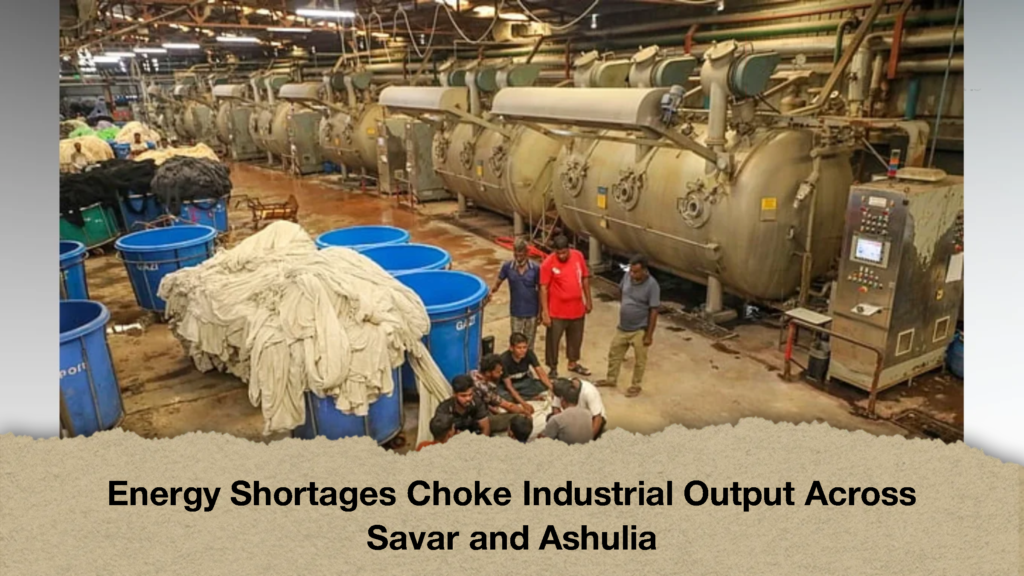
A field investigation covering ten industrial establishments—spanning ready-made garments, fabric washing, yarn spinning, and ceramic manufacturing—revealed widespread operational strain. At A R Wet Processing in Ashulia’s Jirabo area, gas pressure routinely hovers between 1 and 2 pounds per square inch (PSI), far short of the 10 PSI required for heavy machinery. With 80 to 90 processing units on site, management can only operate a fraction simultaneously, causing daily output to plunge from 50,000 pieces to under 30,000.
Back-up power solutions offer little financial respite. At Fun Factory in the Unique Bus Stand area, diesel expenditure has tripled from 5,000 Taka to 15,000 Taka per shift to counter five to six hours of daily load-shedding. Similarly, Little Star Spinning Mill in Jamgora struggles to hit 40 per cent of its installed capacity despite deploying solar panels and battery storage systems, adding 14 to 15 Taka in overheads for every pound of yarn produced.
| Factory / Enterprise | Location | Core Product | Standard Daily Output | Current Daily Output | Output Decline (%) |
| A R Wet Processing | Jirabo, Ashulia | Dyeing & Washing | 50,000 pieces | 27,500 pieces | 45.0% |
| Ring Shine Textiles Ltd. | DEPZ, Savar | Yarn Production | 32,500 tonnes | 8,500 tonnes | 73.8% |
| Protik Ceramics | Dhamrai | Ceramic Ware | 80,000 pieces | 20,000 pieces | 75.0% |
| Monno Ceramics | Dhamrai | Fine China / Ceramics | 20,000 pieces | 10,000 pieces | 50.0% |
| Preeti Composites | Jamgora, Ashulia | Garment Washing | 60 tonnes | 40 tonnes | 33.3% |
| Global Outerwear | Savar | Readymade Garments | 30 tonnes | 11 tonnes | 63.3% |
| Asheya Clothing | Jamgora, Ashulia | Apparel Manufacturing | 80,000 pieces | 50,000 pieces | 37.5% |
| Maxcom Industries BD | Hemayetpur, Savar | Garment Production | 20,000 pieces | 5,000 pieces | 75.0% |
| Fashion Forum | Ashulia | Apparel Manufacturing | 20,000 pieces | 9,000 pieces | 55.0% |
| Little Star Spinning Mill | Jamgora, Ashulia | Yarn Processing | 100% Installed Capacity | 40% Installed Capacity | 60.0% |
Data compiled by Industrial Police-1, which oversees 1,863 manufacturing units across the belt, confirms that while facilities remain open, operational efficiency has cratered. Industrial Police Superintendent Mohammad Mominul Islam Bhuiyan noted that near-constant reliance on diesel generators has driven the regional drop in factory productivity.
The regional squeeze stems from a wider structural deficit in Bangladesh’s natural gas network. Against a national demand of nearly 3,800 million cubic feet per day (mmcfd), typical supply hovers around 2,700 mmcfd. Recent Petrobangla figures recorded national grid delivery at 2,379.9 mmcfd, leaving an 883.2 mmcfd shortfall for power generation alone. Technical snags at one of the country’s two floating liquefied natural gas (LNG) regasification terminals in Maheshkhali further restricted gas feeds throughout July and August.
Power distribution authorities acknowledge that gas starvation directly feeds grid instability. Akhtaruzzaman Laskar, General Manager of Dhaka Palli Bidyut Samity-1, stated that the Savar-Ashulia zone faces a 100-megawatt daily deficit against a total demand of 480 megawatts, leading to a 25 per cent deficit in supply. Residential gas shortages have exacerbated the crisis, forcing local households to turn to electric induction stoves and water heaters, driving grid demand higher during peak hours.
Apparel exporters are sounding the alarm over tight international delivery schedules. Leaders from the Bangladesh Garment Manufacturers and Exporters Association (BGMEA) and the Bangladesh Knitwear Manufacturers and Exporters Association (BKMEA) warned that persistent production delays threaten supply chain integrity. With global delivery dates fast approaching, factory owners fear that missed shipments could damage Bangladesh’s standing as a reliable manufacturing partner and jeopardise prospective order volumes.