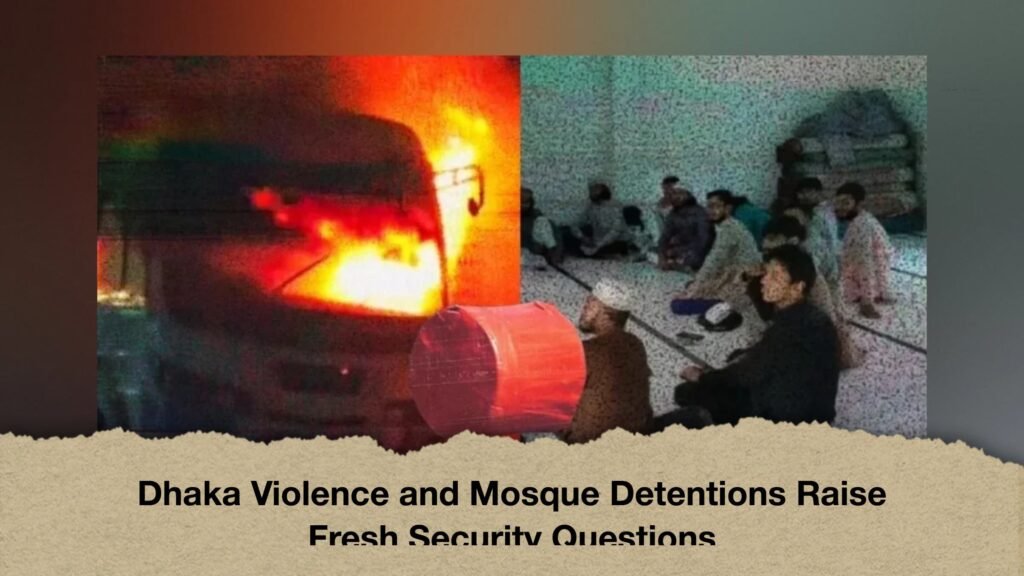
A series of cocktail explosions, arson attacks on vehicles and the recovery of suspected explosive devices in and around Dhaka have raised fresh concerns over security and possible extremist activity. The concern intensified after police detained 23 people from a mosque in the capital’s Farmgate area, with law enforcement authorities alleging that some of them had been discussing plans to establish a new organisation called ‘Ittihadul Ummah’.
According to the authorities, the proposed organisation was allegedly intended to organise people with the aim of establishing a caliphate. The allegation is now being examined through further questioning and forensic analysis of electronic devices.
Law enforcement agencies, however, have cautioned against treating the recent incidents as proof of a wider resurgence of extremism. They say there is not yet sufficient evidence to make such a conclusion, although surveillance of potential extremist activity is continuing.
Human rights activists have also called for a measured, evidence-based assessment. They argue that arrests or the recovery of explosives, considered separately, do not provide enough grounds to draw broad conclusions about the country’s overall security situation. At the same time, they say the sequence of incidents, the allegation of a new organisation being formed and the discovery of bomb-making materials deserve serious investigation.
23 detained after Friday prayers
Police detained 23 people from a mosque in Farmgate after Friday prayers on 18 September. Law enforcement officials alleged that some of those present had been discussing possible extremist activities inside the place of worship.
The detainees were subsequently questioned and their mobile phones examined. Speaking to journalists at a briefing on the country’s law and order situation at the Secretariat on Sunday, 20 September, Home Minister Salahuddin Ahmed said forensic examination of the phones and questioning had failed to produce significant evidence against 11 of the detainees.
Those 11 were later handed over to their guardians and local community representatives, according to the minister and police officials. The remaining 12 were taken into the custody of the Counter Terrorism and Transnational Crime (CTTC) unit for further questioning.
The home minister said investigators had found information during forensic analysis and questioning that allegedly pointed to plans to form an organisation named ‘Ittihadul Ummah’. The authorities allege that those involved were attempting to organise around extremist activities with the objective of establishing a caliphate.
Legal proceedings have begun, the minister said, while further questioning and investigation are being carried out to establish the details of the case.
Explosions and arson reported across Dhaka
The arrests came as Dhaka was witnessing several incidents involving cocktail explosions and arson. On Friday, explosions and fires targeting passenger buses were reported in different parts of the capital.
On Saturday, 19 September, three buses were set on fire in Mirpur and central Badda. A pickup vehicle was also set alight in South Keraniganj. Cocktail explosions were reported from several other areas of Dhaka.
Reports of further explosions emerged from several parts of the capital on Sunday as well.
There is no confirmed evidence in the information currently available that all of these incidents were coordinated or linked to one another. Nevertheless, the frequency and geographical spread of the incidents over a short period have heightened public concern.
The attacks on public and private vehicles have also raised questions about the safety of commuters, while investigators are examining whether any organisational connection exists between the different incidents.
Rights activists urge caution
Human rights activist Nur Khan Liton told Bangla Tribune that extremism was not a new concern in Bangladesh and that its presence had been a subject of concern for years.
He questioned how effectively the activities of such groups had been monitored over the past two years and said there appeared to be some indications of attempts to organise again.
At the same time, he cautioned against reaching conclusions about the people detained in Farmgate before the investigation is completed. According to him, it remains unclear why the individuals had gathered at the mosque or whether they had links to any particular group.
He said the law enforcement and intelligence agencies were investigating the matter and that broad or assumption-based comments should be avoided until the findings are established.
Another human rights activist, Abu Ahmed Faizul Kabir, said allegations of extremism required a careful assessment based on evidence. While the arrests warranted serious investigation, he said it would not be appropriate to conclude solely from the arrests that extremism was gaining significant ground in the country.
He said investigators would need to establish the detainees’ actual involvement, organisational contacts, sources of funding, online activities and possible wider networks before the situation could be properly assessed.
He also stressed the importance of longer-term measures alongside law enforcement, including strengthening critical thinking, tolerance, humanitarian values and an inclusive civic culture among young people.
Bombs and bomb-making materials recovered
The Farmgate arrests are not the only recent development to draw the attention of law enforcement agencies. Several incidents involving the discovery of suspected bombs and bomb-making materials have also been reported.
Police recently recovered what was described as an ‘umbrella bomb’ beneath the Motijheel metro station and a ‘pressure-cooker bomb’ from an abandoned bag in Ashulia.
Earlier, a bomb exploded at a gathering in Savar. Police later recovered several pipe bombs, chemicals and other materials allegedly linked to bomb-making from a rented house in the area.
Within hours, officers also recovered a powerful pressure-cooker bomb from the grounds of a mosque. A separate bomb explosion was reported at the Barishal court premises.
Law enforcement officials have claimed that investigators found indications of links between some of the bomb recoveries and explosions. In the Savar case, authorities also said they had found signs of involvement by Jama’atul Mujahideen Bangladesh (JMB).
Investigators said not everyone who allegedly rented houses using false identities had been detained. Police have arrested one person, while the CTTC unit is searching for another.
CTTC says surveillance remains active
Attempts were made to contact Mohammad Shamsul Haque, additional police commissioner and head of the Dhaka Metropolitan Police’s CTTC unit, for an assessment of the broader extremist threat. He did not answer the phone.
At a recent press conference, however, he said there were no signs of extremism gaining significant momentum in the country. He said the CTTC was continuing to monitor potential extremist activities through intelligence information, online and social media activity and its own databases.
The recent incidents have placed renewed attention on the country’s security environment. Investigators now face several questions, including whether the reported explosions and arson attacks are connected, how far the alleged plans surrounding ‘Ittihadul Ummah’ had progressed, and whether the various bomb-related incidents share any organisational links.
For now, law enforcement agencies are continuing their investigations and surveillance. The findings of those investigations will be crucial in determining whether the recent incidents represent isolated events or point to a wider pattern of organised extremist activity.