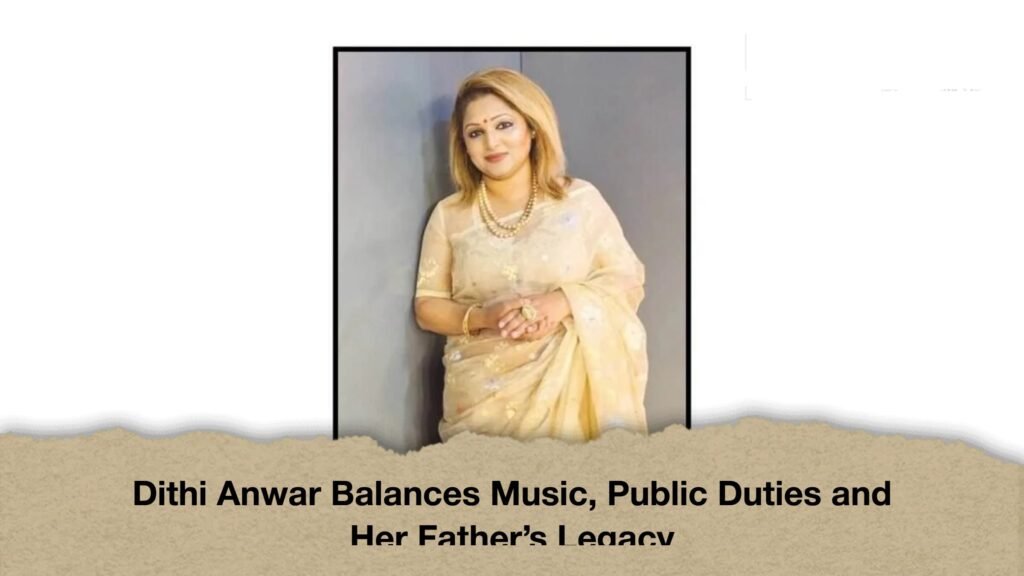
Singer, television presenter and social worker Dithi Anwar has returned to Bangladesh after spending more than a month and a half in the United States. Since her return a few days ago, she has resumed a busy schedule, balancing her responsibilities as a member of the Bangladesh Film Certification Board with new musical releases and plans to preserve songs for future generations.
On her journey home, Dithi attended an event organised by the Bangladesh Association in Dubai as a special guest. She performed at the programme and received a special honour. The engagement provided an opportunity for her to connect with expatriate Bangladeshis through music before returning to her professional commitments at home.
Much of Dithi’s current work centres on her YouTube channel, ‘Dithi Anwar’, where she regularly releases original recordings and cover versions. Among the songs already published in her voice are ‘Ekta Tajmahal Banaiya’, ‘De Re De Re Prem De Re’, ‘Akashke Proshno Koro’, ‘Ghorir Kata’ and ‘Emni Korei Ekdin’.
The releases have a personal significance for the singer. The lyrics of all five songs were written by her late father, celebrated lyricist Gazi Mazharul Anwar, whose work forms an important part of Bangladesh’s musical heritage. By recording his lyrics and making them available through her own channel, Dithi is keeping his creative legacy connected with contemporary audiences.
Singer Apu Aman has joined her as a fellow performer on the duets. The recordings also reflect Dithi’s interest in revisiting established songs while continuing to develop her own musical projects.
One of her latest releases is a new rendition of ‘Emni Korei Ekdin’, originally sung by Abida Sultana for the film ‘Nishana’. Dithi has brought the song back to listeners in her own voice, with her husband, Arif Chowdhury, appearing alongside her as a model in the accompanying video. The project offers audiences another opportunity to hear a familiar film song through a fresh interpretation.
Dithi has also recorded a devotional song from the film ‘Chandidas O Rajakini’, released as part of a Mahalaya initiative organised by Bishwarang. Gazi Mazharul Anwar wrote the lyrics, while the music was composed by the late Alauddin Ali. Tanvir Alam Sajib has arranged the music for the new version.
The release brings together the work of several established figures in Bangla music. It also forms part of a wider tradition of presenting familiar songs in new arrangements, allowing older compositions to reach listeners who may not have encountered their original versions.
Alongside her musical activities, Dithi continues to serve as a member of the Bangladesh Film Certification Board. Her responsibilities therefore extend beyond performing and recording, requiring her to manage institutional duties alongside the work involved in preparing and releasing new music.
Speaking about her schedule, Dithi said she finds happiness in working. She explained that her two sons’ education requires her to spend a particular period of each year outside Bangladesh. When she is in the country, she makes time for her board responsibilities as well as her musical projects.
Her ambitions extend beyond the regular publication of songs. Dithi hopes to develop her YouTube channel into a dedicated music archive, preserving recordings that could serve as useful references in the years ahead. She wants the material to remain accessible not only to listeners but also to people seeking information about the songs.
Digital platforms can provide a convenient way to preserve and share music, particularly when older recordings are difficult for new audiences to discover. A carefully maintained collection can help keep songs in circulation and make them easier to locate. Dithi’s proposed archive reflects this approach, with an emphasis on retaining musical works for future use rather than treating each release as a short-lived publication.
Her father’s extensive songwriting legacy is central to that ambition. By recording songs written by Gazi Mazharul Anwar, Dithi is bringing his lyrics to listeners in a new format while maintaining a personal connection with his work. Her recent releases, including the renewed presentation of ‘Emni Korei Ekdin’ and the devotional song from ‘Chandidas O Rajakini’, illustrate how established compositions can be introduced to audiences through contemporary recordings.
With music, television presentation, social service and film-related responsibilities all forming part of her professional life, Dithi continues to divide her time between several commitments. For now, her priorities are clear: to keep releasing music, fulfil her public duties and build a digital collection that can help preserve songs for generations to come.