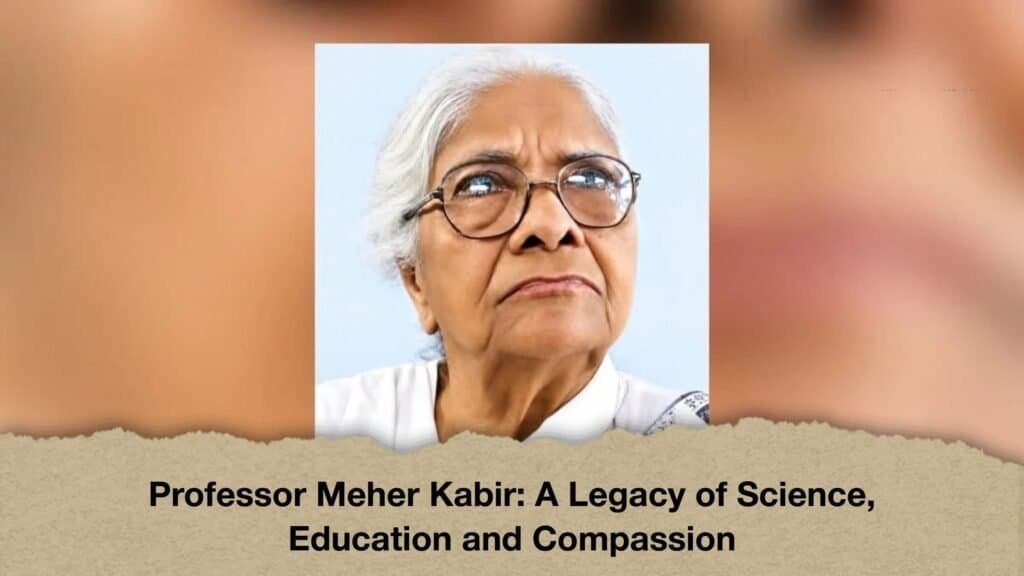
Professor Meher Kabir remains a notable figure in Bangladesh’s history of education, scientific research and social welfare. Through her dedication to teaching, literature, translation and humanitarian work, she demonstrated how knowledge could be used to improve lives and contribute to society. Her career extended beyond the classroom, encompassing efforts to uphold women’s dignity, promote child welfare and support the rehabilitation of women who suffered atrocities during the 1971 Liberation War.
A distinguished teacher in the Department of Chemistry at the University of Dhaka, Kabir devoted much of her professional life to education and the promotion of scientific thinking. Her wide-ranging contributions reflected a commitment to connecting intellectual pursuits with practical social responsibility, leaving a legacy that extended well beyond academia.
Early Life and Education
Meher Kabir was born on 5 June 1921 in Dinajpur. From an early age, she demonstrated a strong interest in learning, which eventually led her towards higher education in science.
She studied at Bethune College and Scottish Church College in Kolkata before pursuing advanced studies at the University College of Science and Technology under the University of Calcutta. In 1942, she earned a Master of Science degree in Applied Chemistry.
According to biographical accounts, Kabir subsequently completed her PhD under the supervision of Acharya Prafulla Chandra Ray, one of the most influential pioneers of modern science in the Indian subcontinent. Ray made significant contributions to chemistry, scientific research and education, helping to establish a stronger foundation for scientific learning in the region.
Kabir’s academic journey reflected the importance of rigorous scientific training and intellectual curiosity. The knowledge she acquired during her studies provided a foundation for her subsequent career in teaching and research, while her wider interests helped shape her identity as an educator with a broad intellectual outlook.
A Career Dedicated to Teaching
Kabir began her professional career in 1949 as a teacher at Comilla Victoria College. She later taught at different educational institutions before joining the Department of Chemistry at the University of Dhaka, one of Bangladesh’s leading centres of higher education.
She also served as provost of Rokeya Hall at the university. The role involved responsibilities beyond academic instruction, placing her within the wider educational environment in which female students pursued higher studies and prepared for professional life.
For Kabir, teaching was not simply a matter of delivering lessons or helping students prepare for examinations. It was also an opportunity to encourage independent thinking, curiosity and a scientific approach to understanding the world.
Scientific education depends on the ability to ask questions, examine evidence and reach conclusions through reasoned analysis. By contributing to higher education, Kabir helped advance the intellectual traditions that support these principles.
Her professional career also illustrated the importance of educators who combine subject knowledge with a broader commitment to students’ development. Her work at the University of Dhaka and her responsibilities at Rokeya Hall formed significant parts of her contribution to the country’s educational landscape.
Bringing Science and Literature Together
Kabir’s intellectual interests were not confined to chemistry and formal education. Writing and translation were also important aspects of her life, reflecting her appreciation of literature and the exchange of ideas across cultures.
Through her translation work, she sought to introduce Bengali readers to literary works and ideas from international literature. Translation plays an important role in making works from different linguistic traditions accessible to new audiences, allowing readers to encounter unfamiliar perspectives, cultures and experiences.
Her engagement with both science and literature demonstrated the breadth of her intellectual interests. Although the two disciplines employ different methods, both can expand human understanding. Science encourages observation, critical enquiry and evidence-based reasoning, while literature offers insights into human emotions, social relationships and the complexities of life.
Kabir’s interests reflected an understanding that intellectual development benefits from exposure to different fields of knowledge. Her work also serves as a reminder that science should not remain confined to laboratories and university classrooms. Scientific thinking has a wider role in everyday life, helping people evaluate information, question assumptions and make informed decisions.
By combining scientific knowledge with literary pursuits, she represented an approach to education that valued both analytical reasoning and cultural awareness.
Supporting Women Affected by the Liberation War
The 1971 Liberation War remains one of the defining events in Bangladesh’s history. Alongside the struggle for independence, the conflict brought immense suffering to civilians. Numerous women experienced sexual violence and other forms of brutal treatment at the hands of Pakistani forces and their collaborators.
After independence, the rehabilitation of these women became an urgent humanitarian responsibility. Survivors faced not only the consequences of wartime violence but also social prejudice, discrimination and difficulties in rebuilding their lives.
According to biographical accounts, Kabir served as president of a rehabilitation centre for women who had suffered atrocities during the war. Her involvement placed her within the wider efforts to support survivors and help restore their dignity and social standing.
Rehabilitation was a complex undertaking. It required more than addressing immediate practical needs; it also involved recognising the rights of survivors, challenging social stigma and creating opportunities for them to rebuild their lives with dignity.
The significance of such work lay in acknowledging the responsibility of society towards those who had endured profound suffering. Supporting survivors required compassion, sensitivity and a willingness to confront the social attitudes that could prevent them from being accepted and treated with respect.
Kabir’s involvement in rehabilitation efforts reflected the humanitarian dimension of her life. It also demonstrated how individuals from academic backgrounds could contribute to addressing some of the most difficult social challenges facing a newly independent country.
Commitment to Child Welfare
Kabir’s social contributions also extended to children. She served as general secretary of the Bangladesh Child Welfare Council, taking on responsibilities associated with the welfare and development of younger generations.
Child welfare is closely connected to access to education, adequate care, safety and opportunities for healthy development. Organisations working in this field can help raise awareness of children’s needs and encourage initiatives aimed at improving their circumstances.
Kabir’s involvement in the council reflected her concern for social well-being beyond the university environment. Her work in education and child welfare was linked by a shared principle: creating conditions in which individuals could develop their abilities and lead better lives.
Her commitment to women’s rehabilitation and children’s welfare also demonstrated the breadth of her public service. Rather than restricting herself to her academic responsibilities, she took an active interest in issues affecting vulnerable members of society.
A Life Defined by Knowledge and Service
Professor Meher Kabir’s contribution to Bangladesh cannot be measured solely through her academic achievements. Her work in science, education, literature, translation and social welfare formed a wider legacy grounded in intellectual curiosity and human responsibility.
As a chemistry teacher, she contributed to scientific education. Through writing and translation, she engaged with the exchange of knowledge and cultural ideas. Her involvement in women’s rehabilitation and child welfare demonstrated a commitment to applying humanitarian values beyond the academic sphere.
These different aspects of her life were connected by a common belief in the value of knowledge and its potential to benefit society. Education can help people develop critical thinking and broaden their understanding, while social engagement can turn those values into practical action.
Kabir’s life also highlights the wider responsibilities of educators and intellectuals. Their influence can extend beyond institutions and professional achievements, shaping attitudes towards learning, equality, dignity and social responsibility.
Remembering her contribution offers an opportunity to recognise the work of those who connect intellectual achievement with public service. Her career stands as an example of how scientific learning, cultural engagement and humanitarian concern can complement one another.
Professor Meher Kabir’s legacy remains relevant to future generations of students, educators and social workers. Her life serves as a reminder that knowledge gains greater significance when it is accompanied by a commitment to human dignity and the welfare of others.