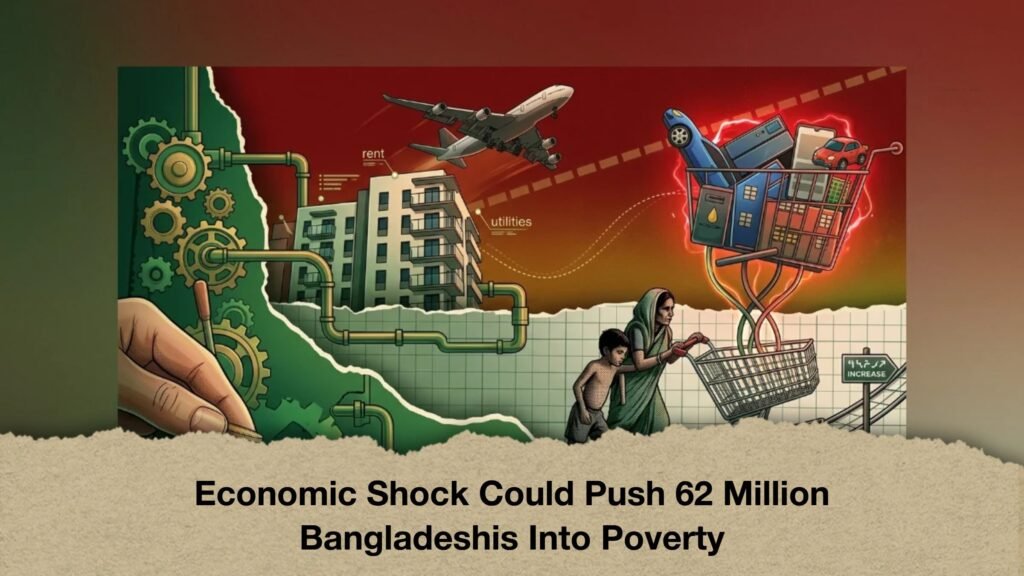
A major economic shock could push around 62 million people in Bangladesh below the poverty line, as persistent inflation, falling real incomes and an energy crisis place growing pressure on households.
The warning comes from the World Bank’s latest Bangladesh Development Update, which highlights a reversal in the country’s long-standing progress in reducing poverty. The report says economic growth has slowed in recent years, weakening employment prospects and household incomes at a time when the cost of essential goods remains elevated.
According to the World Bank, Bangladesh’s poverty rate stood at 18.7% in 2022 but could rise to 22.5% in 2026. Extreme poverty is also expected to increase significantly. Using the international poverty threshold of $3 a day, the extreme poverty rate could rise from 5.9% in 2022 to 10.1% in 2026.
The deterioration is closely linked to prolonged inflation, which has eroded people’s purchasing power over the past four years. Households with limited savings and low incomes have been particularly exposed to the impact of rising food, energy and other essential costs.
The energy crisis has added another layer of pressure. Shortages have disrupted industrial operations, reduced working hours at some businesses and, in some cases, forced factories to suspend production. The industrial sector has consequently faced difficulties in creating new jobs, while uncertainty in the labour market has further weakened household incomes.
The World Bank estimates that the poverty rate increased by 1.1 percentage points in fiscal 2026 alone. Around 2.1 million additional people are estimated to have fallen into poverty since fiscal 2025.
Women have been particularly affected by the deterioration in employment opportunities. However, the full extent of labour-market losses remains difficult to establish because no new Labour Force Survey data have been available since 2025. The World Bank therefore cautions that the scale of employment losses and the deterioration in labour-market conditions cannot yet be measured with complete precision.
Tax system offers limited protection
Alongside the broader economic slowdown, the World Bank has identified weaknesses in Bangladesh’s fiscal system. Government transfers and support programmes can reduce poverty, but the overall tax and benefit structure does not provide sufficient protection to poorer households.
An analysis of 2022 data found that direct taxes and government transfers reduced inequality. The Gini coefficient, a measure of income inequality, fell from 52.4 to 50.7, while the poverty rate declined from 19.6% to 18.8%.
The benefit was partly offset by indirect taxation. Once the impact of indirect taxes was taken into account, the Gini coefficient rose to 51.4 and the poverty rate increased to 20.6%.
This means that while poorer households receive assistance through government programmes, they also bear a significant burden through consumption-based and other indirect taxes. The structure therefore limits the extent to which fiscal policy can protect vulnerable families during periods of economic stress.
Middle East conflict adds pressure
The World Bank has also warned that the ongoing conflict involving Iran and the United States and wider instability in the Middle East are adding to Bangladesh’s economic vulnerabilities.
Long-standing weaknesses in the financial sector, revenue mobilisation, energy systems and public investment have already constrained the economy’s ability to respond to shocks. Rising global energy and commodity prices can make those weaknesses more difficult to manage.
The conflict has pushed up international prices, particularly for fuel and fertiliser, increasing Bangladesh’s import costs. The country’s fuel-import bill has risen by 107%, while fertiliser imports have increased by 42%.
If the conflict continues for an extended period, energy-import costs could rise further. That would place additional pressure on government subsidies and public finances. A prolonged energy crisis could also delay the recovery of private investment and industrial activity, potentially slowing economic growth further.
The World Bank also notes that inflation in most other South Asian economies is currently within or below their central banks’ target ranges, highlighting the continuing inflationary pressure faced by Bangladesh.
Social protection remains fragmented
Bangladesh operates a wide range of social protection programmes to support vulnerable households. Alongside direct assistance, fuel and fertiliser subsidies have also played a role in cushioning households from higher costs.
Yet the World Bank argues that the central problem is not simply the amount of money allocated to social protection. Administrative inefficiency and weak targeting remain major concerns.
In 2026, the government is running 90 social protection programmes through 25 ministries. The large number of separate schemes has contributed to fragmentation, with different eligibility rules, overlapping beneficiary lists and complicated delivery mechanisms.
As a result, assistance does not always reach the people who need it most. According to the World Bank, 62% of households in the poorest 20% receive no social protection benefits. By contrast, 18% of households in the richest 20% receive such support.
Electricity subsidies show a similar pattern. Wealthier urban households receive a disproportionately large share of the benefits, raising questions about whether broad-based subsidies are the most efficient way to protect low-income families.
The World Bank sees the proposed Family Card initiative as a potential opportunity to create a more unified platform for household-based assistance. Its effectiveness, however, will depend heavily on the accuracy of beneficiary selection. If targeting errors remain similar to those seen in older programmes, the new system may not deliver its full potential.
Existing social protection programmes are estimated to reduce the poverty rate by around 3.05 percentage points. Even with similar targeting errors, a Family Card system could reduce poverty by another 0.95 percentage points, potentially lifting around 1.58 million people out of poverty.
If the Family Card were combined with more accurate targeting of old-age and widow allowances and an integrated food assistance programme, the poverty rate could fall by 1.72 percentage points. That could help around 2.85 million people escape poverty, at an additional cost equivalent to about 0.21% of GDP.
Rising burden of energy subsidies
Energy subsidies have become one of the largest pressures on government finances. Subsidies for electricity and gas rose from Tk 8,580 crore in fiscal 2014 to Tk 83,600 crore in fiscal 2025, equivalent to around 1.5% of GDP. Electricity accounts for between 70% and 90% of the total.
The average retail price of electricity is currently Tk 10.63 per unit. However, after accounting for the subsidy on gas used for electricity generation, the actual cost rises to around Tk 15.16 per unit.
That leaves a gap of Tk 4.53 per unit, with government support covering much of the difference. The associated electricity subsidy is equivalent to roughly 1.1% of GDP.
The distribution of the subsidy is also uneven. Residential consumers receive about 72% of electricity subsidies. The richest 20% of households receive around 33%, while the poorest 20% receive only 15.4%. The poorest 40% combined receive roughly 30%.
In relative terms, however, the subsidy remains more significant for poorer households. Direct benefits from lower electricity prices, combined with indirect benefits through cheaper goods produced using subsidised electricity, are equivalent to 18.1% of pre-tax income for the poorest 20% of households. For the richest 20%, the equivalent figure is just 2.3%.
The World Bank warns that removing electricity subsidies without providing alternative social protection could increase the poverty rate by 2.8 percentage points. Around 4.7 million additional people could immediately fall below the poverty line, while the Gini coefficient could rise by 1.6 points as household electricity bills and production costs increase.
Balancing electricity prices and energy security
Reliable and affordable energy is critical for industrial production, export competitiveness, private investment and large-scale employment. Although Bangladesh has substantially expanded its electricity-generation capacity, weaknesses in the sector have continued to undermine its performance.
Domestic natural gas was once the foundation of Bangladesh’s energy system. However, production from older gas fields has declined as reserves have been depleted, while new exploration has not kept pace with rising demand.
In 2017, Bangladesh could meet almost all of its natural gas demand through domestic production. Today, imported liquefied natural gas accounts for around one-third of total gas demand.
The expansion of private power generation has also increased overall generating capacity. Private-sector plants now account for around 43% of total electricity generation. Yet shortages of fuel and limitations in the transmission network continue to constrain the sector.
The World Bank argues that stabilising energy supplies and improving governance and management in the sector should be immediate priorities.
The planned operation of the Rooppur Nuclear Power Plant is expected to add electricity to the national grid and could reduce some pressure on gas-fired generation. However, broader reforms in energy management and subsidy policy will remain necessary if the government is to improve the sector’s financial sustainability.
The World Bank estimates that eliminating major electricity subsidies could generate fiscal savings equivalent to around 1.9% of GDP. Less than one-third of the current subsidy reaches the poorest 40% of the population.
Even if the government fully compensated the poorest 40% for the additional costs resulting from subsidy removal, it could still save around 0.6% of GDP, according to the World Bank.
The findings underline a difficult policy challenge for Bangladesh. Broad subsidies can provide immediate relief, particularly for vulnerable households, but they are costly and can disproportionately benefit better-off consumers. A more targeted social protection system could allow the government to reduce fiscal pressure while protecting those most exposed to inflation, energy costs and employment shocks.