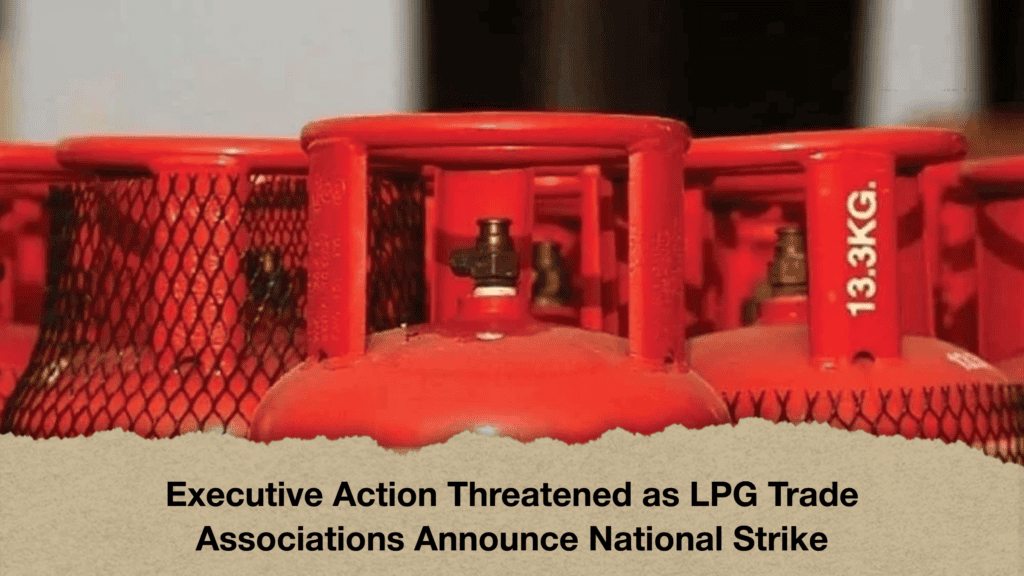
The government has issued a stern ultimatum to Liquefied Petroleum Gas (LPG) distributors and retailers, promising swift legal action if they proceed with a planned two-day nationwide shutdown.
Speaking at a joint press conference on Wednesday morning following an emergency summit with LPG operators, Power, Energy and Mineral Resources Minister Iqbal Hasan Mahmud Tuku and Commerce Minister Khondokar Abdul Muktadir urged industry representatives to withdraw the industrial action. The ministerial briefing, held in the conference room of the Ministry of Power, Energy and Mineral Resources at the Secretariat, served as a platform to reassure households that cooking gas supplies would be safeguarded against market manipulation.
Addressing assembled media, the Commerce Minister delivered a direct message to trade leaders, stressing that state authorities would take uncompromising measures against anyone seeking to engineer artificial shortages or hold essential public commodities to ransom. While affirming that regulatory disputes can be resolved amicably through formal dialogue, he made it clear that attempts to paralyze domestic fuel markets would not be tolerated.
The Energy Minister reiterated the administration’s commitment to protecting domestic consumers from inflated fuel prices. He called upon trade associations to immediately rescind their strike call and engage in good-faith negotiations. Clarifying structural pricing dynamics within the domestic energy sector, the Minister pointed out that the government does not provide financial subsidies for LPG, contrasting Bangladesh’s market-driven pricing mechanism with neighbouring India, where state authorities underwrite substantial fuel subsidies.
The government’s decisive stance follows an announcement on 12 October by the LPG Distributors Association, which declared that all LPG outlets across the country would close on 15 and 16 October. Speaking at a press conference at the National Press Club, association President Selim Khan issued a seven-point charter of demands, warning that failure to secure regulatory concessions would result in an indefinite nationwide blockade.
At the core of the trade association’s grievances are demands for increased profit margins for primary distributors and retail merchants. Furthermore, the association called for an immediate cessation of administrative enforcement drives, penal fines, and alleged harassment conducted by executive magistrates and officials from the Directorate of National Consumer Rights Protection.
Market stability has been severely tested since 4 October, when the Bangladesh Energy Regulatory Commission (BERC) authorized a 252 taka price hike for standard 12-kilogram LPG cylinders, bringing the official benchmark price to 1,837 taka. Despite this official baseline, consumers across the country report widespread price gouging, with retail vendors routinely charging premiums of 400 to 500 taka above the government-stipulated rate.
While retail vendors cite shrinking margins and transportation costs, primary LPG operators and importers insist they continue to supply gas cylinders to secondary distributors strictly at BERC-mandated wholesale tariffs. The growing disparity between primary wholesale prices and the actual cost borne by householders has triggered public frustration, particularly in residential regions that lack municipal pipeline gas infrastructure and rely entirely on bottled LPG for daily cooking.
The current friction comes on the heels of repeated interventions by the government to stabilize essential commodity markets. During a inter-ministerial meeting on 28 September, primary LPG importers assured officials that bulk reserves were plentiful and that no physical supply deficit existed. Subsequently, on 30 September, the Energy Minister directed Deputy Commissioners across all 64 districts to investigate artificial supply crunches and prosecute predatory pricing. A follow-up strategy session with bulk importers was conducted on 3 October in the presence of the Commerce Minister to streamline distribution logistics.
This is not the first time the retail energy sector has attempted to leverage supply disruptions to counter administrative enforcement. On 8 January, LPG traders instituted a sudden nationwide delivery strike in protest against regulatory fines and market inspections. That earlier standoff was resolved late the same evening after BERC officials held emergency talks with trade representatives and pledged to review operational guidelines.
With millions of households reliant on cylinder gas for basic food preparation, a full shutdown on 15 and 16 October would cause immediate hardship to domestic consumers and small catering businesses alike. Whether trade associations step back from the brink or proceed with the strike now depends on the outcome of emergency consultations ahead of the Thursday deadline.