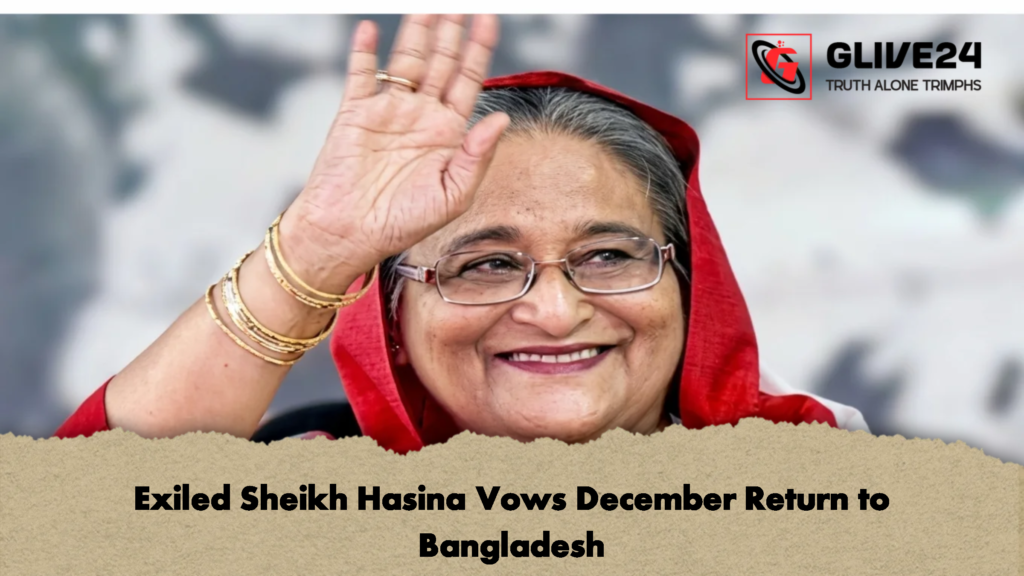
In her first public media appearance in two years, Bangladesh’s former Prime Minister, Sheikh Hasina, addressed a virtual press conference organised by the Foreign Correspondents’ Club (FCC) South Asia in New Delhi on Tuesday. Delivering a passionate address, the ousted leader declared her intention to return to Bangladesh this December, framing her planned homecoming around a pledge to restore democratic governance, the rule of law, and a secular state.
During her speech, Sheikh Hasina became visibly emotional and wept as she paid tribute to her slain family members and the martyrs of the 1971 Liberation War. Reflecting on her forced exile, she insisted that her commitment to the country remained undiminished, maintaining that her sense of national obligation far outweighed any fear for her personal safety. In an effort to foster stability, she issued a broad appeal for national reconciliation to political parties across the spectrum.
The virtual event featured key figures from her former administration, including her former Information and Communication Technology adviser, Sajeeb Wazed Joy, and former minister Mohibul Hassan Chowdhury Nowfel. Addressing the gathering, Sajeeb Wazed Joy expressed grave concern over what he described as a dangerous rise in religious fundamentalism. He further questioned the justification for granting indemnity to individuals implicated in the severe unrest and violent clashes during July and August. Mohibul Hassan Chowdhury adopted a broader tone, urging long-term political tolerance and peaceful co-existence beyond partisan lines.
Sheikh Hasina offered a sharp critique of the unrest that precipitated her departure. She alleged that the movement for civil service quota reform had been used as a calculated pretext to orchestrate a government overthrow through targeted violence. Pointing to the political leadership, she raised allegations regarding the involvement of Dr Muhammad Yunus, who headed the interim administration following her departure. She demanded a full, independent inquiry into the deaths of police officers and journalists, alongside the widespread destruction of vital state infrastructure. Warning international observers, she argued that prolonged instability in Bangladesh could undermine security and economic investment across the entire South Asian region.
Responding to her statements, Prime Minister Tarique Rahman urged citizens to exercise caution and avoid creating unnecessary issues that could destabilise the nation. Political commentators observe that the Awami League’s call for reconciliation—presented as a measure to prevent further bloodshed—has effectively placed the political initiative on the government and the ruling Bangladesh Nationalist Party (BNP).
Political Context and Regional Implications
The former prime minister’s announcement marks a notable turn in Bangladesh’s evolving political landscape. Her departure in August 2024 followed weeks of intense student-led demonstrations that began over civil service quota allocations before turning into a wider movement. The subsequent transition period saw the installation of an interim authority to manage public affairs until formal political structures were re-established.
Stability in Dhaka remains a matter of significant consequence for the wider region. Surrounding nations share intricate trade, security, and diplomatic connections with Bangladesh, making steady governance a priority for South Asia. As international observers keep a close watch on developments, Sheikh Hasina’s prospective return in December introduces fresh momentum into the country’s political discourse.