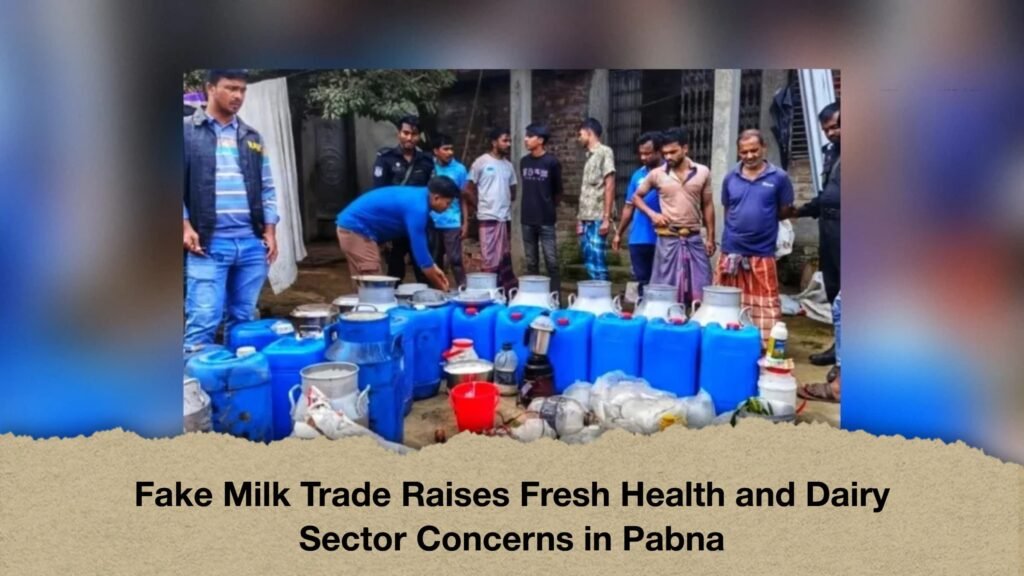
A growing trade in allegedly adulterated milk in Pabna is raising concerns over consumer safety, the livelihoods of genuine dairy farmers and weaknesses in the milk collection system.
The artificial product is reportedly being prepared without cows, using substances including soybean oil, glucose, saccharin, urea fertiliser, detergent powder and caustic soda. It is then allegedly supplied to chilling centres, where milk is collected, subjected to preliminary quality checks and stored before being sent further into the supply chain.
The issue has reportedly become particularly prominent in Bhangura, Chatmohar and Faridpur upazilas, where more than 200 chilling centres have been established. Of these, 92 are associated with recognised companies, while the rest are privately operated, according to information cited by local sources. A number of other chilling centres are also operating in Santhia, Bera and Bhangabari.
People involved in the alleged adulteration trade told local sources that around Tk450 worth of chemicals can be added to 40 litres of a white, non-creamy liquid to make it resemble high-fat milk. The resulting product can reportedly be sold for around Tk2,200, leaving an alleged profit of approximately Tk1,750 per 40 litres.
At that rate, large-scale production can generate substantial returns. Those involved in the trade reportedly operate on a daily basis, producing considerable quantities of the artificial liquid and supplying it to different collection points.
Chemicals reportedly sourced from outside the district
People familiar with the operation have been reluctant to publicly disclose how the artificial milk is produced or distributed. However, speaking on condition of anonymity, some alleged that the chemicals can be obtained from traders in Dhaka, Chattogram and other areas by telephone or through online orders.
The materials are reportedly delivered to production sites through courier and transport services.
Some individuals involved in the trade also alleged that artificial milk can be introduced into certain collection networks through payments to intermediaries. One claim was that a payment of around Tk500 could facilitate access to a chilling centre.
These allegations have not been attributed to all chilling centres or dairy companies. Major milk processors named in the report have denied tolerating adulterated supplies and say they have established procedures for testing and rejecting milk that fails to meet their standards.
Several operators fined
Authorities have taken action against a number of businesses and individuals over allegations linked to adulterated milk.
On 28 September, Uttam Ghosh and his wife, Poly Ghosh, from the Pechakola Ghat area of Bera were fined Tk100,000 by the administration. The report described the penalty as their first such punishment.
Earlier, on 6 September, the owner of Jui Dairy Farm in the Nagdemra area of Santhia was fined Tk200,000 over various violations.
Action has also been taken against Keya Dairy, Amina Dairy and Premium Food in Faridpur, Joydeb Ghosh in Bera and Ashraful Ali of Singari village in Bhangura.
Joydeb Ghosh was reportedly fined Tk200,000 after being accused of producing adulterated milk for 12 years in the Nakalia and Pechakola markets of Bera.
The cases highlight the continuing challenge faced by enforcement agencies. While mobile courts and administrative drives can impose financial penalties, local sources say the trade continues to find opportunities within the wider milk collection network.
Genuine farmers caught in the middle
The alleged adulteration is also having an economic impact on farmers producing genuine milk.
Farmers say they face higher production costs but often struggle to secure a fair price. They allege that some collection centres favour cheaper supplies and that middlemen involved in the collection process can put genuine producers at a disadvantage when commissions are not paid.
Ashraful Islam, a dairy farmer from Baowikhola village, said dishonest traders were selling artificial milk at lower prices, weakening the market for genuine producers.
Farmers selling milk at Tk50 to Tk55 per litre are sometimes unable to cover their production costs, he said. Without stronger action, he warned, the region’s dairy industry could face serious difficulties.
Abdul Latif, president of a local dairy producers’ co-operative association in Santhia, said genuine farmers did not adulterate milk. He attributed the problem to some dishonest intermediaries seeking additional profits.
He also said inadequate quality control at some chilling centres had created opportunities for adulterated milk to enter the supply chain.
A significant gap between demand and production
Data provided by the livestock sector and local dairy farmers indicate that Pabna and Sirajganj together have a daily milk demand of around 450,000 litres. Production, however, is estimated at approximately 350,000 litres.
That leaves a reported daily shortfall of 55,000 to 60,000 litres.
The available milk is distributed among state and private dairy processors, wholesalers, sweet shops and local consumers. According to the figures cited in the report, Milk Vita collects between 120,000 and 150,000 litres a day, while Aftab, Akij, PRAN, BRAC and other private dairy processors account for around 175,000 litres.
Wholesalers collect another 50,000 to 55,000 litres, while more than 200 sweet shops purchase around 15,000 litres. Local consumers in markets account for roughly 10,000 litres.
| Category | Approximate daily volume |
|---|---|
| Total milk demand in Pabna and Sirajganj | 450,000 litres |
| Total milk production | 350,000 litres |
| Estimated daily shortage | 55,000–60,000 litres |
| Milk collected by Milk Vita | 120,000–150,000 litres |
| Milk collected by Aftab, Akij, PRAN, BRAC and other processors | About 175,000 litres |
| Milk collected by wholesalers | 50,000–55,000 litres |
| Milk purchased by more than 200 sweet shops | About 15,000 litres |
| Milk purchased by local market consumers | About 10,000 litres |
| Chilling centres in Bhangura, Chatmohar and Faridpur | More than 200 |
| Chilling centres associated with recognised companies | 92 |
The reported production deficit creates a substantial gap in the regional supply chain. Local sources allege that some dishonest traders exploit this shortage by introducing artificially produced liquid into the market.
Dairy companies point to testing procedures
Saikat Sheikh, administration manager at PRAN Dairy, said the company follows a strict standard operating procedure when collecting milk.
According to him, PRAN uses digital software and LS machines and carries out 13 to 14 stages of testing. Milk that fails to meet the required standards or shows even a small indication of adulteration is rejected.
Sheikh also claimed that four or five chilling-centre employees had been injured over the past year after refusing to accept milk following the detection of adulteration.
He argued that individual companies cannot tackle the problem alone. Controls over the sale and transportation of chemicals used to produce artificial milk would also be necessary, he said, alongside a fixed and mandatory standard operating procedure for all milk-collecting organisations.
Dr Saiful Islam, additional general manager of Milk Vita, said milk samples collected at the company’s chilling centres are tested for fat, solids-not-fat and harmful chemicals using laboratory technology.
If adulteration or harmful chemicals are detected, the milk is immediately rejected and destroyed, he said.
He added that the activities of dishonest middlemen were damaging the reputation of the dairy sector in the region.
Experts warn of limits in basic testing
Dr AKM Humayun Kabir, a professor at Chattogram Veterinary and Animal Sciences University, said natural milk contains a normal balance of different components.
While it may be possible to artificially imitate certain characteristics such as fat content, he said, reproducing the actual structure and nutritional composition of natural milk is not possible through such chemical additions.
He also warned that adulteration may not always be detected through basic testing. Specific laboratory examinations are needed to identify substances such as water, urea, alkalis or formaldehyde, depending on the suspected adulterant.
Without proper testing and quality-control measures, the practice could create a significant public-health concern, he said.
Pabna Civil Surgeon Dr Abul Kalam Azad also expressed concern over the potential health effects of chemically adulterated milk. He said liquids containing substances such as edible oil, detergent and caustic soda could be particularly hazardous, with children and patients among those who could be especially vulnerable to harmful exposure.
Lack of permanent laboratory hampers enforcement
Pabna District Commissioner Aminul Islam said the administration was conducting regular drives to prevent adulterated milk from entering the market.
A major difficulty, however, is the lack of a modern laboratory in the district capable of conducting the necessary chemical tests, he said.
A mobile laboratory from Rajshahi reportedly visits Pabna only once a month, limiting the frequency with which suspected samples can be examined. The district administration is working towards establishing a permanent laboratory, according to the district commissioner.
A permanent testing facility would allow suspected milk samples to be examined more regularly and could strengthen enforcement. Local stakeholders also say that monitoring the sale and transportation of chemicals, ensuring consistent testing at chilling centres and protecting genuine farmers from unfair market practices will be important in addressing the problem.
The dispute over adulterated milk therefore extends beyond the question of food safety. It also concerns the credibility of the milk collection system and the economic survival of farmers who depend on genuine dairy production for their livelihoods.