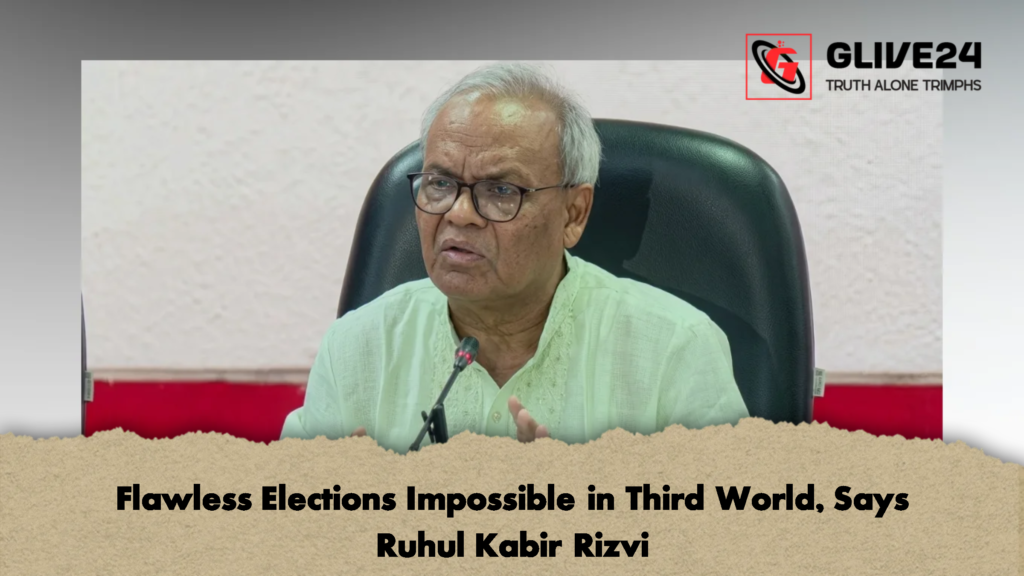
A completely flawless or hundred-per-cent free and fair election is functionally impossible in a developing nation such as Bangladesh, senior Bangladesh Nationalist Party (BNP) leader Ruhul Kabir Rizvi has remarked. Addressing a high-level dialogue in the capital, the senior joint secretary-general and political adviser to the party leadership argued that even established regional democracies like India struggle with electoral perfection, though long-term democratic stability ultimately relies on political consensus and public acceptance of outcomes.
Rizvi delivered his remarks as the chief guest at a national seminar titled “Political and Electoral Violence in 2026: Impact on the Path to Democratic Transition”, held on Monday, 10 August, at the CIRDAP Auditorium on Topkhana Road in Dhaka. The dialogue was jointly organised by the European Partnership for Democracy (EPD) and the human rights organization Odhikar.
Drawing a direct comparison with neighbouring nations, the BNP leader noted that electoral irregularities and public complaints routinely surface during Indian elections as well. However, the crucial distinction lies in institutional maturity and political acceptance once official results are declared by electoral authorities.
Rhetorical Restraint and Cultural Shifts
Addressing the root causes of civil unrest during political transitions, Rizvi cautioned both governing and opposition forces to exercise utmost restraint in their public discourse. He emphasized that the choice of language, tone, and sentence structure used by senior politicians directly influences grassroots followers, warning that inflammatory rhetoric frequently fosters a violent mindset among party activists.
“Regardless of how many laws are enacted to establish democracy, those initiatives will remain entirely ineffective unless there is a fundamental shift in human mindset and political culture.”
— Ruhul Kabir Rizvi, Senior Joint Secretary-General, BNP
Turning to opposition politics, Rizvi stressed that while rigorous criticism of the ruling administration remains a core duty of any opposition movement, such critiques must remain constructive, mutually beneficial, and forward-looking. Constructive engagement, he noted, ensures a smoother democratic trajectory and fosters national statecraft, reiterating that political friction requires accountability from all sides rather than unilateral blame.
Internal Discipline and Organizational Overhaul
Reflecting on internal party management since the major political shifts of 5 August, Rizvi highlighted the BNP’s systematic crackdown on misconduct within its ranks. He detailed how numerous leaders and activists across the main body and its associate organizations faced expulsion, relief of duties, or formal show-cause notices for engaging in unethical practices, extortion, or territorial domination.
Historically, political parties across the region often turned a blind eye to muscle power, praising local enforcers who disrupted rival political offices or dominated local communities. Rejecting that legacy, Rizvi asserted that the contemporary BNP has maintained a strict zero-tolerance policy against internal lawlessness.
He maintained that when a political organization demonstrates the institutional resolve to discipline its own influential members, it signals a positive transformation and confirms that the party is navigating the correct ethical path toward democratic governance.