Prices of essential food items continue to put pressure on household budgets in Bangladesh, with consumers in the capital facing higher costs for vegetables, fish, poultry and eggs. French beans have reached Tk 200 per kilogram, while a dozen eggs is being sold for Tk 150 in several markets. Fish prices have also risen by Tk 20–30 per kilogram for many varieties, adding to the financial strain on families with limited incomes.
The situation was observed on Saturday, 5 September, during visits to markets in Badda, Rampura and Gulshan in Dhaka. Shoppers said they were being forced to reduce the quantity and variety of food they buy as prices continue to rise.
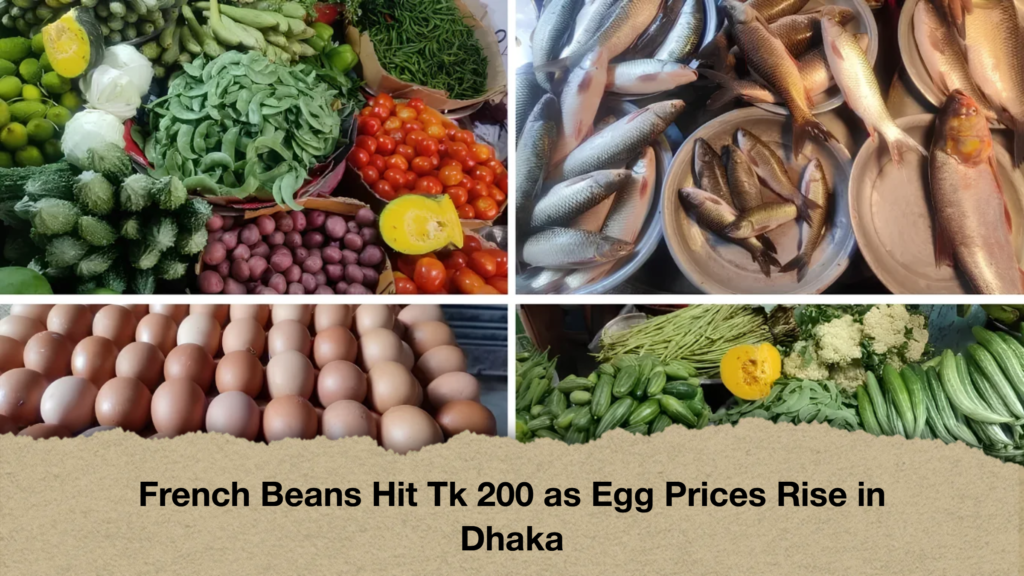
At the markets visited, ridge gourd was selling for Tk 80 per kilogram, tomatoes for Tk 120, bottle gourd for Tk 60–80, green chillies for Tk 120, cauliflower for Tk 80 and cucumber for Tk 80. Round aubergines were priced at Tk 100 per kilogram, while long aubergines were Tk 140.
Carrots were selling for Tk 140 per kilogram, bitter gourd for Tk 80, pointed gourd for Tk 60, okra for Tk 60, spiny gourd for Tk 100 and taro for Tk 80. French beans were the most expensive among the vegetables listed at Tk 200 per kilogram. Snake gourd was Tk 60, while papaya was available at a comparatively lower price of Tk 30. Four lemons were being sold for Tk 60.
Saiful Islam, a vegetable seller at Shehzad Vegetable Store in the Joar Sahara area, said wholesale prices had increased, pushing up retail prices as well. Some vegetables had only recently begun arriving in the markets, which was also contributing to higher prices.
Mohammad Alam, a vegetable trader at Gulshan Kitchen Market, said production of many vegetables was currently lower, resulting in tighter supplies. He expected prices to become more affordable once seasonal vegetables entered the market in larger quantities. Papaya, he said, was currently being produced in greater volume and was therefore available at a relatively lower price.
The fish market is also proving difficult for consumers. Tilapia is selling for Tk 250–260 per kilogram, pangas for around Tk 200, and katla for Tk 450. Rui is priced between Tk 360 and Tk 420 depending on size. Meanwhile, hilsa weighing around 700–800 grams is being sold for as much as Tk 1,900 per kilogram.
Monir Hossain, a fish seller at Rampura Market, said fish prices frequently fluctuate. He attributed the latest increase partly to lower supplies at wholesale markets, saying there was not enough fish to meet current demand.
Poultry prices have risen as well. Broiler chicken is being sold for Tk 185–190 per kilogram, Sonali chicken for Tk 310–320 and layer chicken for Tk 380–390. Asif, owner of a chicken shop at Joar Sahara Market, blamed higher wholesale prices for the increase at the retail level.
Egg prices have followed a similar trend. A dozen eggs is now selling for Tk 150. Seller Mohammad Naim said prices had been rising almost daily. He claimed that the wholesale price for 100 eggs had increased by Tk 50, although retailers were still trying to maintain their previous selling prices where possible.
For many consumers, these increases are forcing difficult choices. Jahid Hossain, a laundry shopkeeper who went to Gulshan Kitchen Market to buy fish, said he had recently been able to afford tilapia and rui. On Saturday, however, he found that the prices of almost all types of fish had increased by Tk 20–30 per kilogram.
Jahid also said he had long wanted to buy hilsa for his family, but its current price was beyond his budget. Instead, he left the market with a bunch of spinach.
Other shoppers voiced similar concerns. They said that previously, when fish or meat was unaffordable, they could still rely on vegetables or eggs as relatively accessible alternatives. Now, however, many vegetables cost Tk 80–100 or more per kilogram, while four eggs can cost around Tk 50.
The rising prices are consequently affecting not only what people buy, but also how much they can put on their dining tables. Sellers point mainly to lower production, reduced supplies and higher wholesale prices as reasons for the latest increases. Consumers, meanwhile, are bearing the immediate burden as everyday shopping becomes increasingly difficult to manage within limited household budgets.