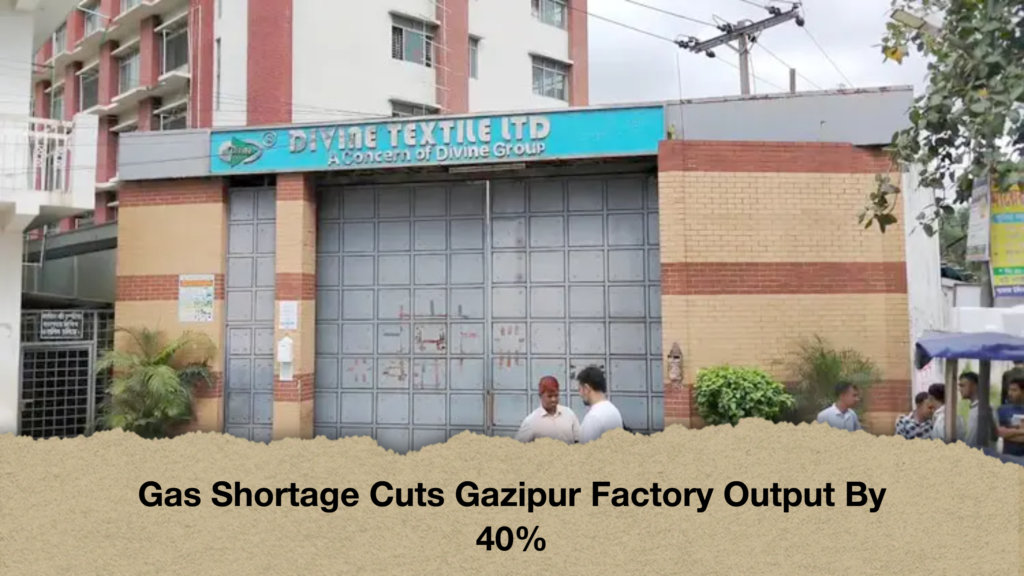
Severe gas shortages are disrupting production across Gazipur, one of Bangladesh’s major industrial hubs, with around 15 per cent of factories reportedly facing difficulties because of inadequate gas pressure.
According to Gazipur Industrial Police-2, the district has more than 3,000 factories of various sizes. Of these, an estimated 400 to 450 are experiencing production disruptions, with output capacity in affected factories falling by as much as 40 per cent on average.
Superintendent of Police Mohammad Amzad Hossain said on Sunday that industrial police teams were visiting factories to assess the situation and determine the extent of the disruption. He added that there was not yet comprehensive official information confirming how many factories had been forced to shut entirely because of the gas shortage.
The impact, however, appears to be significant at factory level. Workers and industry representatives said some factories have been forced to suspend operations temporarily, while others are maintaining partial production whenever gas pressure rises. Frequent fluctuations are making it difficult for factories to maintain production schedules and operate machinery efficiently.
At Konabari, Fuad Spinning Mills Ltd has already been closed since 1 August because of the prolonged gas shortage, leaving more than 500 workers without work. Deputy General Manager Azizul Haque said gas pressure had remained inadequate for several months, making normal production increasingly difficult.
The company continued paying workers’ salaries and allowances for several months despite reduced operations, he said. As losses continued to accumulate because production could not be maintained, the management eventually decided to suspend operations from 1 August. The factory is expected to resume production if the gas supply situation improves.
SADMA Fashion Ltd in Kaliakair is also struggling with inadequate gas pressure. Managing Director Sohel Rana said the dyeing section had been particularly affected because machinery cannot operate properly without sufficient gas. Workers sometimes have to remain idle until pressure improves. Even when production resumes, renewed pressure drops often force operations to slow or stop again.
Paramount Textile Mills Ltd has reported similar difficulties. Its Assistant General Manager, Rabbiul Islam, said the gas shortage had reduced production and disrupted the factory’s regular operations.
Divine Textile Mills Ltd in the Gazipur Palli Bidyut area has reportedly remained closed since Thursday. Company officials could not be reached for comment.
Industrial police have also received a notice from Ripon Garments stating that the factory would temporarily suspend operations and send workers on leave because of low gas pressure. Workers were advised to remain in contact with the management.
Police officials stressed that a factory cannot automatically be classified as having closed because of the gas shortage unless its management formally cites the supply problem as the reason. Industrial police teams are therefore monitoring factories and gathering information on the operational difficulties being faced.
Officials associated with Titas Gas have attributed the problem to reduced gas supply at the central level. As supply remains below demand in Gazipur, factories located towards the end of the distribution network are reportedly suffering more severely from low pressure. Efforts are under way at higher levels to improve gas pressure in the affected industrial areas.
For gas-dependent industries, prolonged shortages can have consequences well beyond a temporary decline in output. Production schedules become difficult to maintain, machinery may remain underused, and labour costs continue even when factories cannot operate at full capacity. Interruptions can also complicate deliveries and disrupt supply chains, particularly for factories serving export-oriented sectors.
Gazipur is home to a large concentration of garment, textile, spinning, dyeing and other manufacturing facilities. A sustained interruption in industrial production could therefore affect not only individual businesses but also workers, suppliers and related service providers.
Factory owners and workers are now calling for the gas pressure to be restored as quickly as possible. For industries already operating under tight production schedules and cost pressures, reliable energy supply remains essential to keeping machinery running, maintaining employment and meeting production commitments.