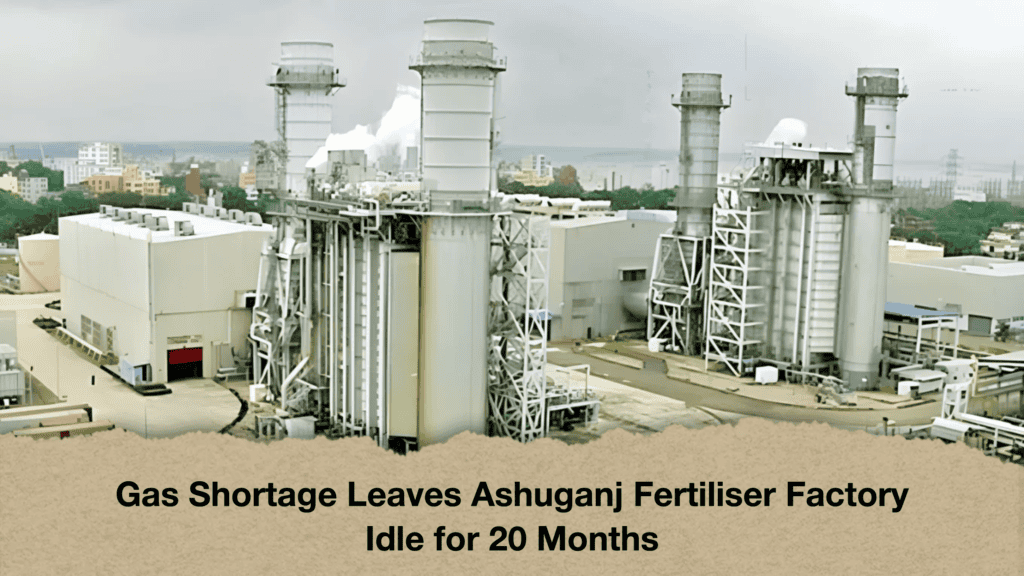
The prolonged shutdown has prevented the factory from producing at least 1,100 tonnes of urea a day, with the resulting daily financial loss estimated at a minimum of Tk 50 million. The disruption is part of a wider pattern: for around 15 years, the factory has reportedly remained closed for more than half of each year because of restrictions on gas supplies.
The consequences extend beyond lost production. The factory’s own fertiliser stocks have fallen to virtually zero, while operating costs and the financial burden of prolonged inactivity continue to rise. Dealers within its distribution area are relying on imported fertiliser to meet demand, increasing the need for overseas purchases and placing additional pressure on foreign exchange reserves.
There are also concerns that keeping the facility idle for such an extended period could damage machinery and complicate any attempt to resume production. Previous shutdowns have reportedly been followed by mechanical problems even after gas supplies became available, making the return to normal operations more difficult.
Four decades of operation under pressure
Established in 1981, AFCCL began commercial production in 1983. At the time, its maximum production capacity was 1,600 tonnes of urea a day. Under current conditions, with adequate gas pressure and a reliable supply, the factory can produce between 1,100 and 1,150 tonnes daily.
However, gas rationing has repeatedly interrupted operations since the 2010–11 financial year. According to sources familiar with the factory, it has often remained closed for six to nine months a year, with some periods of complete inactivity. The latest suspension began in March last year and has continued because of the gas supply shortage.
Based on the factory’s daily production capacity, approximately 643,500 tonnes of urea production had been disrupted over around 19 and a half months up to 18 October. At a selling price of Tk 48,000 per tonne, the value of the production that could not be achieved exceeds Tk 25 billion.
This figure represents the estimated sales value of the unproduced fertiliser rather than the factory’s audited net loss. Nevertheless, it illustrates the scale of the production shortfall and the economic value of the facility’s unused capacity.
Shutdowns push production costs sharply higher
Data covering recent financial years indicate a marked rise in the calculated cost of producing each tonne of urea as the factory has spent increasing periods out of operation.
In the 2015–16 financial year, the factory was closed for 200 days, while the cost of producing a tonne of urea exceeded Tk 12,000. In 2016–17, the shutdown period increased to 296 days and the cost rose to more than Tk 26,000 per tonne.
The pattern continued in subsequent years. The factory was closed for 235 days in 2018–19, when the production cost stood at Tk 17,000 per tonne. In 2019–20, it remained shut for 212 days, with the cost reaching Tk 20,000. In 2020–21, 243 days of closure coincided with a production cost of Tk 24,000 per tonne.
In 2021–22, the factory was closed for 284 days and the cost increased to Tk 33,000 per tonne. The following year, it remained closed for 231 days, while the cost rose to Tk 41,000.
The figures deteriorated further in the next two financial years. In 2023–24, the factory was shut for 323 days and the cost of production reached Tk 71,000 per tonne. In 2024–25, it was closed for 356 days, leaving only a small part of the year outside the reported shutdown period. The calculated cost of producing a tonne of urea consequently rose to Tk 186,000.
No production-cost figure was available for 2017–18 because the factory was not operating that year.
The figures underline the financial difficulties associated with maintaining an industrial facility that spends much of its time idle. However, the reported per-tonne costs should be interpreted in the context of the calculation method and the extent to which fixed operating expenses are allocated across actual production.
Losses exceed Tk 11 billion over a decade
AFCCL remained profitable until the 2015–16 financial year. It began recording annual losses in 2016–17, and the accumulated losses over the following decade have exceeded Tk 11 billion, according to figures cited by sources familiar with the factory.
The reported annual losses were Tk 379.2 million in 2016–17 and Tk 1.407 billion in 2017–18. They fell to Tk 101 million in 2018–19 before rising to Tk 625 million in 2019–20.
The factory recorded a loss of Tk 1.047 billion in 2020–21 and Tk 1.597 billion in 2021–22. The losses then climbed to Tk 2.819 billion in 2022–23, before reaching Tk 1.864 billion in 2023–24 and Tk 1.902 billion in 2024–25.
The figures point to a sustained deterioration in the factory’s financial position. While the value of lost production and the recorded annual losses measure different aspects of the problem, both highlight the cost of leaving the plant’s production capacity unused.
Workers warn of equipment damage and mounting frustration
The long suspension has raised concerns about the condition of the factory’s machinery. Prolonged inactivity can create additional maintenance requirements, while mechanical faults may delay a restart even after gas supplies resume.
Factory workers say the uncertainty has also affected their working conditions and access to various benefits, contributing to dissatisfaction among employees.
Mohammad Abu Kawsar, general secretary of the factory’s collective bargaining agent (CBA), said prolonged production stoppages under gas rationing were turning a previously profitable factory into a loss-making and weakened industrial enterprise. He also argued that importing fertiliser to compensate for interrupted domestic production was wasting foreign currency.
Mohammad Akhtaruzzaman, the factory’s senior vice-president, said the plant could produce at least 1,150 tonnes of urea a day if it remained operational. He warned that prolonged closures could damage machinery and said workers were being deprived of various benefits because production had stopped.
The factory’s managing director, currently serving in an acting capacity, Engineer Sheikh Md Ali Ashraf, said discussions were under way with senior officials of the Bangladesh Chemical Industries Corporation (BCIC) regarding the supply of gas.
No specific timetable for restoring gas supplies or restarting production was provided.
The situation at Ashuganj highlights the difficulty of maintaining domestic fertiliser production when a gas-dependent industrial plant cannot secure a consistent supply of its principal input. Restoring operations would require more than the resumption of gas deliveries: the condition of the machinery would need to be assessed, any necessary repairs identified, and a workable production plan established.
For Bangladesh, the prolonged closure also raises questions about how best to balance limited gas supplies among competing industrial and other demands while protecting existing production capacity. Until a reliable supply arrangement is secured, Ashuganj’s idle capacity, mounting losses and dependence on imported fertiliser are likely to remain significant concerns.