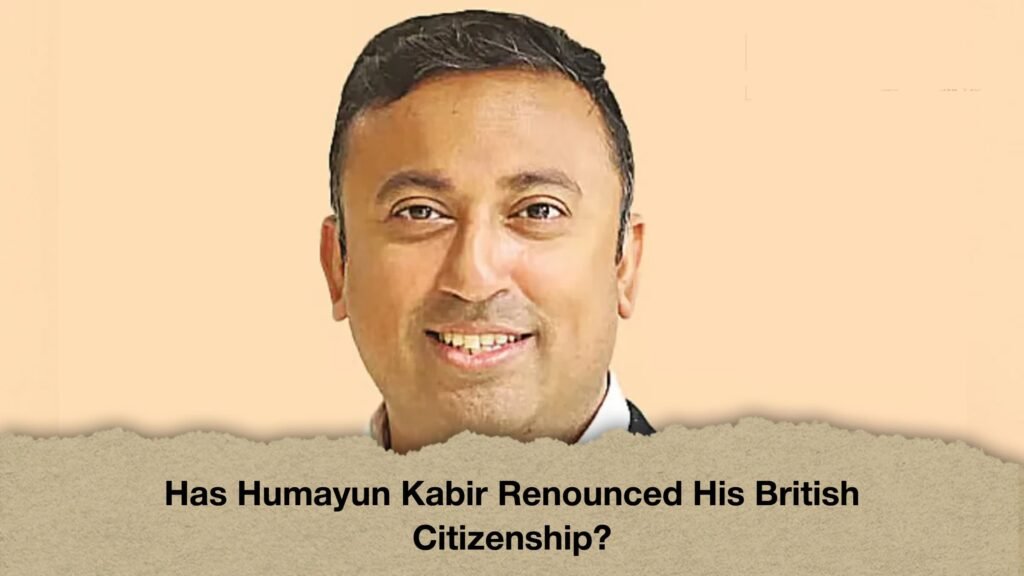
Questions have emerged over whether Foreign Affairs State Minister Humayun Kabir has renounced his British citizenship before taking office, although no official confirmation has so far been made public.
Kabir was sworn in as State Minister for Foreign Affairs on Friday as a technocrat. Before his appointment, he served as the Prime Minister’s Foreign Affairs Adviser with the rank of a state minister. His transition to a formal ministerial role has brought renewed attention to his nationality status because of his long-standing links with the United Kingdom, where he spent most of his life and pursued both his education and early political career.
Born in Osmani Nagar upazila of Sylhet, Kabir moved to the United Kingdom with his family when he was just two and a half years old. He grew up there and later obtained British citizenship. He was also involved in British Labour Party politics before returning to a more prominent political role in Bangladesh.
The question of his British citizenship has gained significance since he assumed a senior government position responsible for foreign affairs. According to sources at Bangladesh’s Ministry of Foreign Affairs, Kabir surrendered his ordinary Bangladeshi passport on 23 February, shortly after taking charge as the Prime Minister’s Foreign Affairs Adviser on 17 February this year.
He was issued an official or diplomatic passport in the same month. His first foreign trip using the diplomatic passport was to Saudi Arabia. Over the following six months, he travelled abroad at least 11 times on the government-issued passport, visiting countries including the United States, China, Russia, Türkiye, India, Qatar, the United Arab Emirates, Mauritius and the Philippines.
The possession of an official or diplomatic passport, however, does not by itself establish whether an individual has retained or relinquished another nationality. The central issue in Kabir’s case is whether he formally renounced his British citizenship before assuming his current government position.
Several leaders of the Bangladesh Nationalist Party’s UK wing have confirmed that Kabir is a British citizen. They could not, however, confirm whether he had completed the formal process of renouncing that citizenship before becoming a state minister.
Government sources in Bangladesh have also said they have no information indicating that Kabir submitted a letter or application seeking to renounce his British citizenship. No government source contacted for the report could provide documentary evidence confirming that such a renunciation had taken place.
Attempts were made on Saturday to obtain a direct response from Kabir. He was contacted several times by telephone, but could not be reached. The public relations office of the Ministry of Foreign Affairs was also approached for clarification, but no response was received.
Kabir’s background in Britain is extensive. According to a source familiar with his academic career, he studied international relations at the University of Sussex, where he completed his undergraduate degree. He subsequently obtained postgraduate qualifications in three different fields from the London School of Economics and Political Science, the University of Cambridge and Leeds Law School.
His professional career also included senior responsibilities in Britain. He worked at the office of the Mayor of London and held important positions within the British government, giving him considerable experience of public administration and international affairs.
His political career began in Britain through the Labour Party. Ahid Ahmed Chowdhury, a former deputy mayor of Tower Hamlets Council, told Prothom Alo that Kabir served as secretary of the Labour Party’s Bethnal Green and Bow branch between 2006 and 2009.
Kabir subsequently became increasingly active in Bangladeshi politics. On 22 October 2025, he was appointed joint secretary-general of the BNP, with responsibility for international affairs. His appointment as the Prime Minister’s Foreign Affairs Adviser followed in February this year, before he was sworn in as State Minister for Foreign Affairs on Friday.
The question surrounding his nationality is therefore centred not on whether he has longstanding British ties—those are well established—but on whether he has formally surrendered his British citizenship. British citizens can voluntarily renounce their citizenship through a formal process, but the completion of that process would need to be established through appropriate documentation or an authoritative statement.
At present, neither Kabir nor the Ministry of Foreign Affairs has publicly confirmed that he has renounced his British citizenship. Government sources contacted for the report say they have no information that he submitted an application to do so, while BNP leaders in the UK confirm his British nationality but cannot establish whether he has subsequently given it up.
Until Kabir himself or the relevant authorities provide documentary or official confirmation, his current British citizenship status remains unclear.