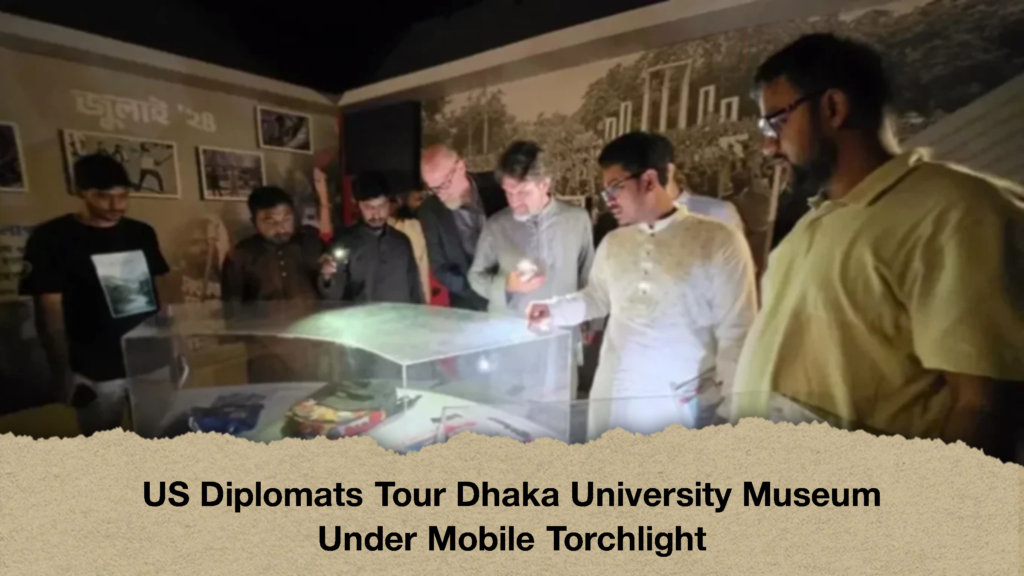
A visiting diplomatic delegation from the United States Embassy in Dhaka was compelled to inspect the July Museum at the Dhaka University Central Students’ Union (DUCSU) by mobile phone torchlight on Sunday, after a sudden power outage plunged the premises into total darkness. The interruption occurred moments after the American officials concluded formal bilateral discussions with campus student leaders inside the historic union building.
The delegation, comprising US Embassy Political Officer James A. Steward and Public Diplomacy Officer Scott Hartmann, met DUCSU Vice President Sadik Kayem before being escorted to the newly curated memorial hall. The exhibition space honours those who lost their lives during the July mass uprising, housing personal artefacts, clothing, and historic memorabilia belonging to prominent martyrs, including Abu Sayed, Mir Mahfuzur Rahman Mughdo, and Wasim Akram.
According to DUCSU executive committee member Mohammad Shahinur Rahman, the blackout commenced shortly after the tour got under way and persisted without interruption throughout the visit. Power had still not been restored when the diplomatic convoy prepared to depart. Rahman admitted that the sudden loss of electricity created a momentary sense of embarrassment for the student hosts, yet organizers swiftly adapted by switching on their mobile torches, guiding the diplomats through the darkened galleries and explaining the historical context behind each display.
Prior to the outage, the meeting between the diplomats and student representatives focused on higher education, professional skill-building, and international academic pathways for Dhaka University scholars. Key discussions centred on broadening access to competitive scholarship programmes across American universities, establishing institutional research partnerships, creating academic exchange opportunities, and expanding postgraduate fellowships for Bangladeshi applicants.
Sadik Kayem highlighted the need to streamline admission channels and expand financial assistance for gifted domestic students pursuing advanced qualifications in the United States. He proposed collaborative workshops, guidance seminars, and structured counselling sessions to assist prospective applicants with standardised testing, academic writing, and English proficiency. The student leadership also made the case for stronger institutional links with American academic and professional bodies to enhance career readiness among graduates.
The dialogue concluded with broader discussions on public diplomacy initiatives, youth leadership frameworks, and cross-cultural exchange between young people in both nations. Expressing optimism about future engagements, Kayem urged the US Embassy to expand its educational outreach programmes, ensuring that Bangladeshi students can take full advantage of emerging global academic networks.