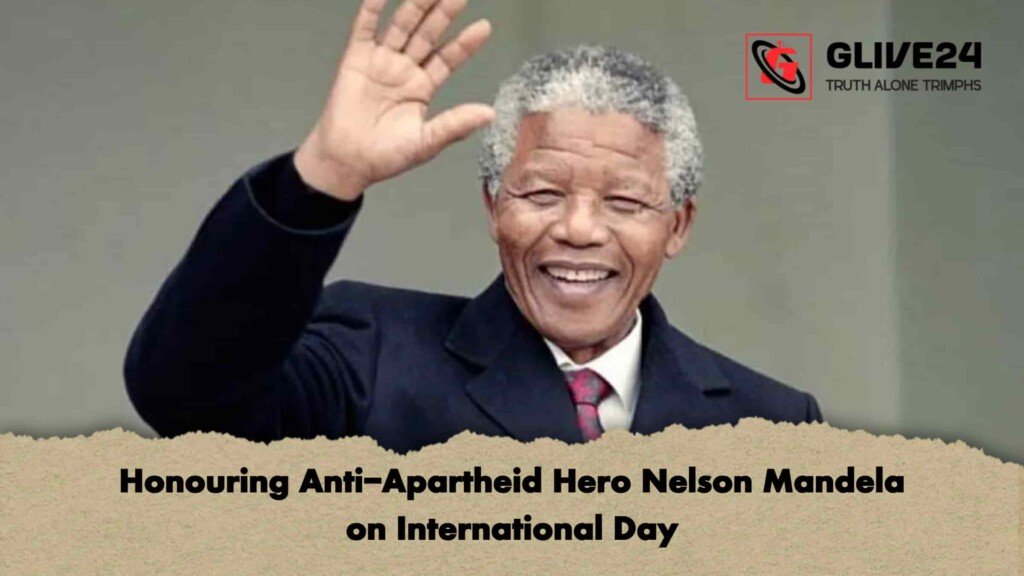
The enduring legacy of Nelson Rolihlahla Mandela, an iconic figure in the global struggle against racial oppression and a towering symbol of peace and reconciliation, is being celebrated worldwide. Born into the noble Thembu royal family on 18 July 1918 in the village of Mvezo, located in South Africa’s Eastern Cape province, Mandela’s life journey from a traditional rural upbringing to the global stage remains one of the most compelling narratives of the twentieth century. Each year, his birthday is formally observed across the globe as Nelson Mandela International Day, a day officially sanctioned by the United Nations to recognise his monumental contributions to human rights, democracy, and social justice.
Mandela’s intellectual and political awakening began during his higher education at the University of Fort Hare and the University of the Witwatersrand, where he studied law. He subsequently established South Africa’s first black-led law practice in Johannesburg alongside his trusted colleague Oliver Tambo. Despite the potential for a prosperous personal career, Mandela chose to dedicate his life to a far greater purpose: the liberation and restoration of dignity to millions of non-white South Africans systematically oppressed by the institutionalised regime of apartheid.
His political activism intensified in 1943 when he joined the African National Congress (ANC). Recognising the need for a more dynamic and assertive approach to combatting racial segregation, Mandela co-founded the ANC Youth League in 1944. As the white-minority government formalised apartheid legislation, Mandela became a central figure in organising non-violent mass protests, civil disobedience campaigns, and strikes. However, as the regime responded with increasing brutality, culminating in the Sharpeville massacre, Mandela concluded that peaceful protest alone would not suffice. He subsequently helped establish and lead Umkhonto we Sizwe (Spear of the Nation), the armed wing of the ANC, to mount an organised resistance against state-sponsored tyranny.
The state actively sought to suppress Mandela’s influence. In 1956, he was arrested alongside 150 other activists on charges of high treason. Although the protracted Treason Trial concluded after five years with the acquittal of all defendants, Mandela’s freedom was short-lived. In 1962, he was arrested again for leaving the country without permission and inciting workers to strike. Following the famous Rivonia Trial, in which Mandela delivered an unforgettable speech declaring he was prepared to die for the ideal of a democratic and free society, he was sentenced to life imprisonment in 1964.
Mandela endured 27 years of incarceration, spending 18 of those years under brutal conditions at the notorious Robben Island prison, followed by periods at Pollsmoor Prison and Victor Verster Prison. Rather than silencing him, his prolonged imprisonment transformed him into the world’s most significant political prisoner and a universal symbol of resilience against oppression.
On 11 February 1990, amidst mounting international pressure and escalating domestic unrest, Mandela was unconditionally released by President F.W. de Klerk. Rejecting calls for retribution, Mandela remarkably chose the path of forgiveness, peace, and national reconciliation. He led complex negotiations with the apartheid government to dismantle the segregationist framework and chart a peaceful transition to a multi-racial democracy. His extraordinary efforts culminated in the historic 1994 general election—the first in South Africa to grant universal suffrage to all racial groups.
The timeline below details the critical milestones of Nelson Mandela’s journey from his release to his enduring legacy.
Mandela is released from Victor Verster Prison after 27 years of confinement, advocating for peace and reconciliation.
Mandela and President F.W. de Klerk are jointly awarded the Nobel Peace Prize for their work to peacefully terminate the apartheid regime.
South Africa holds its first fully democratic election. Mandela is elected as the nation’s first black president.
Mandela steps down after serving a single presidential term, establishing a powerful precedent for democratic governance.
The United Nations officially observes the first Nelson Mandela International Day to promote global community service.
Mandela passes away at the age of 95 in Johannesburg, prompting widespread global mourning and tributes.
During his presidency from 1994 to 1999, Mandela prioritised national unity, effectively averting a widely feared racial civil war. He famously utilised the 1995 Rugby World Cup, hosted by South Africa, as a powerful vehicle to unite a fractured populace. His administration also established the Truth and Reconciliation Commission to investigate past human rights abuses, offering amnesty in exchange for full truth-telling—an unprecedented approach to national healing.
Mandela passed away on 5 December 2013 at the age of 95. His profound philosophy continues to echo across generations, reminding humanity that no one is born hating another person due to the colour of their skin, their background, or their religion. As the world reflects on his remarkable life, his message endures: true strength is found not in hatred or revenge, but in love, compassion, and the unwavering pursuit of equality.