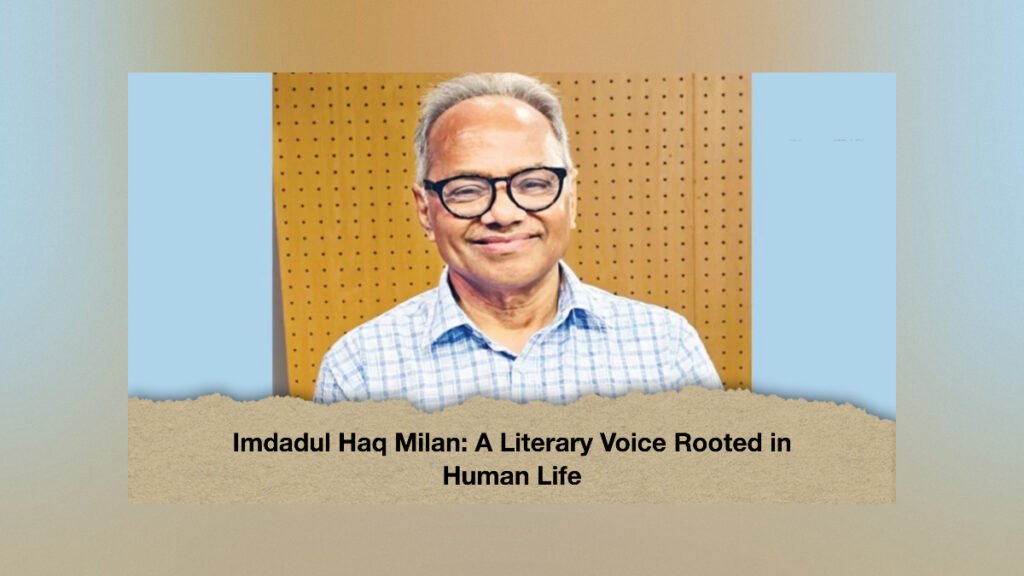
Imdadul Haq Milan has earned a distinctive place in Bangla literature through a long and varied career spanning fiction, novels, drama and journalism. Known for his accessible prose, memorable characters and close attention to ordinary human experience, he has remained one of Bangladesh’s widely read contemporary fiction writers.
Born on 8 September 1955 at his maternal grandparents’ home in Medinimandal village in Bikrampur, Milan was raised against a backdrop that brought him close to rural life and its people. His ancestral home is in Poisha village of Louhajang upazila in Munshiganj. His parents were Giasuddin Khan and Anwara Begum.
The experiences of his childhood and adolescence, particularly his observations of rural society, relationships and everyday struggles, later became recurring elements in his literary work. Rather than presenting distant or unfamiliar worlds, Milan has often drawn on situations and emotions that readers can recognise from their own lives.
An early beginning in children’s literature
Milan entered the literary world by writing for children and young readers. His early stories were published in the magazine Kishore Bangla. His literary career gained wider attention in 1977 when his story Sajani appeared in the weekly magazine Bichitra.
That publication marked an important stage in his emergence as a writer. He subsequently produced stories, novels, plays and other works in considerable numbers, gradually establishing a broad readership in Bangladesh and beyond.
From Banka Jal to Nurjahan
Milan’s literary output covers a wide range of subjects and settings. Among his notable books are Adhibas, Poradhinata, Kalakal, Banka Jal, Niranner Kal, Porobash, Kalo Ghora, Mati O Manusher Upakhyan, Por, Kemon Acho Shobujpata and Jibonpur.
His acclaimed novel Nurjahan received considerable attention among readers on both sides of Bengal. The work reflects several of the qualities associated with Milan’s fiction, including an emphasis on human relationships, emotional conflict and the realities of everyday life.
Various sources have put the number of his published books at more than 200, reflecting the scale of a literary career that has continued across several decades.
A defining feature of Milan’s writing is his focus on people and their personal circumstances. His characters experience love, separation, disappointment, hope, hardship and uncertainty. These are not merely narrative devices; they form the emotional foundation of many of his stories and help explain his enduring connection with readers.
A successful career as a dramatist
Milan has also made a significant contribution to Bangla television drama. He has written more than 150 plays, several of which became popular with television audiences.
Among his notable dramas are Kon Kanoner Phool, Baro Rokom Manush, Rupnagar, Yuboraj, Kothay Sejon, Alta, Ek Jona, Nilu, Tomakei, Chhoa Kodom, Anchal, Khuje Berai Tare, Kon Gramer Meye and Meyeti Ekhon Kothay Jabe.
His television work helped extend his reach beyond the traditional literary audience. Characters and stories created by him became familiar to viewers, strengthening his reputation as a writer whose work could move comfortably between the printed page and the television screen.
Journalism and editorial responsibilities
Alongside his literary activities, Milan has had a substantial career in journalism. He served in an editorial capacity at the Bangladeshi daily Kaler Kantho.
His work in journalism provided another platform through which he remained connected with contemporary society and public life. The combination of his literary and journalistic careers has given him a distinctive position within Bangladesh’s cultural and media landscape.
Major awards and recognition
Milan’s contribution to Bangla literature has been recognised through a number of major awards. Among the most significant are the Bangla Academy Literary Award in 1992, the Kazi Mahbubullah Award in 2018 and the Ekushey Padak in 2019.
The Bangla Academy’s official record lists Milan as a recipient of its Literary Award in 1992 for his overall contribution to literature. In 2019, he received the Ekushey Padak, one of Bangladesh’s highest civilian honours, in recognition of his contribution to Bangla language and literature.
These honours represent important milestones in a career that has extended across generations of readers.
A writer closely connected to ordinary lives
At the heart of Milan’s fiction is the human experience. His stories have explored love and loss, family relationships, rural communities, social pressures and the loneliness of urban life. Nature, rivers, villages and changing social conditions also frequently appear within the worlds he creates.
His appeal has partly rested on the familiarity of those worlds. Readers can recognise aspects of their own surroundings in his characters, whether they are confronting personal relationships, social expectations or the uncertainties of everyday existence.
Over the decades, Milan has built a body of work that reflects changing times while retaining a strong interest in the individual. His career also demonstrates the breadth of contemporary Bangla literary culture, where fiction, drama and journalism can intersect and reach audiences through different forms.
As Imdadul Haq Milan marks his birthday on 8 September, attention naturally returns to the long literary journey that has made him a familiar name to generations of Bangla readers. His contribution is reflected not only in the number of books and plays associated with his name, but also in the lasting familiarity of the people and situations portrayed in his work.
Imdadul Haq Milan at a glance
- Born: 8 September 1955
- Birthplace: Medinimandal, Bikrampur
- Ancestral home: Poisha village, Louhajang, Munshiganj
- Professions: Fiction writer, novelist, dramatist and journalist
- Early literary work: Children’s stories
- Breakthrough story: Sajani, published in 1977
- Notable novel: Nurjahan
- Other notable works: Adhibas, Poradhinata, Kalakal, Banka Jal, Niranner Kal, Porobash and Jibonpur
- Bangla Academy Literary Award: 1992
- Kazi Mahbubullah Award: 2018
- Ekushey Padak: 2019