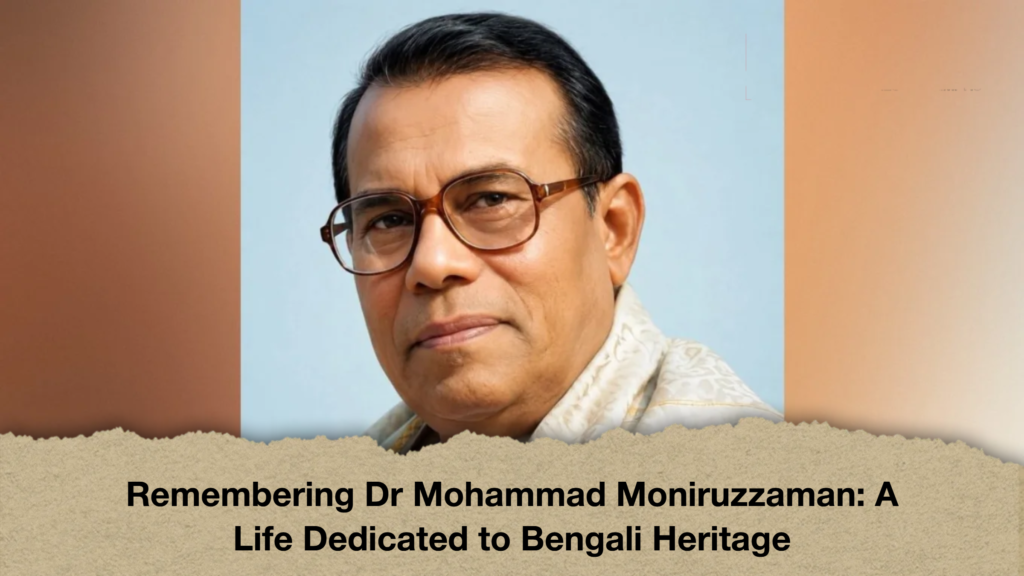
The cultural tapestry of Bengal is woven with the deep-rooted love for its soil, nature, and people—elements that defined the extraordinary life and legacy of Dr Mohammad Moniruzzaman. An eminent poet, literary critic, linguist, researcher, and academic, Moniruzzaman left an indelible mark on the Bengali intellectual landscape. His timeless patriotic song, “Amar Desher Matir Gandhe Bhore Ache Sara Mon”, immortalised by the melodious composition of Abdul Ahad, remains a timeless anthem echoing the collective heartbeat of the nation.
Born on 15 August 1936 in the Kharki Para neighbourhood of Jessore town, he was the eldest among eight siblings born to Mohammad Shahadat Ali and Rahela Khatun. His younger brother, Mohammad Rafiquzzaman, would also grow up to become a celebrated lyricist, establishing a remarkable literary lineage within the family. Young Mohammad demonstrated exceptional academic brilliance from an early age. He completed his Secondary School Certificate from Jessore Zilla School in 1953, followed by his Higher Secondary Certificate from Rajshahi Government College in 1955. He subsequently enrolled at the University of Dhaka, where he secured first-class honours in his bachelor’s and master’s degrees in Bengali language and literature in 1958 and 1959 respectively.
His professional journey commenced in 1959 when he joined the Department of Bengali at the University of Dhaka as a research fellow, transitioning into a lectureship by 1962. Balancing rigorous academia with creative output, he earned his PhD from the University of Dhaka in 1969 before pursuing post-doctoral research at the School of Oriental and African Studies at the University of London. By 1975, he attained professorship and later served as the chairman of the Bengali department, guiding generations of students. His administrative acumen also extended to the Bangla Academy, where he served as a member of the executive council.
Beyond academia, Moniruzzaman was a fiercely patriotic intellectual who stood firmly with the Bengali nationalist movement during the tumultuous days of 1971, enduring the wrath of the Pakistani military junta for his active participation in the non-cooperation movement. His creative genius flourished across multiple domains, including iconic cinematic compositions of the 1960s such as “Tumi Ki Dekhecho Kabhu Jiboner Parajoy” and “Holud Bato Mendi Bato”. In recognition of his profound contributions to national literature and culture, he was honoured with the prestigious Bangla Academy Literary Award in 1972 and the Ekushey Padak in 1987.
Survived by his wife Rashida Zaman and their children, Ruhina Hasmin Zaman Karim and Asif Zaman Shubh, the prolific writer breathed his last on 3 September 2008 at the age of seventy-two. Although physical existence is transient, the creative spirit of a true bard transcends mortality. Through his scholarly pursuits, poetry, and deeply moving patriotic melodies, Dr Mohammad Moniruzzaman continues to inspire successive generations across Bengal.