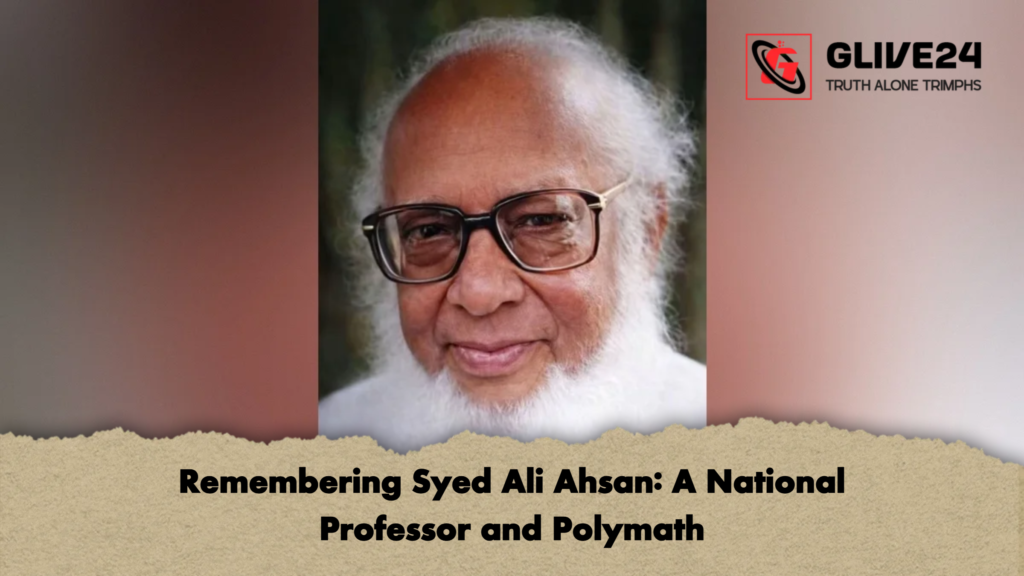
The profound impact of literature and culture on refining human intellect remains an undeniable truth—a truth vividly embodied in the life and works of National Professor Syed Ali Ahsan. As one of Bangladesh’s most distinguished scholars, intellectuals, and cultural icons, his contributions spanned poetry, literary criticism, academic leadership, and national policy. His legacy continues to serve as an enduring testament to the power of intellectual dedication.
Early Life and Family Heritage
Syed Ali Ahsan was born on 26 March 1920 in the village of Alokdia, situated in the Magura district of present-day Bangladesh. He was raised in an esteemed family with deep educational and spiritual roots. His father, Syed Ali Hamed, served as a dedicated school inspector, whilst his mother, Syeda Kamrunnesa Khatun, hailed from a prominent zamindar and pir family in Agla village, Nawabganj, Dhaka.
Growing up in an environment that deeply valued learning, he developed a passion for literature from an early age. During his student days, his sharp intellect and creative flair quickly drew attention. He became a regular contributor to leading literary journals of the era, including Azad, Masik Mohammadi, and Saogat, publishing poetry, short stories, and critical essays. Pursuing higher education at the University of Dhaka, he earned both his Bachelor’s and Master’s degrees in English literature with distinction.
Academic Leadership and Intellectual Movements
Syed Ali Ahsan’s career was defined by active civic participation and visionary institutional leadership. As a university student, he actively joined the anti-British independence movement. Following the partition of the subcontinent, he served as the founding General Secretary of the ‘Purba Pakistan Sahitya Sangsad’ (East Pakistan Literary Society), pioneering an intellectual movement that merged traditional Bengali folk literature (puthi) with Islamic cultural heritage.
His university teaching career began in 1949 when he joined the Department of Bengali at the University of Dhaka. In 1954, he was appointed Head of the Department of Bengali at the University of Karachi. Returning to East Pakistan, he served as the Director of Bangla Academy from 1960 to 1967, transforming it into a pivotal centre for linguistic research and cultural promotion. Subsequently, in 1967, he accepted a professorship at the University of Chittagong, where he also served as the Dean of the Faculty of Arts.
Role in the 1971 Liberation War
When the Bangladesh Liberation War erupted in March 1971, Syed Ali Ahsan crossed into India to support the cause of independence. Based in Kolkata throughout the nine-month conflict, he worked tirelessly to rally international opinion behind the Bangladeshi struggle. As a prominent contributor and orator for Shadhin Bangla Betar Kendra (Free Bengal Radio Centre), his sharp essays and inspiring broadcasts provided immense moral strength to freedom fighters and civilians alike.
Nation-Building and State Responsibilities
Following independence, Professor Ahsan played a pivotal role in establishing the academic and cultural infrastructure of the new nation. In 1972, he was appointed Vice-Chancellor of the newly established Jahangirnagar University, laying the foundation for its development into a premier seat of learning.
His intellect was repeatedly called upon for key state assignments. He led the finalisation of the official Bengali text of the Constitution of Bangladesh, rendered an acclaimed English translation of the National Anthem, and drafted the founding constitution of the Bangladesh Shilpakala Academy. He was also instrumental in merging the Bangla Development Board with Bangla Academy to streamline national cultural research.
On 27 September 1975, he assumed office as the Vice-Chancellor of Rajshahi University. Later, in 1977, he joined the President’s Advisory Council, taking charge of the Ministry of Education, Culture, Sports, and Religion. In 1989, the Government of Bangladesh honoured him with the title of National Professor, alongside appointing him Chairman of the University Grants Commission (UGC).
Major Works and State Recognition
As a prolific writer and scholar, Syed Ali Ahsan authored numerous seminal works covering poetry, literary analysis, and comparative literature. Amongst his notable publications are:
Nazrul Islam
Walt Whitman-er Kabita (Poems of Walt Whitman)
Padmavati (Critical Edition)
Rabindranath: Kabyabicharer Bhumika (Introduction to the Poetry of Tagore)
German Sahitya (German Literature)
Madhusudan: Kabya Kabi o Kabyadarsha (Madhusudan: Poetry, Poet, and Poetic Ideal)
Khabichitra: Bishwasahitya (Tales from World Literature)
Bangla Sahityer Itihas: Prachin Yug (History of Bengali Literature: Ancient Era)
Bangla Sahityer Itihas: Madhya Yug (History of Bengali Literature: Medieval Era)
Bangla Sahityer Itibritta: Adhunik Kal (Chronicles of Bengali Literature: Modern Era)
For his extraordinary contributions to Bengali language and literature, he received the country’s highest state honours, including the Bangla Academy Literary Award in 1967, the Ekushey Padak in 1983, and the Independence Day Award (Swadhinata Padak) in 1987.
Professor Syed Ali Ahsan passed away on 25 July 2002. His lifelong dedication to education, literature, and the service of his nation remains a guiding light for scholars and readers across the Bengali-speaking world.