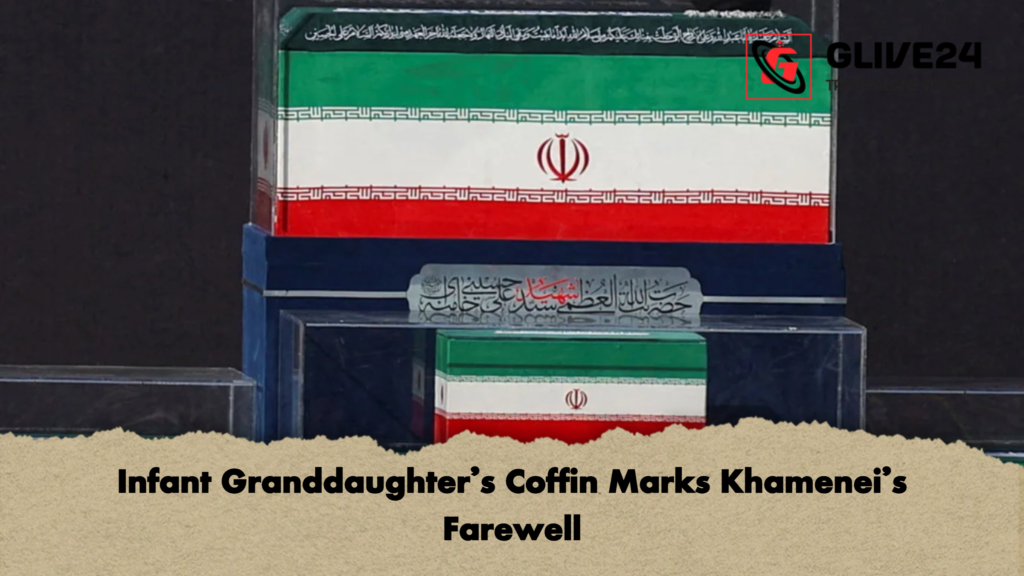
The state funeral of Iran’s late Supreme Leader, Ali Khamenei, began in Tehran on Saturday, drawing vast crowds of mourners as the country entered one of the most significant periods of national mourning in its recent history. Draped in the flag of the Islamic Republic of Iran, Khamenei’s coffin was brought into the funeral grounds with his familiar black turban placed on top, a symbol long associated with his religious and political leadership.
Alongside his coffin stood four others carrying the bodies of family members who were also killed. Among them, the smallest coffin drew particular attention. It belonged to his 14-month-old granddaughter, Zahra Mohammadi Golpayegani, whose death became one of the most poignant images of the funeral ceremony. All of the coffins were covered with Iran’s national flag.
The other family members laid to rest beside Khamenei included his son-in-law Mesbah-ul Huda Bagheri, his eldest daughter Seyyeda Bushra Hosseini Khamenei, and Zahra Haddad Adel, the wife of the current Supreme Leader Mojtaba Khamenei and daughter-in-law of the late leader.
According to the report, Ali Khamenei and several members of his family were killed in a joint military strike by the United States and Israel on 28 February. Since then, Iran has observed nationwide mourning, with thousands of people gathering across the country to pay their final respects.
As part of a six-day funeral programme, Khamenei’s body was transferred to Tehran on Friday. The schedule provides for his remains to be taken to several cities in Iran as well as neighbouring Iraq before his final burial, allowing people in different locations to participate in the farewell ceremonies.
Large numbers of supporters gathered outside Tehran’s Grand Mosalla from Friday night, hours before the venue opened to the public on Saturday morning. Officials said they expected between 15 and 20 million people to attend funeral events in Tehran over the following three days. Once the gates were opened, thousands entered the complex within a short period, filling the vast prayer grounds with mourners.
AFP reported that many participants carried red banners, widely recognised as symbols of demands for revenge. Chants including “Death to America” and “Revenge, revenge” echoed through the crowd as mourners paid tribute to the late leader.
One 27-year-old mourner described the occasion as unimaginable, saying he had come to bid farewell to the leader he admired and never expected to witness such a tragic day. He remarked that he wished he had never lived to see the loss.
Senior Iranian political and military figures also attended the ceremonies on Friday to honour the late Supreme Leader. Parliament Speaker Mohammad Bagher Ghalibaf, who has also served as one of Iran’s principal representatives in negotiations with the United States, was seen visibly emotional and in tears during the tribute.
Among the senior officials attending the funeral was Ahmad Vahidi, who was appointed commander of Iran’s Revolutionary Guard after his predecessor was killed in the same attack. India was represented at the ceremony by Syed Ata Hasnain and Pavitra Margarita.
The official funeral schedule states that Khamenei’s coffin will remain in Tehran until Monday, when a large funeral procession will take place across the capital. His body will then be transported to the holy city of Qom on Tuesday, followed by visits to sacred cities in neighbouring Iraq on Wednesday. The final burial is scheduled for Thursday in Mashhad, the city in north-eastern Iran where he will be laid to rest.
The funeral has become more than a farewell to a national leader. The deaths of several close family members, particularly the 14-month-old Zahra Mohammadi Golpayegani, have added a deeply personal dimension to the national mourning, making the ceremony one of the most emotionally charged state occasions witnessed in Iran in recent years.