
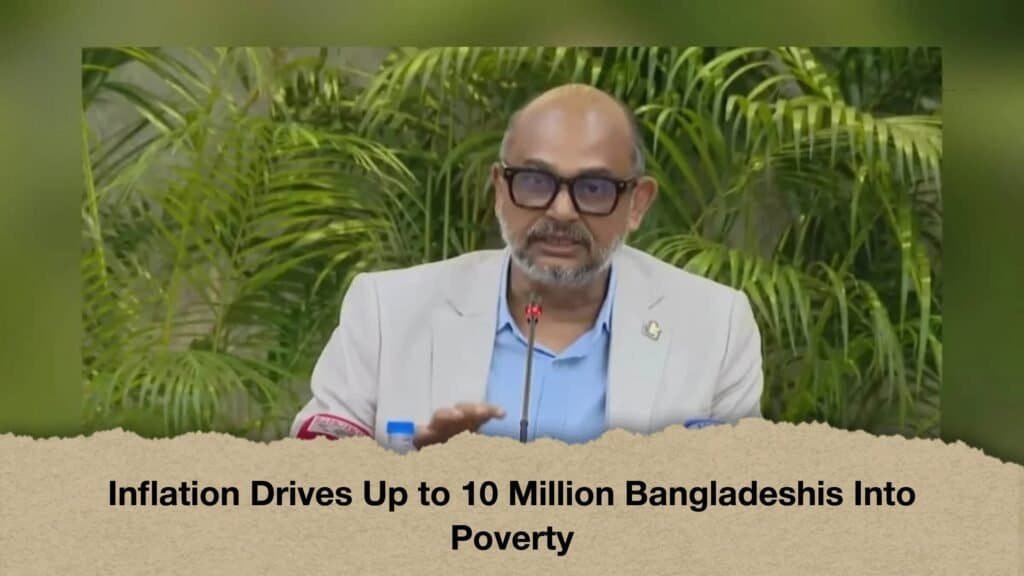
Referring to findings from a recent World Bank report, Titumir said persistent increases in living costs had placed enormous pressure on low- and middle-income households, while limited employment opportunities had further weakened their financial security.
He made the remarks on Wednesday (21 October) during a meeting with journalists organised by the district administration at Rajbari Municipality Auditorium. Rajbari District Council Administrator Abdus Salam Mia was also present.
Describing the country’s economic condition as fragile, Titumir said the government had inherited serious structural weaknesses and was working to address the challenges through social protection initiatives, financial reforms and measures to stimulate employment.
“We are going through a critical period. We have inherited a fragile economy. Prolonged inflation has placed enormous pressure, particularly on lower- and middle-income groups. According to estimates, between eight million and 10 million people have fallen below the poverty line,” he said.
The adviser explained that sustained price increases had eroded household purchasing power, making it increasingly difficult for families to meet everyday expenses. The impact has been particularly severe among people with limited or relatively fixed incomes.
He identified weak private-sector investment as another major concern, saying the lack of adequate investment had contributed to a worsening employment situation.
Young people and educated jobseekers were among those most affected, he said, stressing that unemployment within these groups had become a significant economic challenge.
The difficulties have been compounded by developments in the Middle East, where ongoing instability has contributed to higher energy prices and placed additional pressure on Bangladesh’s economy.
Rising energy costs can increase industrial production and transportation expenses, creating further challenges for businesses and consumers already struggling with inflation.
Family and Farmer Card Initiatives to Address Poverty
Titumir said the government was pursuing targeted social protection measures, including Family Cards and Farmer Cards, to support financially vulnerable households and agricultural communities.
He expressed hope that these initiatives would help reduce poverty and ease the economic difficulties facing ordinary citizens.
The programmes form part of the government’s proposed response to the deterioration in living standards caused by prolonged inflation and limited income opportunities.
According to the adviser, improving the financial position of vulnerable families would be essential to restoring economic stability at the household level.
Social protection measures can provide relief to people facing immediate financial difficulties, although their effectiveness depends on implementation and the ability to reach intended beneficiaries.
Titumir said the government expected the initiatives to contribute towards improving living conditions and reducing the burden on lower-income groups.
Discrepancies in GDP Estimates Raise Concerns
The adviser also addressed differences in Bangladesh’s gross domestic product (GDP) figures published by various organisations.
He acknowledged that economic estimates differed between institutions and alleged that misleading interpretations and distorted information were circulating on social media.
GDP is a key indicator of economic performance, measuring the value of goods and services produced within a country over a specified period.
Differences in statistical methods, reporting periods and economic forecasts can result in variations between estimates produced by different organisations.
Titumir’s remarks highlighted concerns about public interpretations of economic data at a time when Bangladesh is facing significant financial challenges.
Banking Sector Reforms May Require $40 Billion
Turning to the financial sector, Titumir said approximately $40 billion would be required to reform Bangladesh’s banking industry.
He presented the figure as an indication of the scale of the challenges confronting the sector and the need for substantial corrective measures.
The adviser accused the previous administration of allowing favouritism and patronage-based practices to damage various areas of the economy.
According to him, such practices contributed to weaknesses that now require structural reforms.
A stable banking system is crucial for supporting investment, facilitating business operations and maintaining confidence in financial institutions.
Weaknesses in the sector can restrict the availability of financing for businesses, potentially limiting industrial expansion and employment generation.
Titumir emphasised that banking reforms would need to be considered alongside broader efforts to improve the investment climate and strengthen the country’s economic foundations.
Energy Security Identified as Key to Economic Recovery
The adviser placed particular emphasis on energy security, describing reliable supplies of electricity and gas as essential for attracting investment and sustaining industrial activity.
He criticised previous governments for failing to take adequate steps towards domestic gas exploration and long-term energy planning.
Bangladesh has considerable opportunities to expand renewable energy generation, particularly through solar power, but these possibilities were not effectively utilised by the previous administration, he alleged.
Titumir said uninterrupted energy supplies to factories and commercial establishments were necessary to encourage new investment.
Energy shortages and uncertainty over supply can disrupt production, increase operating expenses and discourage businesses from expanding their activities.
For industries dependent on natural gas and electricity, dependable energy infrastructure is an important consideration when making long-term investment decisions.
The adviser argued that improving energy security would help create a more favourable environment for industrial growth and employment generation.
He also stressed the importance of strengthening domestic gas exploration and developing a sustainable energy strategy to address future demand.
Education Spending Targeted to Reach 5% of GDP
Addressing unemployment among educated young people, Titumir called for major changes to Bangladesh’s education system.
He said expanding employment opportunities would require a stronger emphasis on skills development and better preparation for the demands of the labour market.
The government was working to create jobs, but improving the capabilities of young workers was equally important, he added.
According to Titumir, the government plans to allocate 2 per cent of GDP to education, which he described as an unprecedented level of spending in the country’s history.
He said the allocation would gradually increase, with a target of reaching 5 per cent of GDP by 2030.
The proposed increase reflects the government’s stated intention to strengthen human capital and address weaknesses in the relationship between education and employment.
Titumir stressed that developing practical and professional skills was essential for reducing unemployment among educated young people.
Educational reform, he suggested, should focus on ensuring that students acquire knowledge and abilities relevant to available employment opportunities.
A workforce equipped with appropriate skills can contribute to higher productivity and improve the country’s capacity to attract investment.
The adviser linked improvements in education to Bangladesh’s wider economic recovery, arguing that sustainable growth would depend partly on the development of a capable and productive workforce.
Government Plans 151-Bed Hospitals at Upazila Level
Alongside education, Titumir identified healthcare development as another important priority.
He said building a skilled workforce would not be sufficient without ensuring that people had access to adequate healthcare and could maintain good health.
Referring to the historical development of healthcare infrastructure, the adviser said upazila health complexes had been equipped with 20 beds during the administration of former President Ziaur Rahman.
He added that their capacity was subsequently increased to 50 beds during the tenure of former Prime Minister Khaleda Zia.
The government is now undertaking an initiative to establish 151-bed hospitals at the upazila level, he announced.
Expanding hospital capacity at the local level could improve access to medical treatment, particularly for residents of rural communities who depend on public healthcare facilities.
The proposed expansion would represent a substantial increase in capacity compared with the 50-bed facilities described by the adviser.
Titumir emphasised that healthcare improvements were closely connected to economic development, as a healthier population could contribute more effectively to national productivity.
Economic Challenges Demand Broad-Based Reforms
During the meeting, Titumir outlined several interconnected challenges facing Bangladesh, including persistent inflation, rising poverty, unemployment, weaknesses in the banking system and uncertainty surrounding energy supplies.
He presented social protection programmes, investment promotion, education reform and healthcare expansion as important elements of the government’s response.
The adviser maintained that improving employment opportunities and strengthening support for vulnerable households would be essential to reversing the deterioration in living standards.
He also highlighted the need to address structural weaknesses inherited by the government, particularly in financial institutions and energy infrastructure.
The proposed initiatives span both immediate economic relief and longer-term development objectives, with particular attention to poverty reduction and human capital.
Titumir expressed optimism that programmes such as Family Cards and Farmer Cards, together with measures to encourage investment and create employment, could help ease the financial difficulties facing ordinary Bangladeshis.
His remarks reflected the considerable challenges confronting the country’s economy, where prolonged price pressures and limited job opportunities have placed millions of households at risk.
The effectiveness of the government’s proposed response will ultimately depend on how successfully its social protection measures, financial reforms and development plans are implemented.