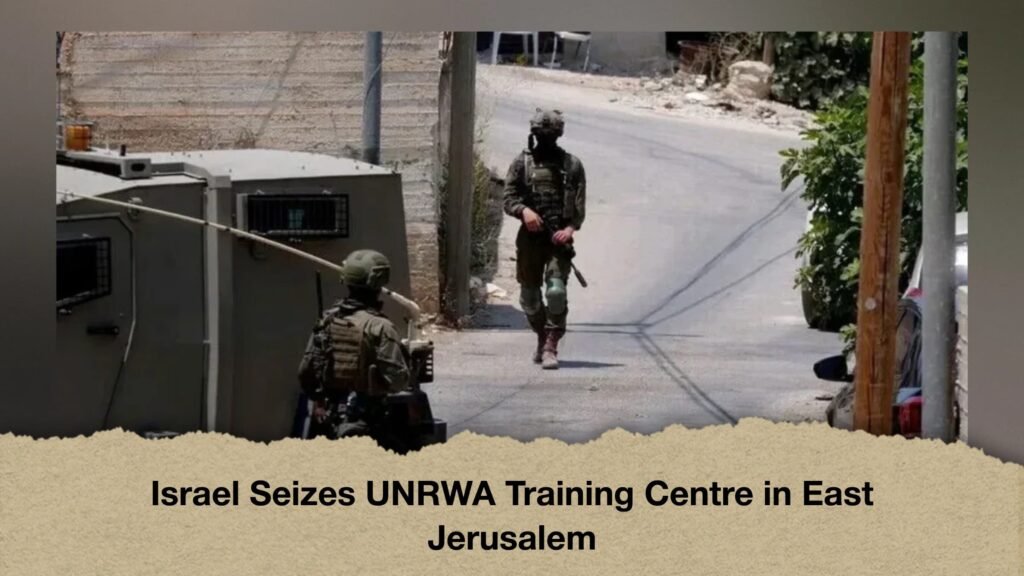
Israeli forces have taken control of a technical training centre operated by the United Nations Relief and Works Agency for Palestine Refugees in the Near East (UNRWA) in occupied East Jerusalem, escalating tensions surrounding the UN agency and its operations in Palestinian areas.
Israeli police and military personnel entered the Qalandia training centre on Tuesday morning with at least four armoured vehicles and more than 50 security officers, according to the information provided. The operation targeted one of UNRWA’s long-standing facilities for technical and vocational education.
Shortly after the operation, Israeli National Security Minister Itamar Ben-Gvir posted a photograph of the facility on X, formerly known as Twitter, and wrote: “UNRWA is now in our hands.” The statement came as Israeli authorities have continued to take a tougher position towards the UN agency and its activities in East Jerusalem.
The Qalandia training centre is regarded as one of UNRWA’s oldest technical education institutions. It has provided vocational training to Palestinian refugees and has been part of the agency’s broader efforts to improve access to education and employment opportunities.
UNRWA strongly condemned the Israeli forces’ entry into the facility, describing it as an unauthorised intrusion and seizure of a protected UN site. The agency called on the international community to intervene immediately to safeguard the integrity of its facilities in East Jerusalem, including the training centre.
The incident comes amid a wider dispute between Israel and UNRWA over the agency’s presence and operations. Israel has repeatedly accused UNRWA of failing to maintain sufficient distance from armed Palestinian groups, allegations that the agency has rejected while maintaining that its humanitarian and educational work is essential for Palestinian refugees.
UNRWA has for decades provided education, healthcare, relief and other essential services to millions of Palestinian refugees across the region. Its facilities have therefore remained central to the delivery of assistance, particularly during periods of conflict and severe humanitarian pressure.
The seizure of the Qalandia facility could have implications beyond the building itself. Technical and vocational training programmes are designed to equip young people with practical skills that can improve their prospects for employment. Any disruption to such programmes could affect students who depend on these opportunities.
Gaza authorities warn children against flying kites
Meanwhile, local authorities in Gaza have urged parents to prevent children from flying kites, following threats from Israeli leaders over kites, balloons and drones being sent towards Israel.
Local committees issued the warning after Israeli Prime Minister Benjamin Netanyahu said on Sunday that the launching of kites, balloons or drones towards Israeli territory must stop immediately. He warned that those responsible could be targeted for killing and that areas from which such objects were launched could be evacuated.
Israeli Defence Minister Israel Katz has repeated the warning, reinforcing the threat of military action against those involved.
Gaza authorities said their intention was not to restrict children’s childhood activities but to protect them from potential Israeli strikes. The warning reflects the heightened security concerns in areas where even seemingly harmless activities can become associated with military confrontation.
The use of kites and balloons in the Israel-Gaza conflict has previously been linked to attempts to cause fires and damage in areas near the Gaza border. Israeli authorities have treated such incidents as security threats, while Palestinians have frequently viewed the measures taken in response as adding to the pressure on civilians living in the densely populated territory.
The two developments underline the increasingly difficult environment facing Palestinians. In East Jerusalem, a UNRWA facility has been seized by Israeli forces, while in Gaza, parents are being advised to restrict a traditional childhood activity because of fears that children could be caught up in military retaliation.
For UNRWA, the latest incident also adds to the challenges surrounding its ability to maintain humanitarian and educational operations in areas where political and security tensions remain extremely high.