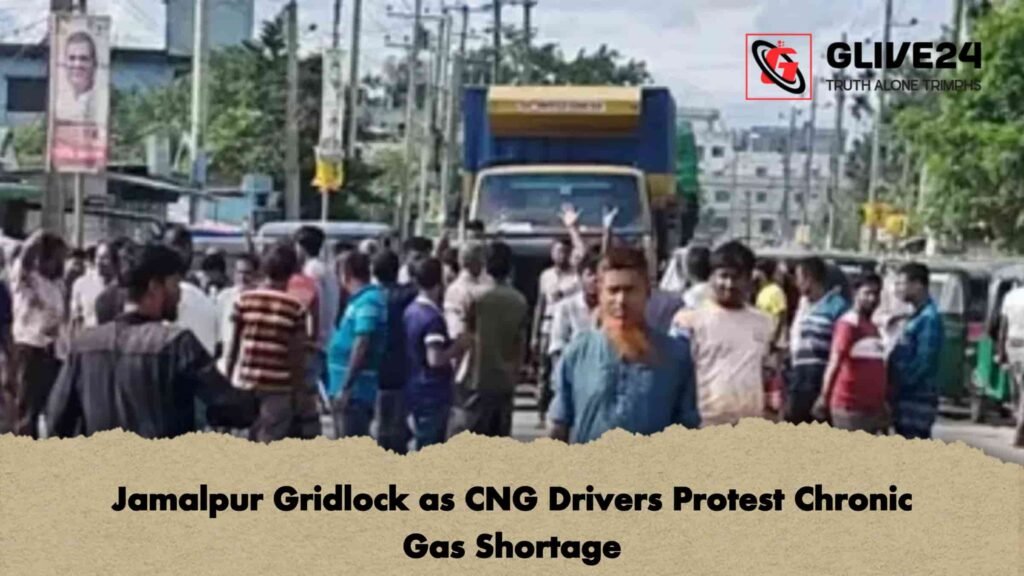
Commuters across Jamalpur faced severe disruption on Thursday morning after commercial compressed natural gas (CNG) auto-rickshaw drivers staged a major road blockade along the Jamalpur–Tangail highway, demanding an urgent expansion of local refuelling infrastructure and a lasting solution to recurring gas shortages.
The demonstration commenced at approximately 6:00 am, stranding hundreds of vehicles along the primary transit corridor connecting the district with neighbouring regions. Long queues of freight lorries, inter-district buses, and private vehicles formed on both sides of the highway as protesters refused to clear the carriageway, leaving daily commuters and passenger transport completely immobilised.
At the heart of the grievance is a critical imbalance between fuel supply points and the volume of commercial vehicles operating in the district. Protesting drivers pointed out that Jamalpur currently relies on just a single facility—the Jabed Filling Station—to serve the entire area’s CNG-powered public transport.
While official figures from the Bangladesh Road Transport Authority (BRTA) show around 3,000 registered CNG auto-rickshaws in the district, field estimates suggest that more than 5,000 vehicles, including those operating from adjacent areas, depend on this solitary refuelling outlet daily.
Driver Joynal Abedin expressed the frustration felt across the local transport community: “I joined the refuelling queue at 2:00 am, only to be told hours later that the supply had been exhausted. This is not a one-off occurrence; it is a routine ordeal. Expecting thousands of vehicles to rely on one station is simply impossible. When we spend half our working day queuing for gas, we cannot earn enough to sustain our families. We were left with no choice but to block the road until the authorities commit to approving new gas stations and fixing this crisis.”
This acute local deficit reflects a broader structural challenge within the national energy and transport sectors. While the adoption of compressed natural gas has been encouraged across Bangladesh as an economical and cleaner alternative to liquid fuels, regional distribution networks often struggle to maintain adequate pressure, leaving commercial transport workers particularly vulnerable to supply halts.
Local law enforcement authorities intervened to de-escalate the tension and clear the highway. Nazmus Sakib, Officer-in-Charge of Jamalpur Sadar Police Station, confirmed that police teams were deployed to the site to negotiate with the drivers. “The blockade was staged in response to the gas shortage and the absence of additional filling stations,” he noted. “Our officers are holding discussions with the demonstrators to address their concerns peacefully and restore order on the highway.”