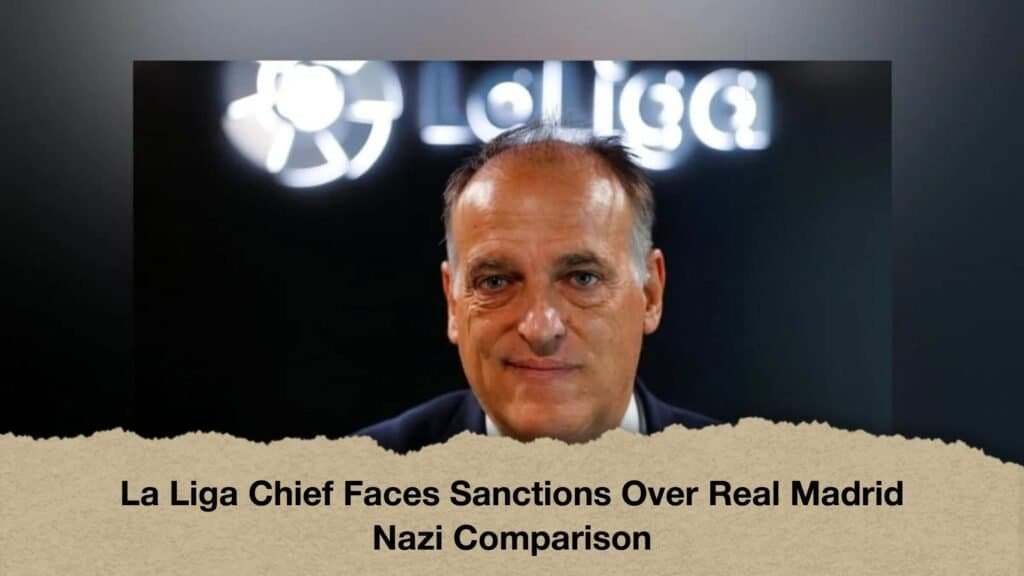
La Liga president Javier Tebas could face disciplinary action after comparing Real Madrid’s television broadcasts criticising referees to the propaganda methods employed by Joseph Goebbels, Nazi Germany’s propaganda minister. The controversial remarks have intensified tensions between the Spanish football authorities and one of the country’s most prominent clubs.
Spain’s National Sports Council (CSD) has referred the matter to the Administrative Tribunal for Sport (TAD), requesting an examination of whether Tebas breached regulations governing dignity, respect and appropriate conduct in sport.
The dispute follows months of growing frustration at Real Madrid over refereeing decisions in Spain’s top-flight competition. The club has repeatedly used its official television channel, Real Madrid TV, to scrutinise match officials, question controversial decisions and highlight what it considers inconsistencies in refereeing standards.
Tebas, who has frequently criticised the club’s approach to broadcasting, escalated the disagreement with comments published on social media on 16 October.
The 64-year-old football administrator accused Real Madrid of employing a coordinated communication strategy designed to undermine confidence in refereeing and influence public opinion.
In his post, Tebas claimed that Real Madrid maintained a network of spokespersons, with the club itself directing their activities.
He described its alleged strategy as selecting convenient examples, repeating insults, creating suspicion and publicly identifying perceived opponents.
Tebas then compared those methods to the propaganda techniques associated with Joseph Goebbels, a senior figure in Adolf Hitler’s Nazi regime.
The historical comparison immediately sparked controversy, given Goebbels’ central role in spreading Nazi ideology and manipulating public opinion through state-controlled propaganda.
Real Madrid responded strongly to the remarks, condemning the comparison and demanding Tebas’ immediate resignation as La Liga president.
The disagreement has since developed into a potential disciplinary case.
According to the CSD, Tebas’ comments could constitute a serious infringement under Article 76.4(b) of Spain’s Sports Law 10/1990, which addresses conduct considered incompatible with the dignity and decorum expected in sporting activities.
The council has asked the Administrative Tribunal for Sport to determine whether the remarks meet the legal threshold for disciplinary proceedings.
If a violation is established, Tebas could face sanctions ranging from a formal warning or financial penalty to a temporary suspension, depending on the applicable legal provisions and the tribunal’s findings.
No disciplinary punishment has been confirmed, and the referral does not itself establish that the La Liga president committed an offence.
Tebas, however, has rejected suggestions that his comments were intended as an insult to Real Madrid supporters or the club’s values.
In a subsequent statement, he defended his choice of language, arguing that the historical reference was intended to illustrate a particular propaganda technique rather than draw a broader comparison between the football club and Nazi ideology.
He also challenged what he described as an inconsistent response from Spain’s sporting authorities to the public statements made through Real Madrid’s official television channel.
Tebas questioned why the Ministry of Sport and the CSD had remained silent when Real Madrid TV allegedly portrayed the refereeing system as corrupt and suggested that the league championship was being stolen.
He argued that accusations of corruption and manipulation could themselves damage the integrity of Spanish football.
The La Liga president also raised concerns about the consequences such allegations might have for referees, participating clubs and millions of supporters.
His response suggested that sporting authorities should apply standards of respect and appropriate conduct consistently, regardless of whether criticism originates from a football club or a league official.
The dispute reflects a wider disagreement over the role of club-controlled media in Spanish football.
Real Madrid TV has become an increasingly prominent platform for the club’s criticism of refereeing decisions. Its coverage has frequently attracted attention beyond the club’s supporters, contributing to broader discussions about officiating standards, transparency and accountability.
Criticism of refereeing decisions is a familiar feature of professional football, particularly in competitions where individual decisions can influence league standings and championship outcomes.
However, the distinction between legitimate scrutiny and allegations that could undermine confidence in sporting institutions remains a sensitive issue.
For Real Madrid, public criticism of officiating is part of its broader effort to challenge decisions it considers unfair. Tebas, meanwhile, has argued that repeated accusations against referees risk damaging the credibility of the competition he oversees.
Their latest confrontation has moved beyond football administration into questions of legal responsibility and professional conduct.
The use of a comparison involving Nazi propaganda has added another dimension to the controversy, prompting scrutiny of the language employed by senior sporting officials when addressing disagreements with clubs.
The Administrative Tribunal for Sport will now be responsible for assessing the complaint and determining whether further disciplinary measures are justified.
Its findings could have significant implications for Tebas, particularly if the tribunal concludes that his public remarks violated the standards expected of a senior figure in Spanish football.
For now, the dispute remains unresolved. Real Madrid continues to challenge the La Liga president’s comments, while Tebas maintains that his criticism was directed at the club’s communication methods rather than its supporters or institutional identity.
The case has once again exposed the strained relationship between Real Madrid and La Liga’s leadership, raising wider questions about the boundaries of public criticism, institutional accountability and respect within Spanish football.