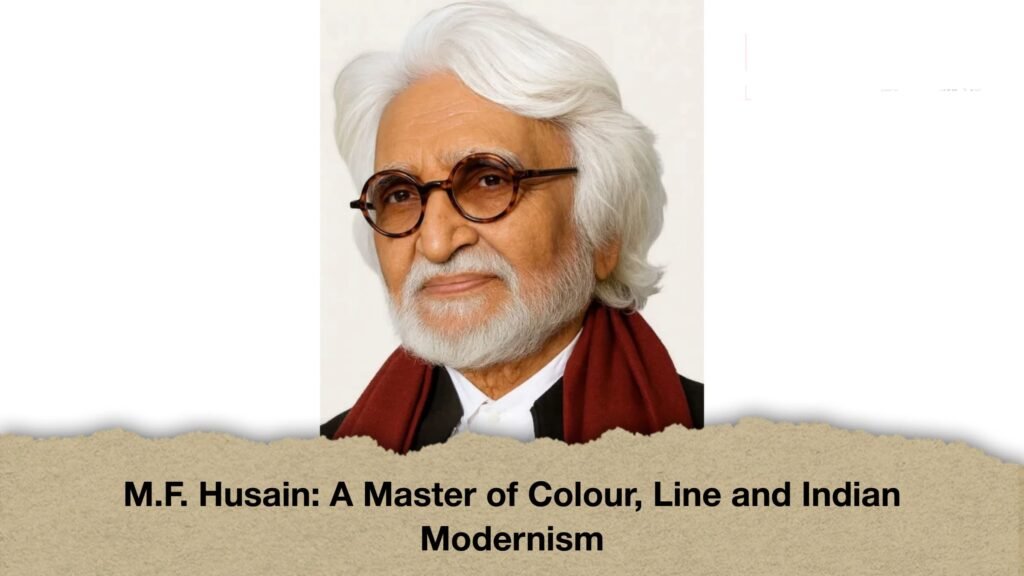
Maqbool Fida Husain, widely known as M.F. Husain, occupies a distinctive place in the history of modern Indian art. Through bold lines, vivid colours and energetic forms, he transformed scenes from Indian life, mythology, history and popular culture into a visual language that gained international recognition.
Born on 17 September 1915 in Pandharpur, Maharashtra, Husain lost his mother at an early age. He later grew up in Indore, where his interest in art gradually developed. Unlike many artists of his generation, he did not build his career through a conventional course of formal art education. Much of his artistic identity emerged through observation, practice, experimentation and years of working with images in different forms.
Husain moved to Bombay, now Mumbai, where he initially made a living by painting cinema posters and large billboards. The work demanded speed, confidence and an ability to create striking images on a very large scale. These early experiences became an important part of his development as an artist. The sweeping lines and simplified, forceful forms that later became associated with his paintings reflected his ability to communicate visually with remarkable economy.
His artistic subjects were wide-ranging. Everyday people, urban life, rural settings, women, horses and scenes from India’s cultural traditions repeatedly appeared in his work. He also painted figures such as Mahatma Gandhi and Mother Teresa, while episodes and characters from the Ramayana and Mahabharata provided recurring inspiration.
Rather than attempting to reproduce the world exactly as it appeared, Husain interpreted it through his own imagination. His paintings often relied on simplified forms, vigorous outlines and strong blocks of colour. Movement was another important element, particularly in his depictions of horses, which became among the most recognisable motifs associated with his work.
A major chapter in Husain’s career began in 1947, when he became one of the founding members of the Bombay Progressive Artists’ Group. The group was formed during a period when Indian artists were exploring new approaches to modern art. Its members sought to move beyond established conventions and develop forms of expression that could engage with both India’s artistic traditions and the changing international art scene.
Husain’s work reflected this tension between tradition and modernity. Influences from modern Western art appeared alongside Indian folk traditions, mythology, historical memories and contemporary social life. This combination helped establish a visual identity that was distinctly his own.
His creative interests extended beyond painting. In 1967, Husain made Through the Eyes of a Painter, a short film that was screened at the Berlin International Film Festival. The film won the Golden Bear in the short-film category, marking an important achievement in his career and demonstrating his interest in visual storytelling beyond the canvas.
Cinema remained a recurring influence throughout his life. Having started his career painting film posters, Husain maintained a fascination with Indian popular culture. He was also famously captivated by Bollywood actress Madhuri Dixit. It was widely reported that he watched Hum Aapke Hain Koun..! several times and admired Dixit’s appearance and screen presence. His interest in the actress later became a notable part of the public story surrounding the artist.
Husain’s career was not without controversy. Some of his paintings became the focus of intense disputes in India, leading to legal challenges and threats. He subsequently spent extended periods outside the country. In 2006, he began living in Qatar and became a Qatari citizen in 2010. The controversies surrounding his work contributed to wider debates over artistic freedom, religious sentiment and the limits of expression.
Despite those disputes, Husain received some of India’s highest civilian honours for his contribution to the arts. He was awarded the Padma Shri, Padma Bhushan and Padma Vibhushan. His reputation also extended well beyond India, with his works being exhibited and held in museums, galleries and private collections internationally.
Husain died on 9 June 2011 at the age of 95 in a London hospital. By then, he had spent decades establishing himself as one of the most recognisable figures in Indian modernism.
His journey from painting cinema billboards to achieving international acclaim was unconventional. It was also deeply connected to his ability to find artistic possibilities in subjects that surrounded him. Indian mythology, historical figures, ordinary people, cinema and the movement of horses could all become material for his distinctive visual language.
His paintings were rarely about simply reproducing an image. Instead, they reflected an interpretation of the world through colour, line and form. That approach allowed familiar subjects to appear unfamiliar, encouraging viewers to look at them from a different perspective.
Years after his death, M.F. Husain remains an important figure in discussions about modern Indian art. His work continues to be examined for its treatment of Indian culture, modernism and visual expression, while the controversies surrounding some of his paintings remain part of the wider history of his career.
Husain’s legacy ultimately rests on a lifetime of experimentation. He crossed boundaries between fine art and popular culture, painting and cinema, tradition and modernity. His colours and lines gave familiar subjects a new visual identity, ensuring that his name would remain closely associated with the evolution of modern Indian painting.
On the anniversary of his death, M.F. Husain is remembered as an artist who built a highly individual language from colour, movement and form. His life may have ended in 2011, but the paintings he left behind continue to occupy a lasting place in the story of Indian art.