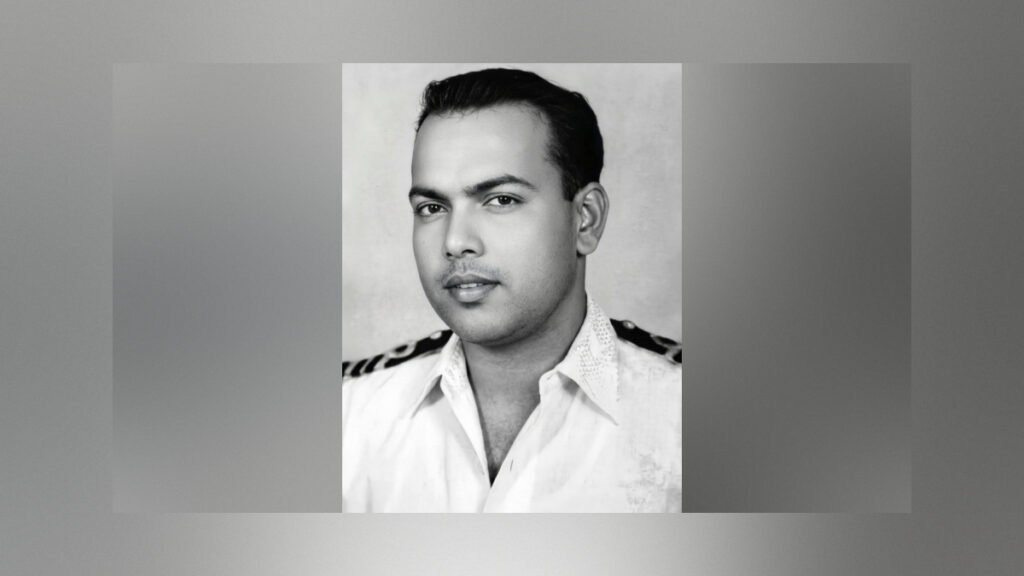
18 September marks the birth anniversary of Shaheed Lieutenant Commander Moazzem Hossain, a naval officer whose life became closely associated with the struggle for Bengali rights and the movement for independence. An accused in the historic Agartala Conspiracy Case and later a martyr of the 1971 Liberation War, Hossain remains remembered for his courage, political commitment and sacrifice.
Born in 1933 in Dumuritola village of Pirojpur district, Moazzem Hossain grew up in a family where public service was part of his early environment. His father, Mofazzel Ali, was a government official, while his mother was Latifunnesa Begum.
Hossain completed his matriculation from Kachua High School in Bagerhat in 1947 and subsequently enrolled at Bagerhat College. He later studied for the Intermediate in Science (ISC) at the historic Brajamohan College in Barishal. In 1950, while still pursuing his studies, he joined the Pakistan Navy.
The same year, he received training under the Royal Navy. After completing his training, he was commissioned into the Pakistan Navy. He later pursued higher studies in mechanical and marine engineering, developing professional expertise that helped him take on important responsibilities within the naval service. He was promoted to the rank of lieutenant commander in 1967.
Arrest and the Agartala Conspiracy Case
As political and economic discrimination against Bengalis deepened under Pakistani rule, Hossain became increasingly involved in efforts connected with Bengali political rights and self-determination. He was accused of attempting to organise Bengali personnel serving in the armed forces and of maintaining contacts with others involved in plans associated with the independence of East Pakistan.
On 9 December 1967, a team from Pakistan’s military intelligence authorities arrested him under the Pakistan Defence of Pakistan Rules.
In 1968, the Pakistani government established a special tribunal to prosecute a case formally styled State versus Sheikh Mujibur Rahman and Others. It subsequently became widely known as the Agartala Conspiracy Case.
There were 35 accused in the case. Sheikh Mujibur Rahman was named as the first accused, while Lieutenant Commander Moazzem Hossain was the second. The allegations against Hossain included organising Bengali members of the navy with the objective of pursuing independence for East Pakistan and communicating with military and civilian figures in connection with the alleged plan.
The case became a major political issue in what was then East Pakistan. Public opposition to the proceedings helped turn the wider autonomy movement into a broader mass mobilisation. Amid the intense political upheaval of 1969, the Pakistani authorities withdrew the case on 22 February, leading to the release of Sheikh Mujibur Rahman and all the other accused.
Following his release, Hossain returned to the Pakistan Navy. His involvement in the country’s political struggle, however, did not end there.
From Military Service to Political Activism
Hossain retired from the navy on 18 March 1970. After leaving military service, he became directly involved in political activity and continued to advocate the establishment of an independent state based on the Lahore Resolution.
On 24 March 1970, he announced a movement aimed at establishing an independent state on the basis of the Lahore Resolution. Four days later, on 28 March, he formed the Lahore Resolution Implementation Committee. The organisation was subsequently developed into a nationalist political platform.
The political situation in East Pakistan deteriorated rapidly in March 1971 as the non-cooperation movement intensified. Hossain remained active during this period, seeking to organise public support in different districts. He also instructed political workers associated with his movement to receive military training.
For Hossain, the political crisis had moved beyond the question of administrative or constitutional reform. His activities increasingly centred on Bengali freedom, political self-determination and national dignity.
Killed at the Beginning of the Liberation War
The situation changed dramatically on the night of 25 March 1971, when the Pakistan Army launched a major military crackdown in East Pakistan. The operation targeted civilians as well as people associated with the Bengali political movement, triggering widespread violence across Dhaka and other areas.
On the morning of 26 March, a group of Pakistani soldiers led by Colonel Taj entered Hossain’s residence in Dhaka and shot him dead.
His death came at the very beginning of Bangladesh’s Liberation War. Hossain, who had once served as an officer of the Pakistan Navy, was killed by the forces of the state he had served after becoming associated with the struggle for Bengali independence.
His death therefore became part of the wider human cost of the conflict that followed the military crackdown. His journey from a professional naval officer to an accused figure in the Agartala case, and later an active participant in the political movement for independence, reflects the dramatic transformation experienced by many Bengalis during the final years of Pakistan’s rule.
Remembered Through National Honours
Efforts were later made to preserve Moazzem Hossain’s memory through national institutions and commemorative measures.
On 16 January 1976, a Bangladesh Navy training establishment in Rangamati was named BNS Shaheed Moazzem in his honour. A commemorative postage stamp bearing his name was issued on 14 December 1993. A road in Dhaka was also named after him.
In 2012, the Government of Bangladesh posthumously awarded him the Independence Award, one of the country’s highest civilian honours.
In his personal life, Hossain was the elder brother of Raj, a well-known film villain. His historical significance, however, extends far beyond his family connections. He is remembered primarily as a naval officer, an accused in the Agartala Conspiracy Case, a political organiser associated with the independence movement and a martyr of the Liberation War.
A Lasting Place in Bangladesh’s History
Lieutenant Commander Moazzem Hossain’s life unfolded during one of the most turbulent periods in the history of the Bengali people. His military career, arrest in the Agartala case, return to naval service, subsequent political involvement and death in March 1971 form a distinctive chapter in the country’s journey towards independence.
His story also illustrates the changing political consciousness among sections of Bengali personnel serving in Pakistan’s armed forces during the years preceding the Liberation War. What began as a military career ultimately became intertwined with the broader struggle over political rights, self-determination and independence.
On his birth anniversary, Moazzem Hossain is remembered with respect for the role he played in that turbulent period and for the life he lost at the dawn of Bangladesh’s struggle for independence. His memory remains associated with the sacrifices made by those who became involved in the movement for Bengali freedom and ultimately paid the highest price.