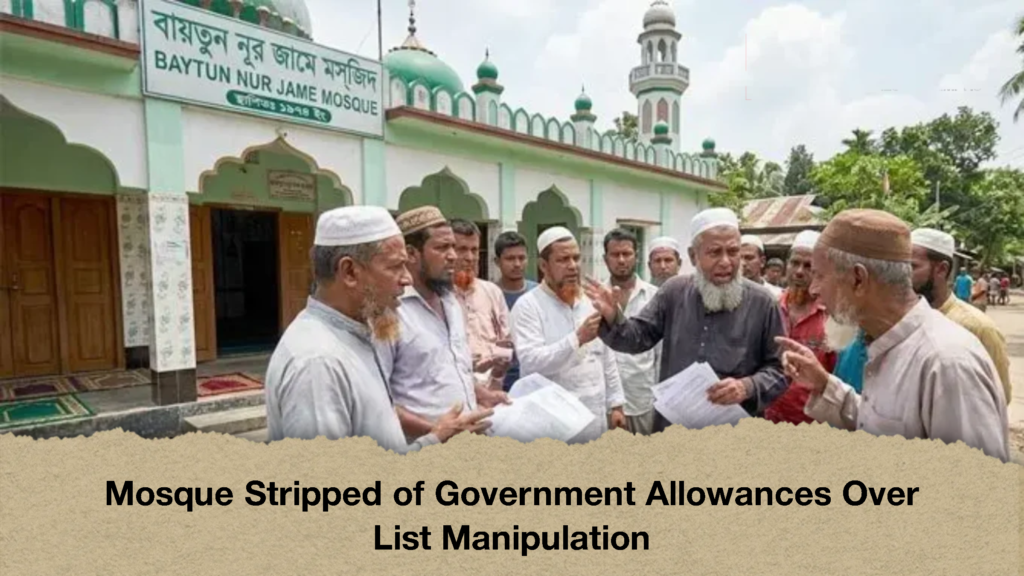
A state stipend initiative designed to support grassroots Islamic religious workers has triggered widespread local outrage in Keshabpur, Jashore, after political figures were improperly listed as beneficiaries in place of genuine mosque personnel. The controversy emerged at the Garbhanga Baitun Nur Jame Mosque in Panjia Union, culminating in the complete removal of the establishment from the government welfare roster following official intervention.
The scheme, overseen nationwide by the Ministry of Religious Affairs, provides dedicated monthly financial allowances of 5,000 taka for Imams, 3,000 taka for Muezzins, and 2,000 taka for Khadems (caretakers). During the initial phase across Keshabpur Upazila, authorities sought candidate selections covering 15 mosques per union. Under local distribution quotas, Bangladesh Nationalist Party representatives were allocated eight mosque selections per union, while the remaining seven—amounting to 77 mosques across the upazila—were assigned through the constituency’s Member of Parliament.
Discontent erupted in Panjia Union when community members reviewed the submitted candidate list for Garbhanga Baitun Nur Jame Mosque. The establishment’s longtime Imam, Maulana Abdul Rahman, and its serving Khadem, Abdul Razzak, were absent from the roster. Instead, political party functionaries were registered under fraudulent designations: mosque committee cashier and local party figure Tobibur Rahman was named as the “Imam”, while ward party president Abdul Mutaleb Molla appeared as the “Khadem”.
Outraged worshippers and local residents lodged a formal written complaint with the Member of Parliament for Jashore-6. The lawmaker instructed Panjia Union party leader Masud Kamal to inspect the matter and correct the documentation.
Local residents maintained that no meaningful inquiry was carried out and that the falsified list was forwarded to administrative offices unchanged. Mosque committee president Islam Sardar strongly condemned the incident, explaining that executive members were left entirely uninformed during the drafting process and only discovered the manipulation after the names were submitted.
In response to the accusations, Masud Kamal maintained his innocence, claiming he served only as a liaison who forwarded the paperwork provided by the mosque committee without altering its contents.
Reviewing the dispute, Jashore-6 Member of Parliament Professor Moktar Ali explained that administrative inquiries revealed entrenched factional disputes within the local management structure. To maintain institutional fairness and prevent escalating friction, authorities withdrew Garbhanga Baitun Nur Jame Mosque entirely from the government honourarium programme.