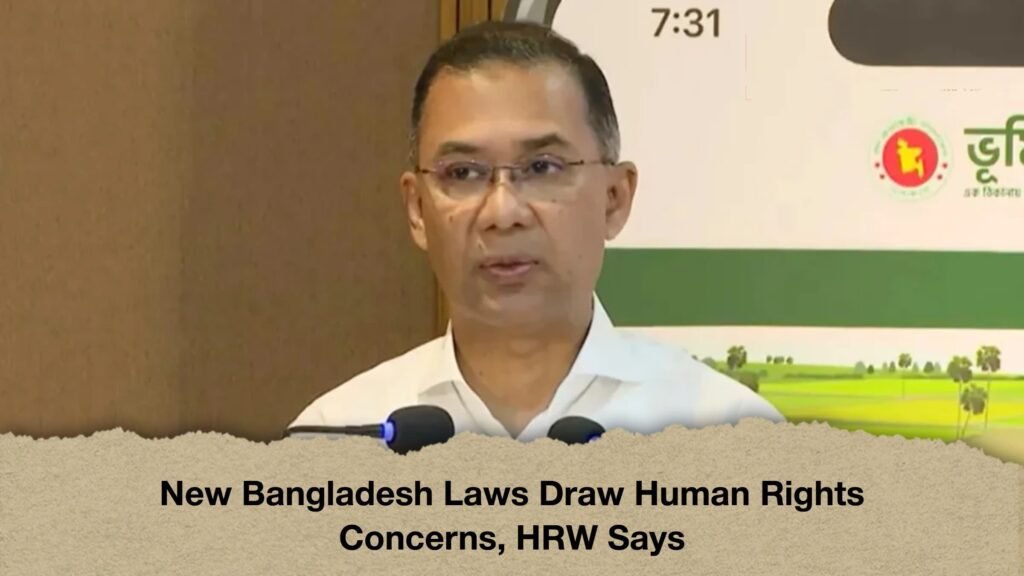
Three laws approved by Bangladesh’s parliament in September have weakened existing human rights safeguards and rolled back reforms introduced during the country’s interim administration, Human Rights Watch (HRW) said on 23 September.
The international rights organisation said the measures risk reducing the ability of state institutions to prevent and investigate serious abuses, including enforced disappearances, extrajudicial killings and other violations. HRW also said the legislation marked a retreat from reform commitments made by the ruling Bangladesh Nationalist Party (BNP) government.
The criticism focuses primarily on changes to the National Human Rights Commission (NHRC), a new legal framework for investigating enforced disappearances, and the replacement of the Rapid Action Battalion (RAB) with a new force called the Special Response Battalion (SRB).
Changes to the National Human Rights Commission
According to HRW, the interim government that governed Bangladesh from August 2024 to February 2026 introduced two ordinances intended to strengthen the NHRC. The measures expanded the commission’s powers to investigate allegations involving security agencies and created a National Preventive Mechanism to inspect and monitor places of detention.
The reforms also sought to make the commission’s appointment process, staffing and funding arrangements more independent. HRW had previously urged the new BNP-led government to retain and strengthen those safeguards rather than allow the ordinances to lapse.
The government ultimately allowed the ordinances to lapse and introduced new legislation. HRW says the law passed on 6 September does not allow the NHRC to directly investigate alleged rights violations by security forces as broadly as the earlier framework permitted. Instead, the commission is generally required to request a report from the agency facing the allegation.
The organisation also raised concerns about the appointment process for commissioners, as well as the commission’s budgetary and administrative independence. In HRW’s assessment, the new framework does not adequately meet international standards for national human rights institutions, known as the Paris Principles.
Enforced disappearance law changes accountability rules
Another major concern relates to the Enforced Disappearance Prevention and Redress Act, which parliament passed on 6 September.
HRW said an earlier interim-government ordinance had given the NHRC authority to investigate allegations of enforced disappearance and to monitor and inspect detention facilities, including locations suspected of being used for secret detention. Those powers have been removed or reduced under the new legislation, according to the organisation.
The law has also changed the standard for establishing command responsibility. Under the earlier framework, an officer could potentially be held responsible where they knew, or should have known, about a violation and had the ability to prevent it, reflecting standards based on the Rome Statute of the International Criminal Court.
Under the new law, HRW says evidence of a direct order is required to establish responsibility against a commanding officer for an enforced disappearance. The organisation argues that this could make it harder to establish accountability higher up the chain of command.
RAB replaced by Special Response Battalion
The third major issue raised by HRW concerns the restructuring of Bangladesh’s elite law-enforcement force.
Parliament passed the Special Response Battalion Bill on 10 September, paving the way for the abolition of RAB and the creation of the SRB under Bangladesh Police. The government formally brought the new arrangement into effect on 16 September through a gazette notification.
Under the new law, RAB’s personnel, powers, facilities, funds, property and records were transferred to the SRB. HRW therefore argues that the change does not go far enough to address the accountability concerns associated with RAB.
The organisation also pointed out that the new force initially retained the same basic logo, with ‘RAB’ replaced by ‘SRB’. SRB officials have since said that changes to the logo, flag, monogram and uniform are being processed and will be implemented after government approval.
The government has presented the SRB as a new specialised police unit. The Home Ministry has argued that the new force will operate under a separate legal framework, while officials have stressed the importance of professionalism, transparency and accountability.
Questions over the force’s legacy
The transition is particularly significant because RAB has faced years of allegations involving extrajudicial killings, enforced disappearances and other serious human rights violations.
The United States imposed sanctions on RAB in 2021 over serious human rights concerns. HRW said seven former senior officers of the force have also been placed under targeted US sanctions, while several former RAB members are facing proceedings before Bangladesh’s International Crimes Tribunal over alleged crimes against humanity, including enforced disappearance.
The new legislation has prompted different responses inside Bangladesh. Opposition lawmakers have argued that transferring RAB’s personnel and resources to the SRB risks creating essentially the same force under a different name. The government, however, has maintained that RAB has been abolished and replaced by a new specialised unit.
A parliamentary committee that reviewed the SRB legislation also stressed the need for proper training, professionalism, transparency and accountability among members of the new force.
HRW calls for stronger safeguards
HRW’s Asia director, Elaine Pearson, said Bangladesh needs genuine security-sector reform and an independent human rights institution with sufficient authority to investigate allegations of abuse if it is to prevent a recurrence of past violations.
She also warned that shielding security forces from effective scrutiny and accountability would not help build public confidence that killings and enforced disappearances would not return.
The organisation’s concerns are rooted partly in Bangladesh’s record between 2009 and 2024, when the Awami League government was in power. HRW has documented allegations against law-enforcement agencies involving extrajudicial killings, enforced disappearances, arbitrary arrests and excessive force against protesters during that period.
HRW’s latest assessment argues that changing the name or administrative structure of a security force is not, by itself, sufficient to address past abuses. It has called for rigorous human rights vetting of personnel, independent external oversight, safeguards governing arrest and detention, preservation of records and evidence, and clear mechanisms for accountability under the SRB.
The organisation has also urged Bangladesh’s international partners to press the government to incorporate strong human rights protections into the rules that will govern the SRB. It has called for continued scrutiny of the renamed force until adequate measures are in place to address past violations and ensure accountability.
At the centre of the debate is whether Bangladesh’s new legal and security framework will provide sufficiently independent checks on state institutions. HRW’s position is that stronger investigative powers, independent oversight and clear accountability mechanisms are essential to prevent serious abuses from recurring.