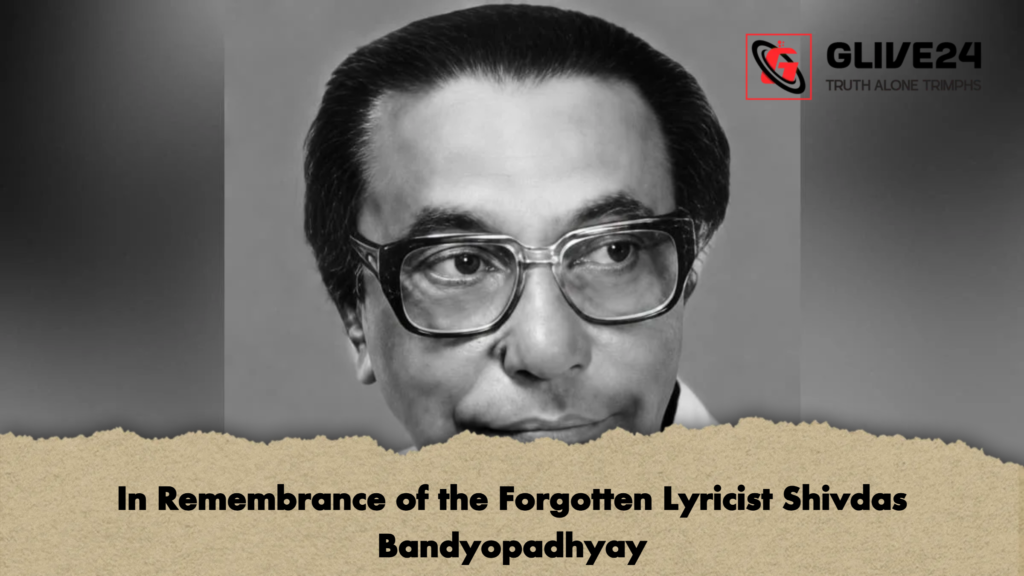
In the vast history of Bengali music, certain names gradually fade into the shadows of time while their artistic creations continue to resonate deeply across generations. People sing their compositions, weep to their poignant melodies, and pass their words down through decades, often without knowing the identity of the genius who penned them. Shivdas Bandyopadhyay remains one of the most prolific yet tragic examples of such a forgotten literary titan.
Born on 27 December 1932 in Khulna, Bandyopadhyay grew up in a household shaped by both civic duty and revolutionary fervor. His father, Sachigopal Bandyopadhyay, served as a police officer, whilst his mother, Radharani Devi, actively participated in the anti-colonial Swadeshi movement. His early schooling commenced in Khulna, but the turmoil of the 1947 Partition completely upended his life. Forced to flee communal violence, his family abandoned their ancestral home and sought refuge in Kolkata as destitute migrants.
Settling in South Kolkata at the residence of his sister, the essayist and photographer Shivani Chattopadhyay, Bandyopadhyay refused to let hardship derail his ambitions. He earned a degree from Asutosh College and subsequently took up a modest, low-paying teaching job at Khanpur School. Encouraged by his sister, he began publishing literary pieces in prestigious periodicals including Desh, Basumati, and the Sunday supplement of Anandabazar Patrika. The sociopolitical upheavals spanning the 1940s to the 1960s heavily influenced his artistic sensibility.
His musical journey gathered momentum after meeting the celebrated composer Aparesh Lahiri, who invited him to write for the cultural group Kranti Shilpi Sangha. Shortly thereafter, an encounter with poet and filmmaker Premendra Mitra helped him secure enlistment as an official lyricist for All India Radio.
Over the ensuing decades, Bandyopadhyay authored songs that defined an era. Legendary musical icons including Lata Mangeshkar, Kishore Kumar, Manna Dey, Bhupen Hazarika, Sandhya Mukhopadhyay, Runa Laila, Ruma Guha Thakurta, Ila Basu, and Angshuman Roy brought his verses to life. Iconic compositions such as Ami Ek Jajabor, Bistirno Dupare, Dola He Dola, Sobar Hridoye Rabindranath, Chetonay Nazrul, and the timeless humanitarian anthem Manush Manusher Jonno all flowed from his pen. Moved by the 1971 Bangladesh Liberation War, he also authored Ganga Amar Ma, Padma Amar Ma, beautifully rendered by Bhupen Hazarika to unite the shared heritage of Bengal.
Despite his immense artistic contribution, Bandyopadhyay faced lifelong neglect and severe financial distress in his final years. When the Assamese adaptation of Ganga Amar Ma, Padma Amar Ma gained widespread popularity, his original authorship was largely unacknowledged—a painful oversight that underscored his career of quiet deprivation. He passed away in poverty on 8 August 2009. Although the Kolkata Municipal Corporation later unveiled a commemorative bust in Ward 112 to honour his memory, the true monument to Shivdas Bandyopadhyay remains his immortal body of work.