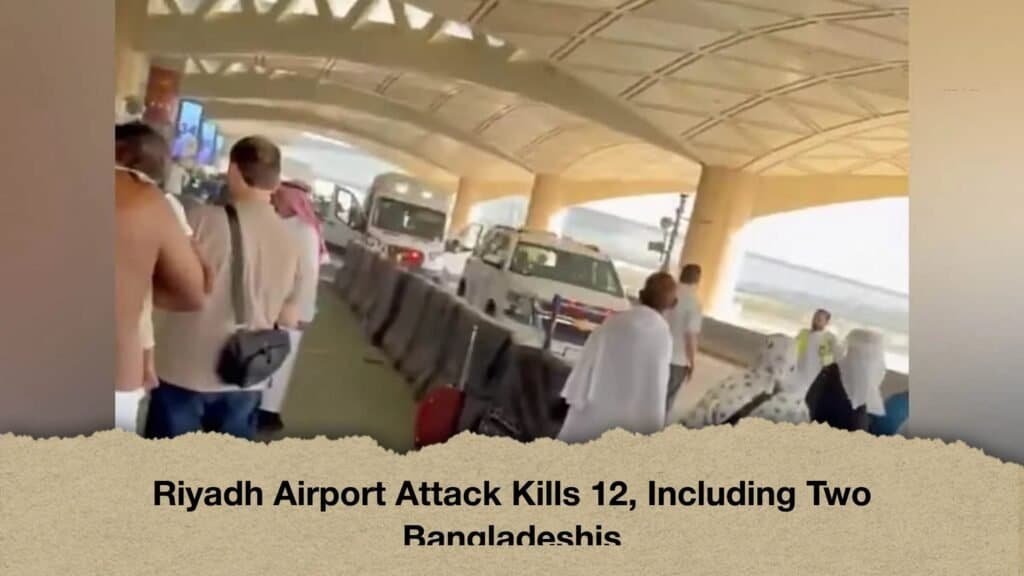
Twelve people, including two Bangladeshi nationals, have been killed and 309 injured in an attack on King Khalid International Airport in Saudi Arabia’s capital, Riyadh, according to Saudi authorities. The assault took place on Saturday and was claimed by Yemen’s Iran-backed Houthi armed group. Airport operations were temporarily suspended, while hundreds of flights were cancelled or delayed as officials assessed the damage and reviewed security arrangements.
Mohammed al-Bukhaiti, a senior Houthi official, claimed responsibility for the attack, saying it was carried out in retaliation for Saudi military operations in Yemen. He also alleged that Saudi strikes had targeted civilian infrastructure.
The incident marks the third attack on King Khalid International Airport this week, raising concerns about the security of a major aviation hub and the potential impact of the escalating hostilities on civilian travel.
According to a statement issued by the Saudi General Authority of Civil Aviation on social media platform X, the 12 people killed included four Saudi nationals, two Bangladeshis, and one citizen each from the United States, Jordan, Palestine, Syria, Sudan and Egypt.
People familiar with the situation said the injured were taken to hospitals by ambulance and helicopter. Medical facilities experienced a surge in patients, with some of the wounded reported to be in critical condition.
Panic and confusion inside the terminal
Witnesses described scenes of panic inside the airport following the explosion. Several injured people were seen lying on the terminal floor as passengers attempted to reach safety.
A witness who was at the airport on Saturday, speaking on condition of anonymity, said they had seen the explosion and subsequently noticed several injured people inside the terminal. More than a dozen ambulances were seen heading towards the airport, the witness added.
Footage verified by Reuters also showed ambulances at the airport after the attack.
An injured passenger told Reuters, also requesting anonymity, that they had seen something moving through the sky outside the airport. Shortly afterwards, part of the ceiling near an exit gate collapsed, according to the passenger.
Another traveller, who witnessed the attack in the domestic terminal, told Agence France-Presse that they had been at Gate 403 when the incident occurred at Gate 401.
“I saw injured people with my own eyes. Everyone was running around,” the passenger said, describing the confusion that followed the explosion.
The accounts indicate that the attack caused immediate disruption inside the terminal. However, the precise nature of the weapon used, the full extent of the structural damage and the circumstances leading to the explosion were not immediately established.
A medical source said health officials had urgently summoned doctors to help manage what was described as a serious emergency. Emergency teams worked to transport and treat the injured as hospitals dealt with the influx of casualties.
Third attack on the airport this week
Saturday’s assault followed two earlier attacks on King Khalid International Airport during the same week, in which four people were killed. A Saudi commercial aircraft parked on the runway also sustained extensive damage in one of the earlier incidents.
The latest attack reportedly occurred without any advance warning. Saudi Arabia’s threat-detection and alert system did not issue a signal before the incident, according to the information provided by the authorities.
The absence of a warning has raised questions about the effectiveness of the airport’s security arrangements and its ability to detect incoming threats. However, no detailed explanation was immediately available regarding why the alert system failed to issue a warning.
The repeated attacks have heightened concerns about the vulnerability of major transport facilities amid the continuing conflict involving Saudi Arabia and the Houthis. Airports are particularly sensitive targets because an attack can threaten passengers and staff while disrupting domestic and international connections.
The full extent of the damage to the airport and the impact on its infrastructure remained under assessment.
Further incidents reported near Saudi facilities
Hours after the attack in Riyadh, a spokesperson for the Saudi-led international coalition fighting the Houthis said on X that a projectile had struck near King Fahd International Airport in Dammam, in Saudi Arabia’s eastern region.
The initial statement did not provide a detailed account of the incident or specify the extent of any damage. The term ‘projectile’ can refer to different types of airborne weapons or objects, and further information was not immediately available to establish precisely what had struck near the airport.
In the early hours of Sunday, the coalition announced that it had intercepted a missile to the south-east of Riyadh.
The reports of further incidents have added to concerns about the security of Saudi Arabia’s aviation infrastructure. They also underline the potential for regional hostilities to affect civilian transport, even when the immediate targets or consequences of individual incidents remain unclear.
The Saudi-led coalition has been involved in the conflict against the Houthis, whose attacks and military activities have repeatedly raised security concerns across the region. Al-Bukhaiti’s stated justification for Saturday’s assault reflects the continuing cycle of retaliation between the opposing sides.
Hundreds of flights cancelled or delayed
Following the attack, the Saudi General Authority of Civil Aviation temporarily suspended operations at King Khalid International Airport while officials assessed the damage and reviewed the security situation.
According to flight-tracking service Flightradar24, all flights bound for Riyadh were either diverted to other airports or cancelled. At one point, a helicopter was observed circling above the airport.
Flightradar24 reported that 155 arriving flights and 161 departing flights were cancelled on Saturday. A further 222 flights experienced delays in either departure or arrival.
The disruption affected passengers travelling to and from Riyadh, as well as those using the capital as a connecting point for onward journeys. Travellers faced uncertainty over revised departure times, alternative routes and the availability of replacement services.
The cancellations and delays also created operational challenges for airlines, which had to adjust their schedules in response to the temporary closure. The full number of passengers affected was not immediately available.
Several airlines had already suspended or cancelled services to Riyadh earlier in the week, including on Thursday, amid Houthi attacks and related security concerns. Saturday’s assault added to the disruption and left the airport’s immediate operating situation uncertain.
Concerns over the safety of international travellers
The deaths of two Bangladeshi nationals have brought the human cost of the attack into sharp focus for Bangladesh. The Saudi authorities identified the two victims as Bangladeshi citizens, but their names, occupations and other personal details were not immediately released.
Information about arrangements to repatriate their bodies was also not immediately available. Nor was there a separate breakdown showing how many of the 309 injured people were foreign nationals.
The presence of victims from several countries highlights the international nature of air travel through Riyadh and the risks posed when major civilian transport facilities come under attack. For passengers, the immediate concerns are access to medical assistance, reliable information about flight changes and assurances that airport operations can resume safely.
Saudi authorities said damage assessments were under way, but no definitive timetable for the full resumption of normal services was immediately announced.
For now, the priorities remain treating the injured, determining the extent of the damage and evaluating the security risks. The repeated attacks this week have disrupted one of Saudi Arabia’s important aviation gateways and raised fresh questions about how long the disruption might continue.
The incident also reinforces the wider consequences of the conflict beyond the battlefield. When airports and other civilian facilities are affected, the impact extends to international travellers, airline operations and the movement of people across borders. Until the security situation becomes clearer, passengers travelling through Riyadh may continue to face uncertainty and disruption.