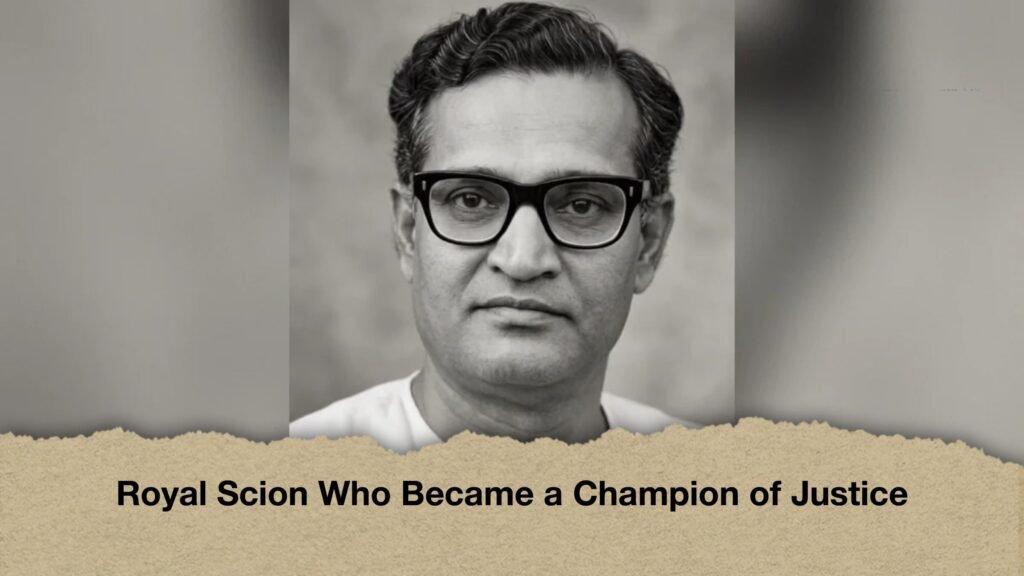
Barrister Snehasangshukanta Acharya remains remembered as a remarkable figure who chose public service over inherited privilege. Born into the royal family of Mymensingh, he went on to become a prominent Bengali lawyer, left-wing politician, humanitarian and advocate of democratic rights. His life brought together the worlds of law, politics, social activism and education, while his personal choices set him apart from the privileged circumstances into which he was born.
Acharya was born on 1 September 1913 into the distinguished royal family of Mymensingh. He was the youngest son of Maharaja Shashikanta Acharya Chowdhury. His family background afforded him wealth, influence and social standing, yet he did not allow those advantages to determine the direction of his life. Instead, he became increasingly concerned with the conditions and rights of ordinary people.
After completing his BA at Scottish Church College in Calcutta in 1936, Acharya travelled to London to study for the Bar. His time in Britain proved influential in shaping his political thinking. He became acquainted with progressive political circles and developed a strong interest in the lives and struggles of working people.
During his stay in London, he also played a significant role in introducing Jyoti Basu, who later became Chief Minister of West Bengal, to senior leaders of the Communist Party of Great Britain. The association reflected the wider political networks that were developing among Indian students and activists in Britain during the period.
When Acharya returned to India in 1940, he began practising law at the Calcutta High Court. At the same time, he became actively involved in the communist movement. For him, the legal profession was not simply a means of earning a livelihood. He regarded law as an important instrument for defending the rights of people facing oppression and discrimination.
His political and humanitarian commitments became particularly visible during the turbulent years immediately before independence. In 1946, the British authorities expelled him from Mymensingh. The region was experiencing the devastating effects of communal violence at the time, and Acharya became involved in relief and humanitarian work. His efforts reflected a commitment to assisting people regardless of their religious, communal or social background.
In 1947, he was elected to the provincial committee of the Communist Party of India. Independence did not bring an end to the political difficulties he faced. Because of his political activities and beliefs, he spent many years in detention without trial. His imprisonment continued until 1963, making incarceration one of the longest and most difficult chapters of his life.
The experience of prison later became part of his literary legacy. Acharya recorded his experiences in English, and the memoir was subsequently translated into Bengali and published as Jelkhana Diary. The work documented aspects of political imprisonment, including the hardships, isolation and psychological pressures faced by a political detainee. It also reflected his determination to remain committed to his political convictions despite prolonged confinement.
After the Communist Party split, Acharya joined the Communist Party of India (Marxist). He subsequently served as a member of the state legislative assembly for six years. His political career, however, never overshadowed his standing as a lawyer, which remained one of the defining aspects of his public life.
Acharya made a significant contribution to the legal profession at both national and international levels. In 1957, he was one of the organisers of the Afro-Asian Lawyers’ Conference. A year later, in 1958, he was elected the first general secretary of the All-India Democratic Lawyers’ Association. His involvement in such organisations demonstrated his continuing interest in the relationship between law, democratic rights and social justice.
He later assumed one of the most senior legal positions in West Bengal. During the second United Front government, Acharya became the state’s first Advocate General. When the Left Front came to power in 1977, he was appointed Advocate General once again. He remained in the post until his death, bringing decades of legal experience and public service to one of the state’s most important constitutional offices.
Acharya’s personal life was also closely connected with Bengal’s political and cultural circles. He married Supriya Mukherjee, a prominent woman leader of the Communist Party. Through the marriage, he became the son-in-law of writer Sourindramohan Mukherjee and the brother-in-law of renowned Rabindra Sangeet singer Suchitra Mitra.
His commitment to education and philanthropy also left a lasting mark. Land belonging to Acharya was donated through a deed for the nominal price of one rupee, helping facilitate the establishment of Jadavpur University. The episode has come to represent another aspect of his approach to wealth: property inherited through privilege could, in his view, be placed at the service of wider educational and social purposes.
The trajectory of Acharya’s life was striking because of the distance between his origins and his chosen path. He was born into royalty but became closely associated with ordinary people and their struggles. He acquired the distinction of a senior barrister, yet remained deeply involved in political and democratic causes. He endured years of imprisonment but continued to maintain his political convictions.
His career also reflected the changing political landscape of Bengal and India across several decades. He lived through the final years of British rule, communal violence, independence, political repression and the emergence of new democratic institutions. Through these upheavals, he combined his legal expertise with political engagement and public service.
Snehasangshukanta Acharya died on 27 August 1986. His death brought to an end a life that had been shaped by law, politics, humanitarian work and a sustained commitment to public causes.
His legacy is not confined to the positions he held or the honours associated with his professional career. It is also rooted in the choice he made early in life to move away from the privileges of his birth and towards the concerns of ordinary people. In the courtroom, he built his reputation as a lawyer; in politics, he campaigned for democratic principles; in prison, he endured prolonged hardship without abandoning his convictions; and through philanthropy, he contributed to the cause of education.
For someone born into a royal household, his most enduring identity was not that of a member of the aristocracy. It was that of a lawyer who chose to stand with people and a public figure whose life remained closely connected with justice, democracy and social responsibility.
Barrister Snehasangshukanta Acharya is therefore remembered not merely for where he came from, but for what he chose to do with the privileges and opportunities he inherited. His life remains a notable chapter in the intertwined history of Bengal’s legal profession, political movements and public life.