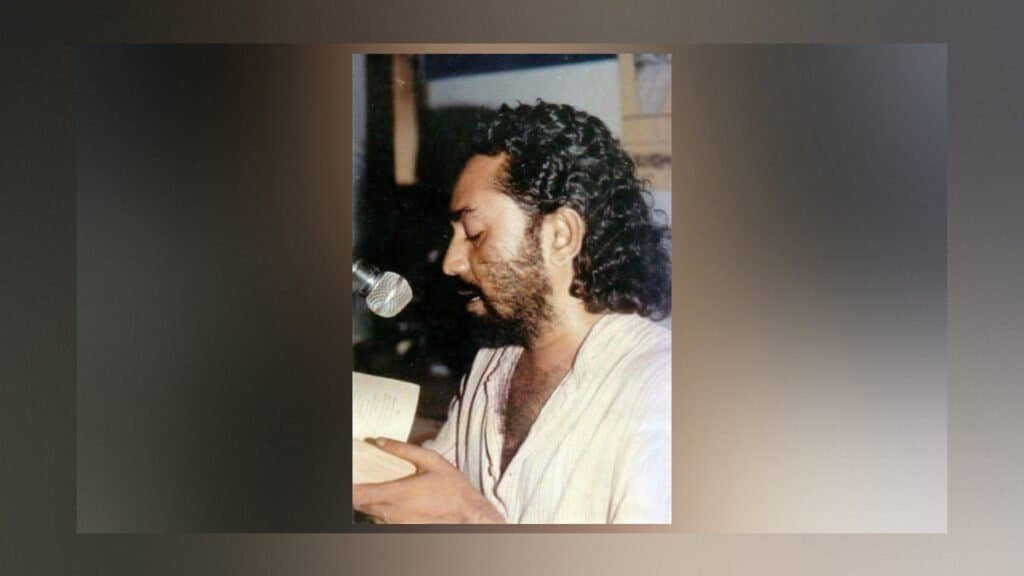
Some voices in Bengali literature transcend their own time, continuing to inspire generations long after their creators have passed away. Rudra Mohammad Shahidullah was one such poet. His writing brought together love and rebellion, hope and anguish, personal longing and resistance to oppression. A powerful voice of his generation, he challenged injustice through poetry and established a distinctive place in the literary and cultural life of Bangladesh.
Born on 16 October 1956, Rudra died on 21 June 1991, aged 34. Despite his short life, he left behind a remarkable body of work that continues to move readers through its emotional intensity, social awareness and unwavering commitment to human dignity. On his birth anniversary, he is remembered as a poet whose words gave expression to both the tenderness of love and the urgency of protest.
A Poet Who Turned Emotion into Resistance
Rudra began writing during a period of significant social and political uncertainty in Bangladesh. In the years following the country’s independence, the hopes generated by the Liberation War existed alongside growing concerns about social injustice, political instability and the erosion of democratic aspirations. These contradictions became important themes in his poetry.
During the 1980s, Rudra emerged as a particularly influential literary voice among young people. His poetry recitals, forceful delivery and emotionally charged language helped him connect with audiences beyond the conventional readership of printed poetry. His words were often direct and accessible, yet they carried a depth of feeling that invited readers to question the society around them.
For Rudra, poetry was more than an exercise in literary expression. It was a means of confronting injustice, examining the promises of independence and articulating the aspirations of ordinary people.
One of his widely recognised passages captures the disappointment that can arise when the ideals of a liberation struggle appear distant from everyday realities:
“The field from which the call for freedom arose,
has now become a marketplace for narcotics.”
The lines evoke a painful contrast between the sacrifices made for independence and the social conditions that followed. They express disillusionment with the betrayal of collective hopes and the desire for a society founded on justice, equality and human dignity.
Rudra’s criticism was rooted in a broader understanding of freedom. Political independence, in his view as reflected through his poetry, could not be separated from the social and moral responsibilities that accompanied it. The achievement of sovereignty was a historic milestone, but the aspirations that inspired the struggle required continued attention.
This ability to connect national experience with personal conscience gave his writing much of its force. His poems encouraged readers not merely to remember the past, but also to examine the present and consider the responsibilities of the future.
The Enduring Power of The Smell of Corpses in the Air
Among Rudra’s most memorable works is Batase Lash-er Gandha, commonly rendered in English as The Smell of Corpses in the Air. The title itself conveys a disturbing image of a society haunted by death, violence and the unresolved wounds of history.
The poem evokes the human consequences of bloodshed and political violence. Its imagery suggests that the memory of death cannot simply be erased from public consciousness. Even when the immediate violence has passed, its moral and emotional consequences may continue to shape the lives of individuals and communities.
The line, “Even today, I smell the stench of corpses in the air,” has come to represent a wider sense of historical anguish and moral unease. It can be read as an expression of the conscience refusing to forget those who have suffered, as well as a demand that society confront the truth about violence rather than allow it to disappear into silence.
Rudra’s writing often gives personal emotion a collective dimension. Grief becomes a way of remembering the dead; anger becomes a response to injustice; and sorrow becomes a reminder of the value of human life.
Such themes help explain why his poetry continues to resonate with successive generations. The political circumstances of Bangladesh have changed considerably since his lifetime, but questions about violence, accountability, freedom and human dignity remain relevant. His poetry offers a powerful literary language through which those questions can be explored.
An Extraordinary Literary Legacy from a Short Life
Rudra Mohammad Shahidullah was born in Barishal, where his father was posted at the time. His ancestral home was in Mithakhali village in Mongla, Bagerhat district.
His interest in literature and culture developed from an early age. He completed his secondary education at Dhaka West End High School in 1973 and passed his higher secondary examinations in 1975. He subsequently studied Bengali at the University of Dhaka, obtaining both his honours degree and postgraduate qualification.
Although his life lasted little more than three decades, Rudra produced a substantial body of literary work. His notable poetry collections include Upadruto Upakul, Fire Chai Swarnagram, Manusher Manchitra, Chobol, Golpo and Diyechhile Shokol Akash.
His writing reflects a wide range of concerns, from the intimate emotions of love and separation to the social conditions that shape human experience. He possessed a distinctive ability to move between lyrical tenderness and uncompromising protest without losing the emotional intensity of either.
His contribution extended beyond poetry. He also wrote stories, verse dramas and songs, demonstrating a creative range that reached across several literary forms.
One of his best-known songs, Bhalo Achhi Bhalo Theko, remains especially popular. Its expression of affection, separation and remembrance has given it a lasting place in the emotional landscape of Bengali music. The song’s appeal lies in its ability to express complicated feelings with simplicity and sincerity.
The contrast between this tenderness and the defiance of his protest poetry is central to Rudra’s artistic identity. He could write about the vulnerability of a lover with the same intensity with which he condemned social injustice. Love and rebellion were not opposing forces in his work; both emerged from a deep concern for human experience.
His literary legacy therefore cannot be confined to a single category. He was a poet of love, but also of resistance, conscience and social responsibility.
Personal Life, Love and Separation
Rudra’s personal life attracted considerable public interest, particularly his marriage to writer Taslima Nasrin. They married in 1981, and their marriage ended in 1986.
Although this relationship remains a subject of discussion, Rudra’s literary significance rests principally on his writing and the ideas that informed it. His work offers a more enduring means of understanding his character as a poet than the controversies or circumstances surrounding his private life.
Personal experiences of love, disappointment and separation often find echoes in literature, allowing individual emotions to become recognisable to a much wider audience. Rudra’s poetry possesses this quality. His treatment of longing and emotional pain can feel intensely personal while also reflecting feelings shared by readers from different backgrounds and generations.
His writing does not portray love as an uncomplicated ideal. It acknowledges vulnerability, disappointment and the memories that remain after relationships have ended. Such emotional honesty gives his romantic poetry its lasting appeal.
At the same time, his personal concerns were never entirely detached from the wider world. His poetry frequently returns to questions of freedom, dignity and the conditions necessary for human beings to live meaningful lives.
This interplay between private emotion and public conscience remains one of the most compelling aspects of his work.
National Recognition and a Legacy That Lives On
Rudra Mohammad Shahidullah died on 21 June 1991, aged 34. His death was a significant loss for Bengali literature, bringing an abrupt end to a creative life that had already made a considerable impression.
Yet his work continued to circulate through books, musical performances and poetry recitals. His poems remain part of the cultural memory of Bangladesh, particularly among readers who value literature as a means of questioning authority, confronting injustice and expressing the aspirations of ordinary people.
In Mithakhali, his ancestral village in Mongla, Bagerhat, the Rudra Smriti Sangsad was established to preserve his memory and literary heritage. Such initiatives help sustain public interest in his work and maintain a connection between the poet, his birthplace and the wider cultural community.
His contribution also received formal national recognition when the Government of Bangladesh awarded him the Ekushey Padak posthumously in 2024. The award acknowledged his contribution to the country’s literary and cultural heritage.
Official honours are an important form of recognition, but a poet’s influence is ultimately measured by the continuing life of his work. Rudra’s poetry remains meaningful because it addresses questions that cannot be settled by a single generation: What does freedom truly mean? How should society remember its victims? What responsibilities accompany independence? And how can love and humanity survive in a world marked by injustice?
These questions give his writing a relevance that extends beyond the circumstances in which it was produced.
For younger readers, discovering Rudra can mean encountering a poet whose work combines emotional openness with moral courage. His writing demonstrates that literature can be both deeply personal and socially engaged, speaking to the heart while challenging the conscience.
Remembering a Poet of Love, Protest and Humanity
Rudra Mohammad Shahidullah’s poetry reminds us that independence is more than the possession of a territory. It also represents the promise of dignity, rights, freedom of thought and justice. The struggle to preserve those ideals does not end when a nation achieves sovereignty; it continues through the choices, responsibilities and actions of subsequent generations.
Rudra understood the emotional power of words. His romantic poems could evoke longing and melancholy, while his protest poetry confronted readers with uncomfortable truths about society and history. Together, these strands of his work created a distinctive voice that remains difficult to forget.
His defiance continues to encourage resistance to injustice. His songs preserve the tenderness of love and the sadness of separation. His poems about violence and freedom remind readers that the value of human life must never be taken for granted.
On his birth anniversary, he is remembered not simply as a poet of the past, but as a writer whose questions remain alive in the present. His work invites each generation to consider what freedom means in practice, how a society should treat its most vulnerable members and why human dignity must remain at the centre of public life.
The poet is gone, but his words continue to travel across time. His voice survives in the memories of readers, in the songs that people continue to cherish and in the spirit of those who refuse to remain silent in the face of injustice.
As long as the people of Bangladesh continue to dream of a fairer society, defend the promise of freedom and seek meaning through love and humanity, Rudra Mohammad Shahidullah will retain his place in the nation’s literary imagination.
On his birth anniversary, heartfelt tribute to Rudra Mohammad Shahidullah—a poet whose love was tender, whose protest was fearless and whose words continue to awaken the human conscience.