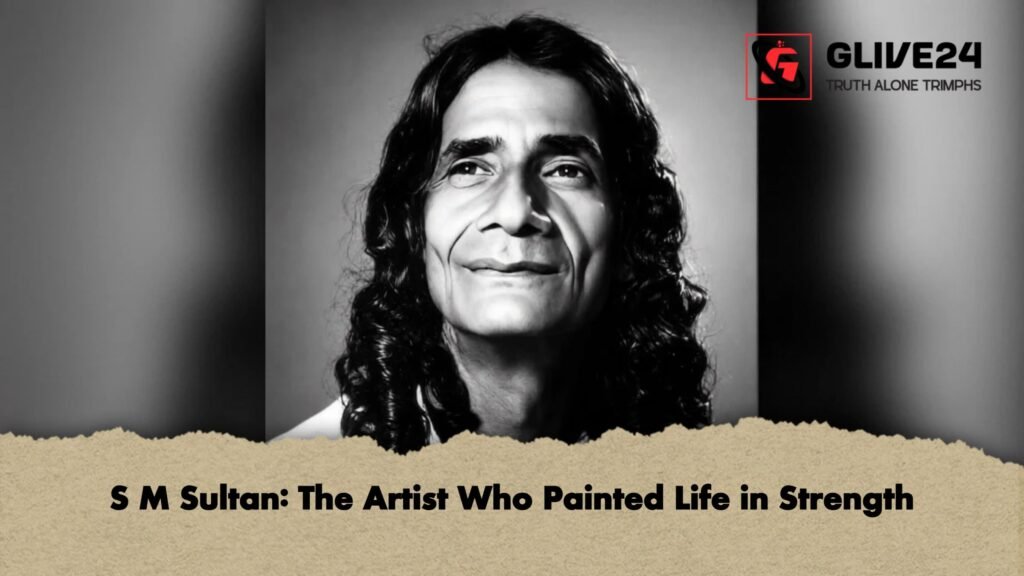
Bangladesh’s art history is marked by a number of artists who looked beyond conventional subjects to capture the lives, struggles and aspirations of ordinary people. S M Sultan stands among the most distinctive of them. Through his paintings, he brought rural Bengal, agricultural labour, the strength of working people and the relationship between humans and nature to the centre of his artistic world.
Born Sheikh Mohammad Sultan, and affectionately known in his childhood as ‘Lal Mia’, Sultan was born on 10 August 1923 in Machimdia village in Narail to a poor farming family. His early surroundings had a lasting influence on his artistic vision. He grew up close to farmland, rural communities and manual labour, experiences that later became central to his work.
Sultan enrolled at Narail Victoria Collegiate School in 1928. His family’s financial difficulties meant that his education was not without obstacles, and he also had to assist his father with agricultural work. Yet his interest in drawing developed from an early age. He began by drawing human faces, gradually revealing a talent that would eventually take him beyond the confines of his rural birthplace.
As a young man, Sultan travelled to Kolkata, where he encountered a much wider artistic environment. His association with art critic Shahid Suhrawardy proved significant in the development of his career. During the 1940s, he gained an opportunity to study art at the Calcutta Art School, although he did not allow conventional academic approaches to dictate the direction of his work.
His artistic journey soon extended beyond the region. In 1946, his paintings were exhibited in Shimla. His works were later shown in cities including New York, Washington, Chicago, Boston and London. Such exposure brought him into contact with international art circles, but it did not sever his connection with his roots.
In 1953, Sultan returned to Narail. His return marked a renewed engagement with the rural world that had shaped his childhood and imagination. Farmers, fishermen and other working people increasingly became central figures in his paintings.
Perhaps the most recognisable feature of Sultan’s art is the extraordinary physical strength of his rural figures. His farmers are often depicted with broad shoulders, powerful limbs and muscular bodies. They are not presented as helpless victims of poverty. Instead, they appear as strong participants in the process of cultivating the land and sustaining society.
This approach gave his paintings a distinctive visual language. The exaggerated physical forms of his figures can be read as an artistic expression of the dignity, endurance and productive power of rural labour. The farmer in Sultan’s paintings is therefore more than an individual character; he represents the centrality of working people to the life of Bengal.
Sultan’s interests extended beyond painting. He was deeply concerned with children’s education and sought to create opportunities for young people to develop their creativity. In Narail, he was associated with initiatives including Nandan Kanan and later Shishu Swarga and Charupeeth. These efforts reflected his belief that children should have access not only to conventional education but also to artistic and creative development.
His personal life was also closely connected with nature. Sultan could play the flute and other musical instruments, and he was known for his affection for animals and birds. His surroundings often included a variety of creatures, reflecting a way of life in which art, nature and everyday existence were closely intertwined.
For Sultan, art was not simply an exercise in beauty. It was a means of expressing human life. His paintings repeatedly returned to themes of labour, nature, community and human resilience. The physical power of his farmers and labourers became one of the defining elements of his artistic identity.
His contribution was recognised through several major honours. Sultan received the Ekushey Padak in 1982. In 1986, he received the Bangladesh Charushilpi Sangsad award. Seven years later, in 1993, he was awarded the Independence Award, the highest civilian honour in Bangladesh.
These recognitions reflected the significance of his contribution to the country’s visual arts. Yet his reputation rests not only on awards or international exhibitions. It is rooted in the distinctive world he created on canvas—a world where rural people occupy the centre of the frame and where physical labour is portrayed with unusual dignity and force.
Sultan died on 10 October 1994 at the Combined Military Hospital in Jessore. He was later laid to rest in Narail, the place that remained closely connected to his identity and artistic imagination.
Decades after his death, S M Sultan remains an important figure in Bangladesh’s cultural history. His paintings continue to evoke the rural landscape and the people whose labour sustains it. His muscular farmers, fishermen and labourers stand apart from conventional portrayals of rural poverty, offering instead an image of strength, resilience and human potential.
His legacy also lies in the way he transformed familiar elements of Bengali life into a distinctive artistic vocabulary. The soil, fields, workers and rural communities that surrounded him were not merely subjects for his paintings. They became the foundation of his vision as an artist.
S M Sultan therefore occupies a unique place in Bangladesh’s art history. He painted people who worked the land, lived close to nature and carried the weight of everyday life. In doing so, he created an enduring body of work that connected art with the lives of ordinary people.
On his birth anniversary, remembering Sultan means returning to the world he placed on his canvases: a world of soil, labour, strength, nature and human dignity. His life ended in 1994, but the visual language he created continues to hold a lasting place in the story of Bangladeshi art.