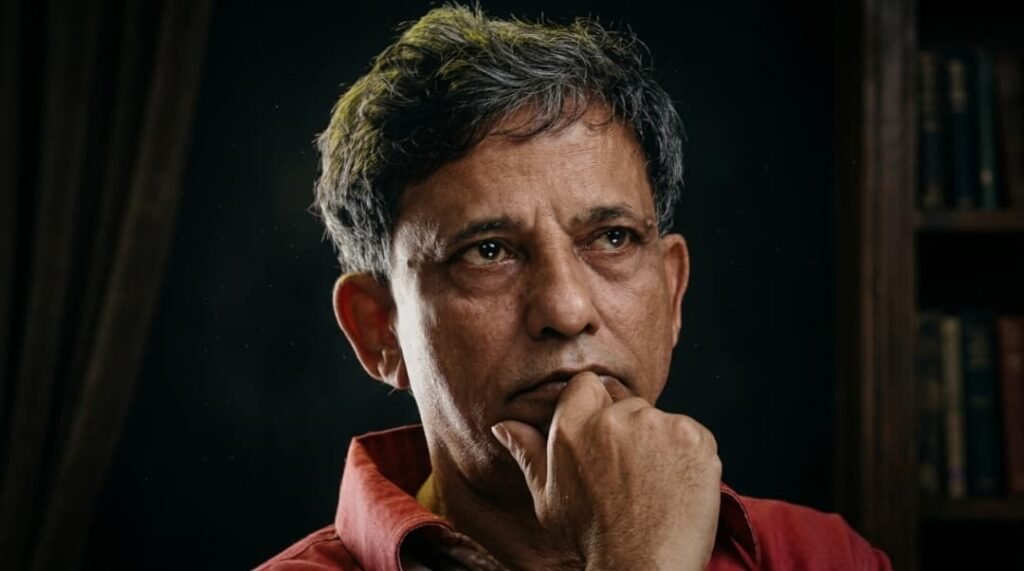
Selim Al Deen remains one of the most influential figures in the history of modern Bengali theatre, celebrated for his determined search for a theatrical language rooted in the soil, people and cultural memory of Bengal. He was not merely a playwright. He was a researcher, theatre theorist, director, organiser and teacher who devoted his life to developing an artistic identity for Bengali drama independent of Western theatrical conventions.
Born on 18 August 1949 in Senerkhil village in Sonagazi, Feni, Selim Al Deen studied Bengali literature at the University of Dhaka, where he completed his master’s degree. He later pursued research into medieval Bengali literature and theatre at Jahangirnagar University, earning a PhD in 1995. His academic career became closely intertwined with his creative work, allowing research, teaching and theatre practice to influence one another.
He began his professional career as a copywriter at the advertising agency Bitopi. In 1974, he joined the Bengali Department of Jahangirnagar University as a lecturer. His contribution to institutional theatre education was particularly significant. In 1986, he played a leading role in establishing the Department of Drama and Dramaturgy at Jahangirnagar University and became its founding chairman. The department subsequently emerged as an important centre for formal theatre education in Bangladesh.
Selim Al Deen’s literary journey had begun much earlier. His first essay, ‘Negro Literature’, was published in the daily Pakistan in 1968. His first radio play was ‘Biporit Tamasay’, while his first television drama, ‘Ghum Nei’, was broadcast in 1970. His first stage play, ‘Sarpbishayak Galpo’, was staged in 1972.
At the heart of his theatrical philosophy was a conviction that Bengali drama needed to discover its own distinctive language and form. Rather than treating Western dramatic traditions as the principal model, he drew extensively upon folk theatre, pala songs, kirtan, mangalkavya, legends, mythology and the everyday lives of rural communities. His works brought together the historical memory of Bengal and the anxieties of modern human existence.
This approach gave his plays a distinctive character. His dramatic language could be poetic and philosophical, yet remained deeply connected to folk traditions and ordinary people. Works such as ‘Kittankhola’, ‘Keramatmangal’, ‘Hatai’, ‘Jaibati Kanyar Mon’, ‘Hargaj’, ‘Nimajjan’ and ‘Dhabaman’ demonstrate the breadth of his artistic vision.
His contribution was not confined to writing for the stage. He worked across theatre, radio and television and was involved in research, direction, screenwriting, poetry, songs, translation and fiction. His writings frequently explored questions of identity, history, suffering, human relationships and the enduring influence of cultural memory.
In 1982, Selim Al Deen and theatre director Nasiruddin Yousuff established Gram Theatre. The initiative helped extend theatrical activity beyond urban centres and encouraged theatre practice in rural communities. It became an important part of the broader theatre movement in Bangladesh, reflecting Selim Al Deen’s belief that theatre should remain connected to the lives and cultural traditions of ordinary people.
His major works also demonstrated his ability to transform traditional material into contemporary theatrical expression. In ‘Kittankhola’, ‘Keramatmangal’, ‘Jaibati Kanyar Mon’ and ‘Nimajjan’, he examined human life, dreams, pain, history and existence through an artistic vocabulary shaped by Bengal’s cultural heritage.
His contribution to Bengali theatre was recognised with several major honours, including the Bangla Academy Award, the Ekushey Padak and the National Film Award, alongside other distinctions at home and abroad. His academic research and creative work also provided an intellectual foundation for subsequent generations of theatre practitioners, researchers and students.
For Selim Al Deen, theatre was far more than entertainment performed on a stage. He regarded it as a powerful medium through which a nation could examine its history, identity and collective memory. His lifelong search for the roots of Bengali theatrical expression led him towards the cultural traditions that had evolved over centuries.
Selim Al Deen died in Dhaka on 14 January 2008, leaving a profound void in Bangladesh’s cultural landscape. Yet his influence did not end with his death. His plays continue to be studied and performed, while his ideas about indigenous theatrical forms remain relevant to discussions about the identity and future of Bengali theatre.
His legacy lies not simply in the number of plays he wrote, but in the intellectual and artistic direction he gave to an entire generation. By looking towards Bengal’s folk traditions, history and people, he demonstrated that a modern theatrical language could emerge from deeply rooted local experience.
On his birth anniversary, Selim Al Deen is remembered with respect as one of the foremost architects of modern Bengali theatre—a playwright who transformed the search for cultural roots into a sustained artistic and intellectual endeavour.