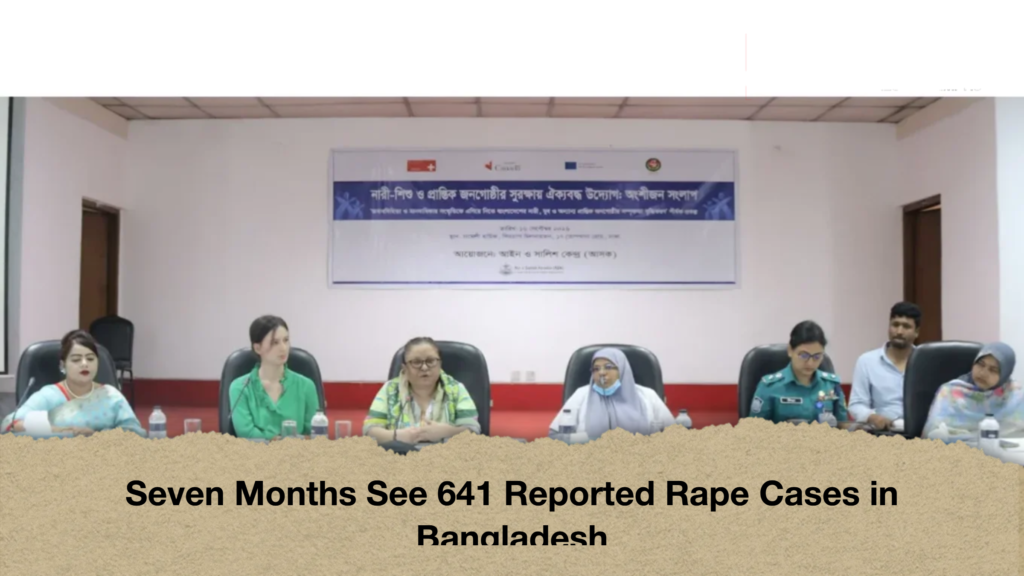
A total of 641 incidents of rape involving women and children were documented in Bangladesh between January and July this year, according to data presented by Ain o Salish Kendra (ASK). Of the reported cases, 400 involved women and 241 involved children.
The figures were presented on Wednesday (16 September) at a stakeholders’ dialogue held at the CIRDAP auditorium in the capital. The discussion focused on strengthening coordinated efforts to protect women, children and marginalised communities, improve access to justice and enhance the delivery of essential support services.
ASK Executive Director Tahmina Rahman, who chaired the dialogue, presented the statistics covering the first seven months of the year. She said 400 incidents of rape of women had been documented during the period. There were also 37 cases in which women were allegedly killed after rape, while 152 attempted rape cases were recorded.
The data also showed a significant level of violence against children. A total of 606 incidents of violence against children were documented between January and July. Among these were 241 reported rape cases and 213 cases involving the killing of children.
Sexual harassment and stalking of women and adolescent girls were also recorded during the period, with 191 incidents documented. The stakeholders also expressed concern over human trafficking. According to the information presented at the dialogue, 1,126 new trafficking-related cases were filed in 2025, while 5,284 cases were either under investigation or pending trial as of May 2026.
Participants said Bangladesh has a range of government and non-government services for victims of violence, including legal assistance, medical treatment, psychosocial support, shelter and rehabilitation. However, gaps remain in coordination between these services. Victims may have to visit several institutions to obtain different forms of assistance, increasing both the time and financial burden involved.
The difficulties are particularly acute in rural and remote areas, where awareness of legal aid and protection services remains comparatively low. Many people are unaware that free legal advice, representation by lawyers, assistance in conducting cases and court-based support are available.
Information presented at the dialogue, citing data published by the National Legal Aid Services Organisation, showed that 1,846,799 people benefited from its legal aid and awareness activities between 2009 and August 2026. Of these, 31,222 received assistance through the Supreme Court Legal Aid Office, while 1,333,777 were served through legal aid offices in all 64 districts.
Participants also pointed to difficulties in the legal aid application process. Multiple approval stages can make applications time-consuming, while irregular meetings of government approval committees can delay decisions. For applicants whose requests are rejected, the appeal process may also be difficult and costly, particularly for people with limited financial means.
Although online applications and helplines are available, their use remains limited in some areas because of technological constraints, restricted internet access in rural communities and a lack of public awareness. Government publicity about these services is also considered less extensive in rural areas than in cities.
Bangladesh has 95 One-Stop Crisis Centres (OCCs) and cells for women affected by gender-based violence. However, participants said comprehensive services are not consistently available at every centre. Shortages of round-the-clock services, dedicated diagnostic facilities and separate counselling spaces were among the concerns raised. Ensuring coordinated access to medical, forensic, legal, psychosocial and rehabilitation services remains a challenge.
Rezmin Sultana, Additional District and Sessions Judge at the Bangladesh Legal Aid Services Organisation, said genuine protection means preventing violations of the rights of women, children and marginalised communities. When violations occur, however, she said no single institution can provide timely remedies on its own, making coordinated action among the relevant agencies necessary.
Other participants included Deputy Commissioner of the Women Support and Investigation Division Mosa Liza Begum, legal officer of the Department of Women Affairs Ivy Akter, OCC coordinator Dr Taiyeba Sultana, Nari Pokkho programme manager Kamrunnahar, Dhaka District Employment and Manpower Office Assistant Director Prabir Dutta, and Katrina Koenig, Deputy Team Leader of the Citizenship-Civic Engagement Fund.
The discussions highlighted that addressing violence requires more than legal proceedings alone. Effective protection also depends on making support services easier to reach, strengthening coordination among institutions and ensuring that victims can obtain timely medical, legal, psychological and rehabilitation assistance.