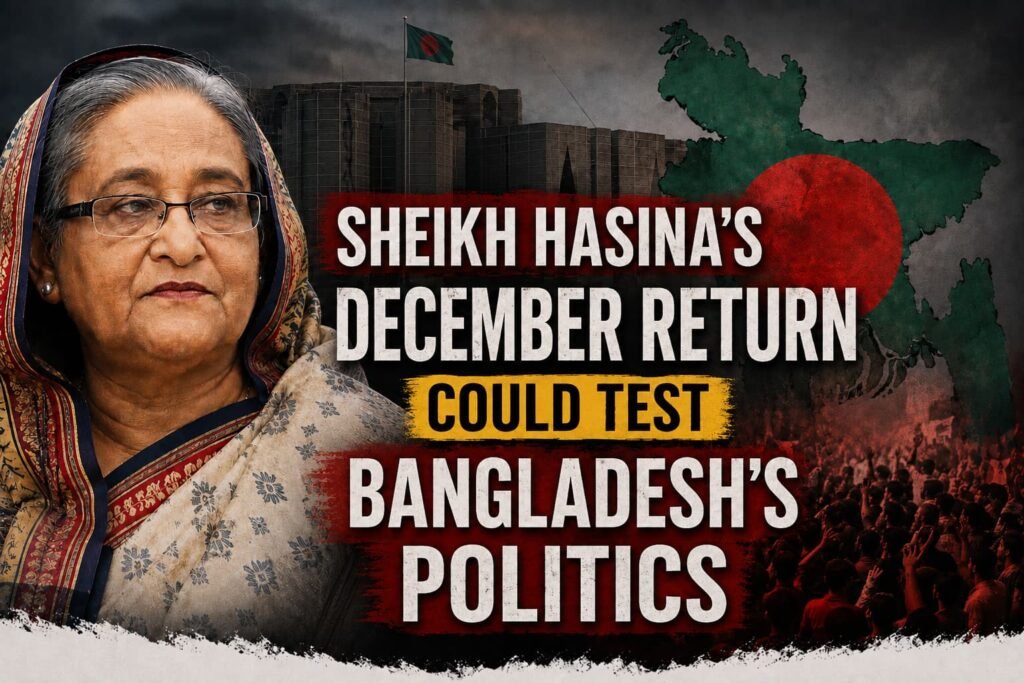
Sheikh Hasina’s stated intention to return to Bangladesh in December could become one of the most consequential developments in the country’s political landscape. Her possible return would not simply involve the movement of a former prime minister from abroad to Bangladesh. It could have implications for ongoing legal proceedings, the future of the Awami League, relations between Bangladesh and India, the conduct of political opposition and the wider direction of the country’s democratic process.
Hasina, who has been staying in India, has repeatedly indicated that she intends to return to Bangladesh in December. Whether that return actually takes place, however, remains dependent on a number of political and legal circumstances.
Legal proceedings could pose the first major challenge
The most immediate issue surrounding any potential return is the legal process facing Hasina in Bangladesh. If she comes back, she could face arrest, court proceedings or other legal measures depending on the status of the cases against her.
She has previously acknowledged the risks associated with returning while speaking to Reuters. That makes any December return considerably more complicated than a conventional political homecoming. It would raise questions about how the authorities would handle a former head of government who is facing legal proceedings, and whether those proceedings would be conducted in a manner that satisfies domestic and international expectations regarding due process.
Her return could therefore place Bangladesh’s judicial and political institutions under intense scrutiny.
The political landscape could change rapidly
A second major consideration is the potential impact on the Awami League. The party has played a central role in Bangladesh’s political history and has remained a significant political force through periods of political upheaval and opposition.
If Hasina were to return, her presence could immediately alter the focus of political debate. Questions about her arrest, court appearances, political activities and the future of the Awami League could dominate public discussion.
The response of the party’s leaders and activists would also be closely watched. A decision by Hasina to return could energise sections of the party and potentially create new political mobilisation. At the same time, the authorities would face the difficult task of maintaining public order while ensuring that political activity remains within the law.
The situation could become particularly sensitive if competing political groups attempted to organise demonstrations or counter-demonstrations around her return.
Opposition parties would face a new political challenge
Hasina’s return would also present a significant challenge to her political opponents. For years, Bangladesh’s political contest has been heavily shaped by competition between the Awami League and its principal rivals.
If she returned, opposition parties would have to decide how to respond. They could seek to challenge her through legal and political channels, campaign against the Awami League or prepare to compete with her party in an electoral environment. The strategy adopted by the opposition could have a direct bearing on the country’s political stability.
There is also a broader concern. If her return leads to heightened confrontation, political competition could become dominated by street protests, counter-protests and conflict rather than electoral debate and institutional processes.
Conversely, if the authorities handle the situation through transparent legal procedures and allow lawful political activity, the episode could provide an opportunity to demonstrate the strength of Bangladesh’s institutions.
India’s position will remain significant
Another important dimension is Bangladesh’s relationship with India. Hasina has spent a considerable period in India, making New Delhi’s position an unavoidable part of the wider diplomatic context surrounding her future.
Any decision concerning her return could therefore have implications beyond Bangladesh’s domestic politics. Dhaka and New Delhi would need to manage the diplomatic consequences carefully, particularly if legal proceedings or political developments surrounding Hasina become a major source of tension.
The reaction of other major international powers would also be closely observed. Bangladesh’s political transition has attracted considerable international attention, and any development involving a former prime minister of Hasina’s stature could have wider diplomatic consequences.
How realistic is a December return?
The central uncertainty is whether Hasina’s repeated declaration that she will return in December will translate into an actual return.
A political statement of intent and the practical ability to return are not necessarily the same thing. The legal environment, security situation, political circumstances and diplomatic considerations could all influence the final decision.
For Hasina, returning would mean confronting the political and legal realities of Bangladesh directly. For the authorities, it would mean managing a highly sensitive situation involving a former prime minister and a major political party. For the opposition, it would mean confronting a political figure who remains capable of reshaping the national debate simply through her presence.
The bigger question extends beyond Hasina
Ultimately, the significance of December lies not only in whether Sheikh Hasina returns, but in what happens if she does.
If her return is prevented through political rather than clearly established legal means, it could deepen political tensions and fuel further controversy. If she returns and is dealt with through transparent, lawful and constitutionally recognised procedures, the episode could become an important test of Bangladesh’s institutions.
The future of the Awami League, the response of opposition parties, the handling of legal proceedings, public order and Bangladesh’s relations with India could all become interconnected.
For that reason, a possible December return should not be viewed simply as the return of a former prime minister. It could become a defining political test for Bangladesh.
The question, therefore, may ultimately be larger than whether Sheikh Hasina will return. The more consequential question is how Bangladesh’s political and institutional system will respond if she does.