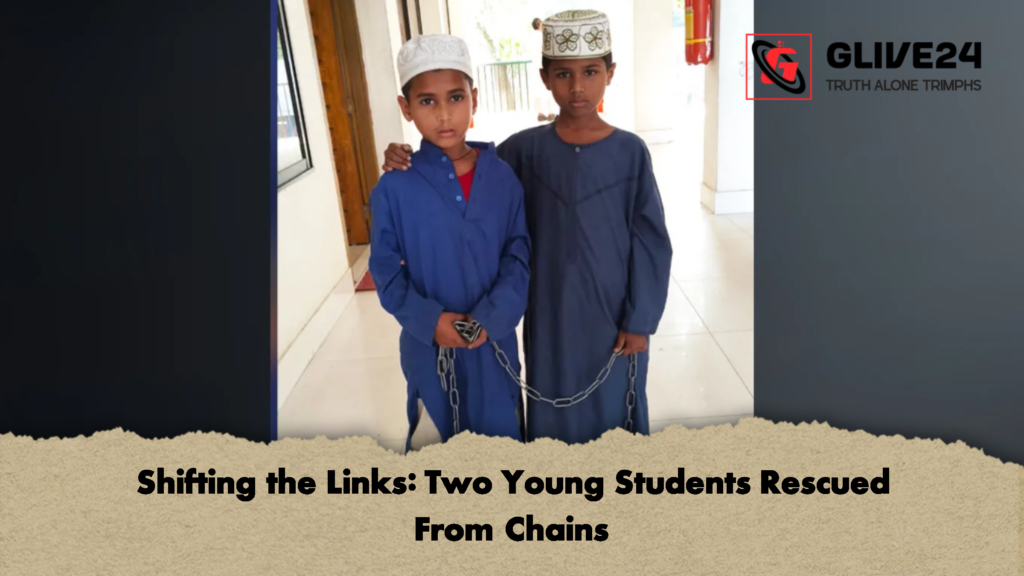
In a scene that has sparked widespread public indignation across the district, two young boys were discovered traversing the streets of Chunarughat with their legs bound together by heavy iron chains. Clad in traditional religious attire—tunics and prayer caps—the children were initially mistaken by passers-by for high-risk detainees due to the clanking metal shackles that severely restricted their gait.
The incident unfolded on Tuesday afternoon, 21 April 2026, in the Chunarughat sub-district of Habiganj. Local residents, appalled by the sight of the two minors struggling to walk, intervened and escorted them to the office of the Upazila Nirbahi Officer (UNO). Following a swift administrative review, the shackles were removed, and the boys were taken into protective custody.
The Victims and the Alibi of Discipline
The two children have been identified as Maruf Islam Sabuj, aged nine, the son of Mofizul Islam from Chanpur village, and Sayem Mia, aged eight, the son of Belu Mia from Patharia village. Both boys were enrolled as residential students at the Deorgach Hafezia Madrasa, a local religious seminary.
According to statements provided by their respective families, the children had repeatedly attempted to flee the institution to return to their homes. Frustrated by what they termed “truancy,” the parents reportedly collaborated with the madrasa authorities to implement a primitive and draconian form of restraint. It is alleged that the parents purchased iron chains for 400 BDT and used them to shackle the children’s legs before leaving them at the madrasa, believing this would “secure” their education.
A Desperate Escape to the Marketplace
The boys remained in chains within the seminary until Tuesday afternoon, when they managed to exploit a momentary lapse in supervision. Bound to one another, they successfully navigated their way out of the madrasa and headed toward the local marketplace. Their objective was to find a blacksmith or a tool that would allow them to sever the iron links and regain their freedom.
However, their conspicuous and distressing appearance immediately drew the attention of the public. A video capturing the moment the authorities used bolt cutters to free the children has since gone viral on social media, prompting a heated debate regarding the limits of parental discipline and the systemic abuse prevalent in some unregulated residential institutions.
| Case Detail | Information and Context |
| Primary Victims | Maruf Islam Sabuj (9) & Sayem Mia (8) |
| Institution Involved | Deorgach Hafezia Madrasa, Chunarughat |
| Method of Restraint | Iron chains purchased by parents for 400 BDT |
| Date of Rescue | Tuesday, 21 April 2026 |
| Administrative Lead | Ghalib Chowdhury (Upazila Nirbahi Officer) |
| Current Legal Status | Children returned to families after police warning |
Official Response and the “Advice” Controversy
Ghalib Chowdhury, the Upazila Nirbahi Officer, confirmed the administrative intervention, stating, “Once the locals brought the children to the council office, our immediate priority was to remove the chains. They were subsequently handed over to the police to ensure their safety and to investigate the circumstances of their confinement.”
However, the subsequent police response has drawn further scrutiny from child rights activists. Shaficul Islam, the Officer-in-Charge (OC) of Chunarughat Police Station, revealed that the decision to shackle the boys was made by the parents themselves, allegedly upon the “advice” or with the tacit approval of those within the madrasa structure. Despite the gravity of the physical restraint, the authorities opted for mediation rather than criminal prosecution. By late Tuesday evening, the boys were returned to their parents following a formal reprimand.
Broader Implications for Child Protection
Human rights advocates have condemned the incident in the strongest possible terms, pointing out that shackling children constitutes a severe violation of the Children Act, 2013. The justification offered by the parents—that the chains were a necessary measure to ensure their children received a religious education—highlights a disturbing cultural trend where “discipline” is used as a thin veil for physical torture.
As the viral footage continues to circulate, calls are mounting for the Ministry of Education and the Ministry of Women and Children Affairs to conduct a thorough audit of residential madrasas in the Habiganj region. For many, the sight of two primary-school-aged children walking in chains like “death-row convicts” is a stark reminder of the urgent need for more robust child protection mechanisms at the grassroots level. While the iron chains have been cut, the psychological impact on young Maruf and Sayem remains a matter of significant concern for local welfare activists, who argue that returning children to the very guardians who shackled them may not be the safest resolution.