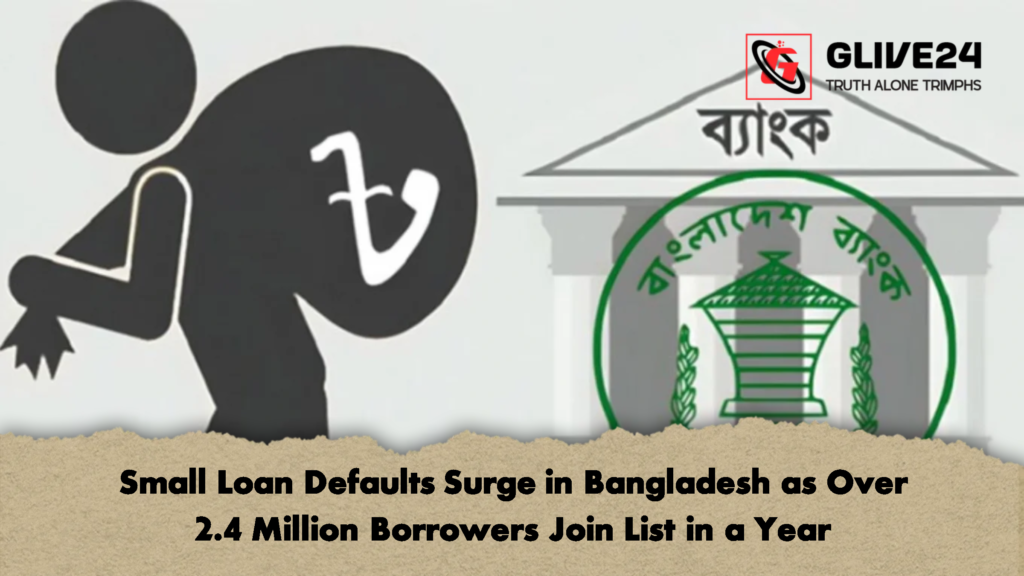
A sharp escalation in loan defaults among small borrowers—specifically Cottage, Micro, Small, and Medium Enterprises (CMSMEs), agricultural workers, home loan recipients, and retail consumers—presents a growing structural risk to Bangladesh’s financial system. Data released by Bangladesh Bank reveals that the total count of defaulted accounts holding loans under Tk 1 crore grew by more than 2.38 million over a 12-month period, climbing from 2.16 million in March of the previous year to 4.54 million by the end of March.
While large corporate non-performing loans (NPLs) account for greater absolute monetary losses, central bank officials emphasize that the rapid expansion of defaults across small-value accounts reflects a broader deterioration in retail credit quality. Prolonged macroeconomic pressure, elevated inflation, rising energy costs, and reduced consumer spending have weakened the debt-servicing capacity of small-business operators and wage earners alike.
Distribution of Defaults by Loan Size
The total outstanding credit across the banking sector stood at Tk 17.83 trillion (17,83,700 crore) as of March, with a overall default rate of 32.7%.
| Loan Bracket | Total Default Rate (%) | Number of Defaulted Accounts |
| Below Tk 1 Crore | 15.0% | 4,543,485 |
| Tk 1 Crore – Tk 10 Crore | > 26.5% | 28,501 |
| Tk 10 Crore – Tk 20 Crore | 45.0% | 6,186 |
| Tk 20 Crore – Tk 30 Crore | ~ 36.0% | 1,574 |
| Tk 30 Crore – Tk 40 Crore | ~ 39.0% | 952 |
| Tk 40 Crore – Tk 50 Crore | ~ 45.0% | 669 |
| Above Tk 50 Crore | 42.5% | 2,035 |
| System-wide Average | 32.7% | — |
Sector-Wise Credit Breakdown
The central bank’s report details non-performing loan concentrations across key economic sectors:
-
Wholesale & Retail Trade: Represents 32% of total credit across the banking sector, with approximately 44% currently classified as non-performing.
-
CMSME Sector: Over 34% of outstanding loans in this category are defaulted. Cottage industries exhibit the highest default rate within this segment at nearly 53%, while medium-scale enterprises stand at approximately 38%.
-
Industrial Sector: Accounts for a 32% default rate across all outstanding industrial credit.
-
Agriculture, Forestry & Fishing: Comprises over 4.25% of total bank loans, with default rates reaching nearly 30% as of March.
-
Construction: Represents 7% of total bank credit, with non-performing loans standing at roughly 30%.
-
Consumer & Retail Credit: Makes up 9% of total bank lending, maintaining a default rate of 7%.
Economic Commentary and Institutional Responses
“The rising default trend among small borrowers is extremely concerning, though hardly surprising. Protracted macroeconomic stress and persistent high inflation have severely eroded the repayment capacity of both salaried employees and small business owners due to rising living expenses and escalating energy costs.”
— Dr Masrur Reaz, Chairman of Policy Exchange Bangladesh
Commercial banks are adjusting operational strategies to mitigate rising default risks:
-
Bangladesh Krishi Bank (BKB): Chairman Mohammad Nurul Amin noted that while the bank succeeded in reducing its defaulted borrower count from 2.4 million to 2.0 million over the past year, its NPL ratio remains elevated at 38%. The bank recently received Tk 600 crore from the government to cover previously waived agricultural loans and has mobilized branch-level recovery teams.
-
Janata Bank: Managing Director Md. Mojibor Rahman confirmed that loan default pressures have extended from large corporate borrowers to smallholders in agriculture and the SME sector. Branch-level oversight is being intensified to restructure eligible accounts under central bank guidelines.
-
Islami Bank Bangladesh: Acting Managing Director Md. Altaf Hossain indicated that excluding distressed exposures connected to the S. Alam Group, the institution’s NPL ratio ranges between 22% and 23%—below the broader industry average—with recovery efforts focused on regularizing non-performing accounts.