15 August marks one of the darkest and most tragic chapters in Bangladesh’s history. On this day in 1975, Sheikh Mujibur Rahman, the country’s founding leader, was assassinated at his residence on Dhanmondi Road 32 in Dhaka, along with most members of his family. The killings left a profound mark on the nation’s political history and have remained a deeply sensitive subject in public life.
For many years, 15 August was officially observed as National Mourning Day during successive governments led by the Awami League. State and political programmes typically included mourning processions, prayers, religious gatherings, discussions and cultural events. Various social and cultural organisations also arranged commemorative programmes to remember the victims of the 1975 tragedy.
The political landscape changed significantly after 5 August 2024. Since then, 15 August has not been observed through the same form of official state programmes that had characterised previous years. Despite the changed political circumstances, however, the date continues to generate discussion across Bangladesh, including within the country’s entertainment industry.
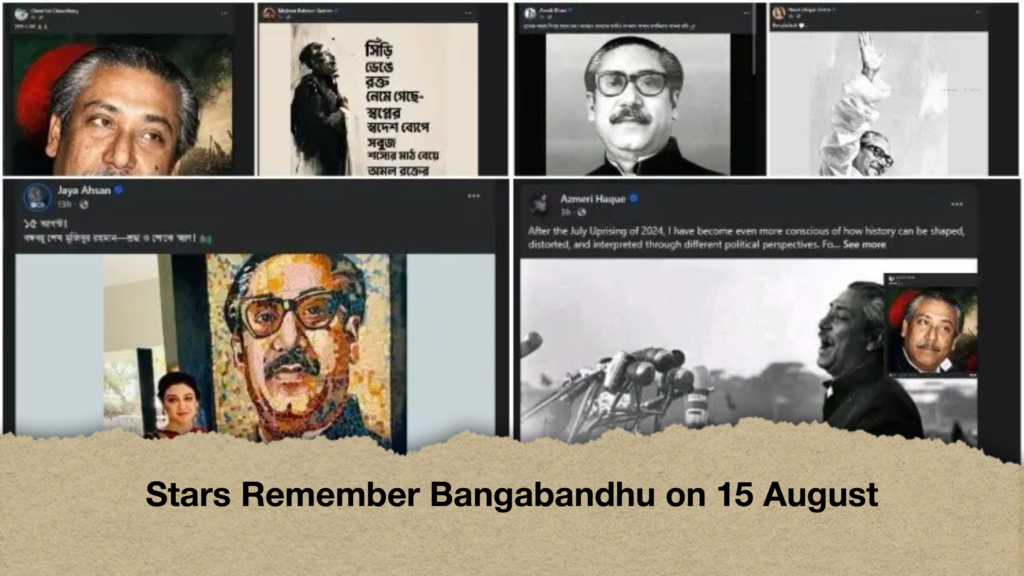
Several prominent figures from the film, television and music sectors took to social media on Saturday to remember Bangabandhu and reflect on the significance of the day. Their messages varied considerably in tone. Some offered direct expressions of grief and respect, while others discussed the complexities of historical interpretation, political change and the moral consequences of violence.
Actress Jaya Ahsan shared a photograph of herself beside a sculpture of Sheikh Mujibur Rahman and expressed respect in remembrance of the 15 August tragedy. Her post conveyed a personal tribute to the former leader on the anniversary of his death.
Actress Azmeri Haque Badhon offered a more extensive reflection. In her statement, she discussed the ways political circumstances and competing narratives can influence how history is presented and understood. Referring to the mass uprising of July 2024 and the political changes that followed, she said the experience had encouraged her to think more critically about historical narratives rather than accepting a single interpretation as absolute.
At the same time, Badhon stressed that disagreement over historical interpretation cannot justify the killing of people. She described the assassination of Sheikh Mujibur Rahman and the members of his family who were killed that day as an injustice, arguing that political ideology or competing readings of history should never be used to legitimise violence.
She also acknowledged Sheikh Mujibur Rahman’s political role and contribution during the long struggle that culminated in Bangladesh’s independence. At the same time, she argued that history should remain open to examination through evidence, context and critical discussion.
Actor Arsh Khan also shared a photograph of Bangabandhu, accompanying it with an emotional message and prayers for his soul. Actress Nazia Haque Orsha, who had been prominently discussed during the July 2024 uprising, likewise posted an image of Sheikh Mujibur Rahman and briefly referred to Bangladesh in her message.
Other members of the entertainment community also marked the day on social media. Actors Chanchal Chowdhury, Milon Bhattacharya, Nazifa Tushi, Mahiya Mahi, Aruna Biswas, Tusti, Tanvin Sweety and Doyel were among those who expressed grief or paid tribute. Singers Konal and Pantha Kanai also remembered Bangabandhu.
Filmmakers Giasuddin Selim, Dipankar Dipon and Mezbaur Rahman Sumon were among other familiar figures from the entertainment sector who shared their reactions to the anniversary.
The responses from the celebrities reflect the wider complexity surrounding 15 August in contemporary Bangladesh. Some messages focused solely on remembrance and mourning, while others sought to place the 1975 killings within the broader context of political transformation and competing interpretations of national history.
Nearly five decades after the assassination, 15 August remains a powerful and contested date in Bangladesh’s public discourse. The reactions from artists and cultural figures demonstrate that, despite profound political changes, the events of 1975 continue to occupy an important place in the country’s historical and cultural consciousness.