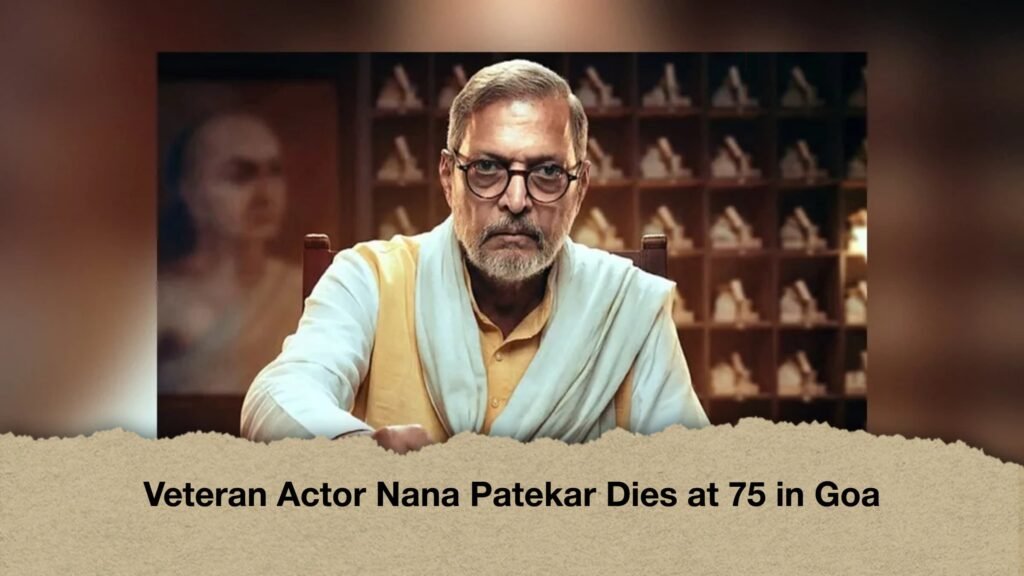
Veteran Indian actor Nana Patekar has died at the age of 75 after suffering a cardiac arrest at his residence in Dona Paula, Goa, according to reports from several Indian media outlets. The news was reported on Thursday morning, citing the Indian news agency ANI and sources at Manipal Hospital.
Patekar was reportedly found unconscious at his residence and was rushed to a nearby Manipal Hospital for emergency treatment. Doctors attempted to revive him for around 45 minutes, administering continuous cardiopulmonary resuscitation (CPR), but he did not respond to the treatment.
Dr Shekhar Salkar, head of the oncology department at Manipal Hospital, was quoted as saying that medical efforts to revive the actor continued after he was brought to the hospital. A medico-legal case (MLC) has also been registered, and an autopsy is expected to be conducted to establish the precise cause of death.
Reports said Patekar was declared dead at around 5.20am. His son, Malhar Patekar, was also reported to have confirmed the death.
The sudden passing of the actor marks the end of a career spanning several decades across Hindi and Marathi cinema. Known for his intense screen presence, distinctive dialogue delivery and ability to portray emotionally complex characters, Patekar became one of Indian cinema’s most recognisable performers.
Born Vishwanath Patekar on 1 January 1951 in Maharashtra, he adopted the name Nana Patekar professionally. Over the course of his career, he worked in a wide range of films and was particularly acclaimed for performances that combined restraint with emotional intensity.
Among his best-known films are Parinda, Krantiveer, Ab Tak Chhappan, Agni Sakshi and Welcome. His filmography also included both serious dramatic roles and commercially successful entertainers, demonstrating the breadth of his acting career.
Patekar’s contribution to Indian cinema was recognised with three National Film Awards. In 2013, the Government of India honoured him with the Padma Shri, one of the country’s prominent civilian awards.
His work extended beyond acting as well. Over the years, he became associated with both mainstream Hindi cinema and Marathi-language productions, earning respect for his distinctive performance style. His dialogue delivery, particularly in intense dramatic scenes, became one of the defining features of his screen persona.
Patekar’s death is expected to prompt tributes from colleagues, filmmakers and audiences across India’s film industries. For generations of viewers, he remained an actor capable of moving effortlessly between hard-hitting drama, socially charged roles and comedy.
His death brings to a close the career of a performer whose work left a lasting mark on both Hindi and Marathi cinema.