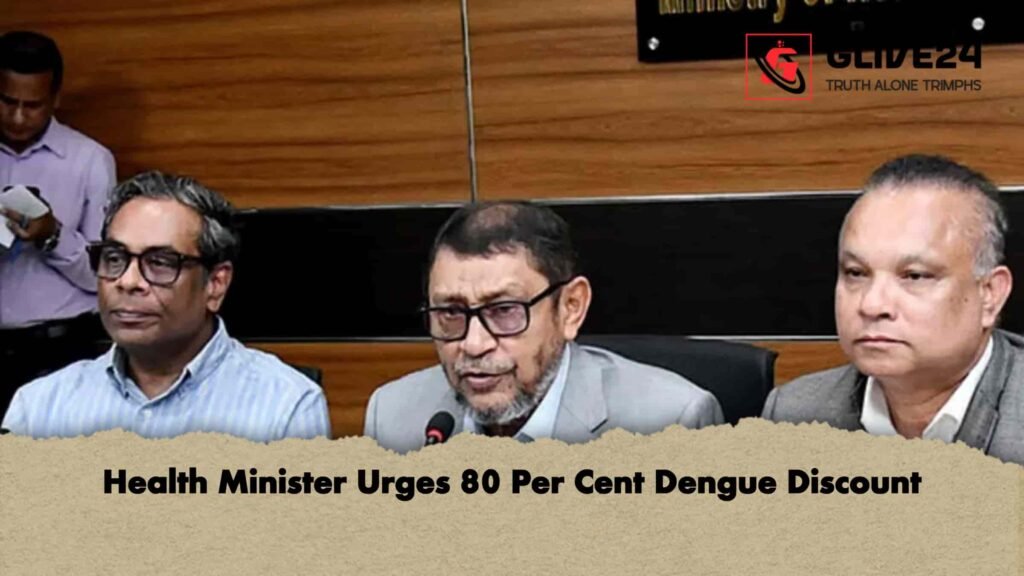
The Minister for Health and Family Welfare, Sordar Md. Sakhawat Hossain, has called upon private sector hospitals to implement an 80 per cent discount on various diagnostic tests required for dengue patients in order to reduce their medical expenses.
The Health Minister disclosed this information to journalists on Tuesday afternoon following a high-level meeting concerning dengue prevention, treatment, and clinical guidelines. The session was convened at the conference room of the Ministry of Health and Family Welfare at the Bangladesh Secretariat.
During the briefing, Minister Sakhawat Hossain strongly urged private healthcare institutions to take special initiatives to lower the overall financial burden of treatment on individuals suffering from the mosquito-borne disease. He confirmed that formal discussions regarding the reduction of medical fees have already taken place between the government and private hospital authorities.
Elaborating on the proposed financial adjustments, the Health Minister stated that private facilities must extend discounts of up to 80 per cent for necessary diagnostic procedures. To illustrate the scale of the relief package, the Minister noted that if a patient’s cumulative diagnostic testing fees amounted to 10,000 Taka, a waiver of up to 8,000 Taka is currently under serious consideration by the administration.
Breakdown of Proposed Dengue Testing Subsidy
The table below outlines the financial impact of the 80 per cent discount framework proposed by the Ministry of Health and Family Welfare for private hospital diagnostics:
| Original Cost of Diagnostics (BDT) | Proposed Discount Rate | Maximum Waiver Amount (BDT) | Adjusted Cost to Patient (BDT) |
| 10,000 | 80% | 8,000 | 2,000 |
Government Mandate on Dengue Management
The meeting at the Secretariat focused extensively on scaling up national healthcare responses ahead of the peak dengue season. The core directives issued from the session include:
-
Clinical Guidelines: Strict enforcement of standardised national medical guidelines across all public and private institutions to streamline patient admission and treatment procedures.
-
Cost Rationalisation: Direct engagement with private clinic owners to curb exorbitant out-of-pocket healthcare expenses for vulnerable patients.
-
Preventative Protocols: Enhancing institutional coordination to ensure that diagnostic facilities remain accessible and affordable during periods of high patient influx.